4 of Uranus’ large moons may hold water: NASA
NASA scientists have found that four of Uranus' largest moons likely contain an ocean layer between their cores and icy crusts
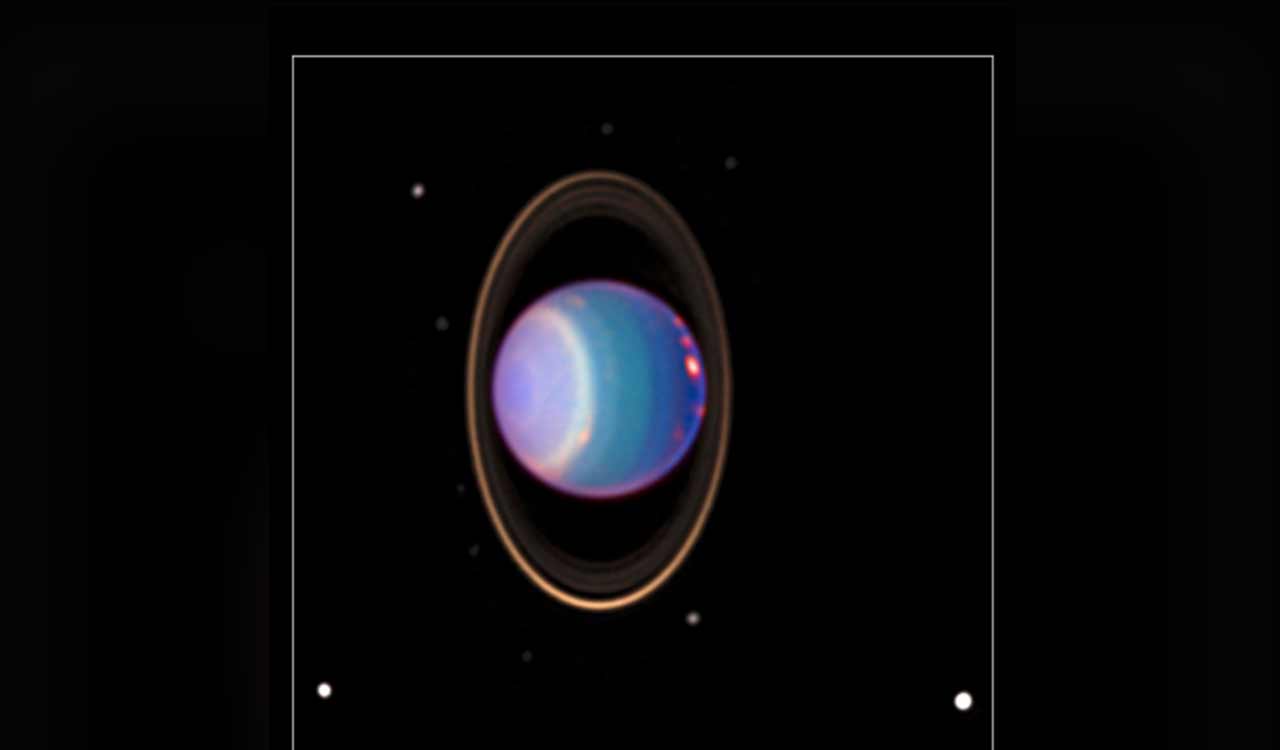


Washington: NASA scientists have found that four of Uranus’ largest moons likely contain an ocean layer between their cores and icy crusts, which suggests that these hold oceans that could be dozens of miles deep.
In all, at least 27 moons circle Uranus, with the four largest ranging from Ariel, at 1,160 kilometres across, to Titania, which is 1,580 kilometres across.
Also Read
The study is the first to detail the evolution of the interior makeup and structure of all five large moons: Ariel, Umbriel, Titania, Oberon, and Miranda.
Published in the Journal of Geophysical Research, the findings showed Miranda is unlikely to have hosted water, but rest all have it.
The study also has implications that go beyond Uranus, said lead author Julie Castillo-Rogez of NASA’s Jet Propulsion Laboratory in Southern California.
“When it comes to small bodies — dwarf planets and moons — planetary scientists previously have found evidence of oceans in several unlikely places, including the dwarf planets Ceres and Pluto, and Saturn’s moon Mimas.
“So there are mechanisms at play that we don’t fully understand. This paper investigates what those could be and how they are relevant to the many bodies in the solar system that could be rich in water but have limited internal heat,” Castillo-Rogez said.
The study revisited findings from NASA’s Voyager 2 flybys of Uranus in the 1980s and from ground-based observations.
The team built computer models infused with additional findings from NASA’s Galileo, Cassini, Dawn, and New Horizons (each of which discovered ocean worlds), including insights into the chemistry and the geology of Saturn’s moon Enceladus, Pluto and its moon Charon, and Ceres — all icy bodies around the same size as the Uranian moons.
They used that modelling to gauge how porous the Uranian moons’ surfaces are, finding that they’re likely insulated enough to retain the internal heat that would be needed to host an ocean.
In addition, they found what could be a potential heat source in the moons’ rocky mantles, which release hot liquid, and would help an ocean maintain a warm environment — a scenario that is especially likely for Titania and Oberon, where the oceans may even be warm enough to potentially support habitability.
By investigating the composition of the oceans, scientists can learn about materials that might be found on the moons’ icy surfaces as well, depending on whether substances underneath were pushed up from below by geological activity. There is evidence from telescopes that at least one of the moons, Ariel, has material that flowed onto its surface, perhaps from icy volcanoes, relatively recently.
In fact, Miranda, the innermost and fifth largest moon, also hosts surface features that appear to be of recent origin, suggesting it may have held enough heat to maintain an ocean at some point. The recent thermal modelling found that Miranda is unlikely to have hosted water for long: It loses heat too quickly and is probably frozen now.
But internal heat wouldn’t be the only factor contributing to a moon’s subsurface ocean.
A key finding in the study suggests that chlorides, as well as ammonia, are likely abundant in the oceans of the icy giant’s largest moons.
Ammonia has been long known to act as antifreeze. In addition, the modelling suggests that salts likely present in the water would be another source of antifreeze, maintaining the bodies’ internal oceans.
Of course, there still are a lot of questions about the large moons of Uranus, Castillo-Rogez said, adding that there is plenty more work to be done: aceWe need to develop new models for different assumptions on the origin of the moons in order to guide planning for future observations.”

Related News
-

Incredible to watch capability ISRO is developing in science missions: Indian-American NASA senior official
-
Astronauts remove faulty ISS antenna during spacewalk; out of time to install spare
-
NASA invites ISRO to join Moon Base programme for lunar South Pole outpost
-
NASA astronauts Anil Menon, Jessica Meir undertake spacewalk to upgrade space station