Centre proposes 850-seat Lok Sabha, women’s quota rollout by 2029 elections
The Union government has proposed increasing Lok Sabha strength to 850 and redefining population criteria through a Constitution Amendment Bill, aiming to fast-track implementation of 33% women’s reservation before the 2029 elections, delinking it from future Census
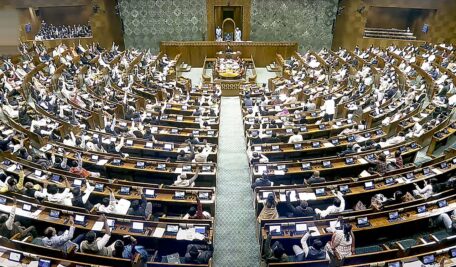


New Delhi: The Union government on Tuesday shared with MPs the text of Constitution (131 Amendment) Bill, 2026 or the proposed amendment to the Women Reservation Bill which aims to raise Lok Sabha seats to 850 – including members from States and Union Territories.
The Bill proposes a cap of 815 on the number of members chosen by direct election from constituencies in the States.
For UTs, the Bill says, “Not more than 35 members to represent the Union Territories, chosen in such manner as Parliament may by law provide”.
At present, there are 530 Lok Sabha members from States and 20 from UTs. However, a delimitation commission had set the number at 543.
Another key amendment proposed in the Bill is the definition of population, giving Parliament the mandate to decide which data is to be made the foundation for the expansion of the number of seats.
For modifying Clause (3) of Article 81 of the Constitution, the Bill proposes, “(3) In this article, the expression ‘population’ means the population as ascertained at such census, as Parliament may by law determine, of which the relevant figures have been published.”
The Union Cabinet had recently cleared the Bill seeking to amend the Constitution for early implementation of 33 per cent quota for women in Lok Sabha and Assemblies, as well as increasing the number of seats in the Lower House of Parliament.
The amendment Bill also proposes changes in Article 82 to substitute “Upon the completion of each census, the allocation of seats” with words “The allocation of seats”.
The proposed amendment aims to delink the quota’s implementation from the 2027 Census and instead base it on the 2011 Census, enabling its rollout before the 2029 general elections.
In Article 82, the amendment Bill also proposes to introduce a role for the Delimitation Commission.
The Bill states that in Article 82 (c) of the Constitution, “for the words ‘by such authority and in such manner’, the words ‘in such manner and on the basis of such census, by the Delimitation Commission’, shall be substituted”.
The Bill also talks about reservation of seats on rotation basis in Lok Sabha and Assemblies and carries paras related to the tenure for which the women’s reservation shall remain in force, subject to extension by Parliament.
Earlier in the day, Union Parliamentary Affairs Minister Kiren Rijiju asserted that there is “nothing controversial” in the proposed amendment to the Women’s Reservation Bill and appealed to all political parties to support it without politicising the issue.
Speaking to IANS, Rijiju said, “The issue of women’s reservation cannot be made a political matter in any form. If we give it a political angle, it would be an injustice to women.”
“The Prime Minister has made a very simple and clear appeal to rise above party politics. The Nari Shakti Adhiniyam (Women’s Reservation Act) is a law that all parties supported and passed unanimously. Now, we have called for a special session to make a constitutional amendment to implement it,” said Rijiju.
The government has convened a special three-day Parliament session from April 16 to discuss and pass the “Nari Shakti Vandan Adhiniyam”.
The Bharatiya Janata Party (BJP) has issued a three-line whip to all its Members of Parliament in Lok Sabha and Rajya Sabha, directing them to remain present in the House from April 16 to 18 during the upcoming Parliament session.

Related News