Opinion: The delimitation Telangana already wrote
KCR’s reforms show true representation lies in governance proximity and service delivery, not just parliamentary seat allocation


By Nayini Anurag Reddy
Article 82 of the Indian Constitution gives the word delimitation a narrow technical meaning, the readjustment of parliamentary constituencies after each census so that representation tracks population. That technical meaning has, over the last fortnight, been allowed to swallow an entire national debate. North against South. Headcount against federal balance. Seats lost against seats gained. The Constitution (131st Amendment) Bill was tabled, fought over, and rejected in the Lok Sabha. The argument continues outside it.
Also Read
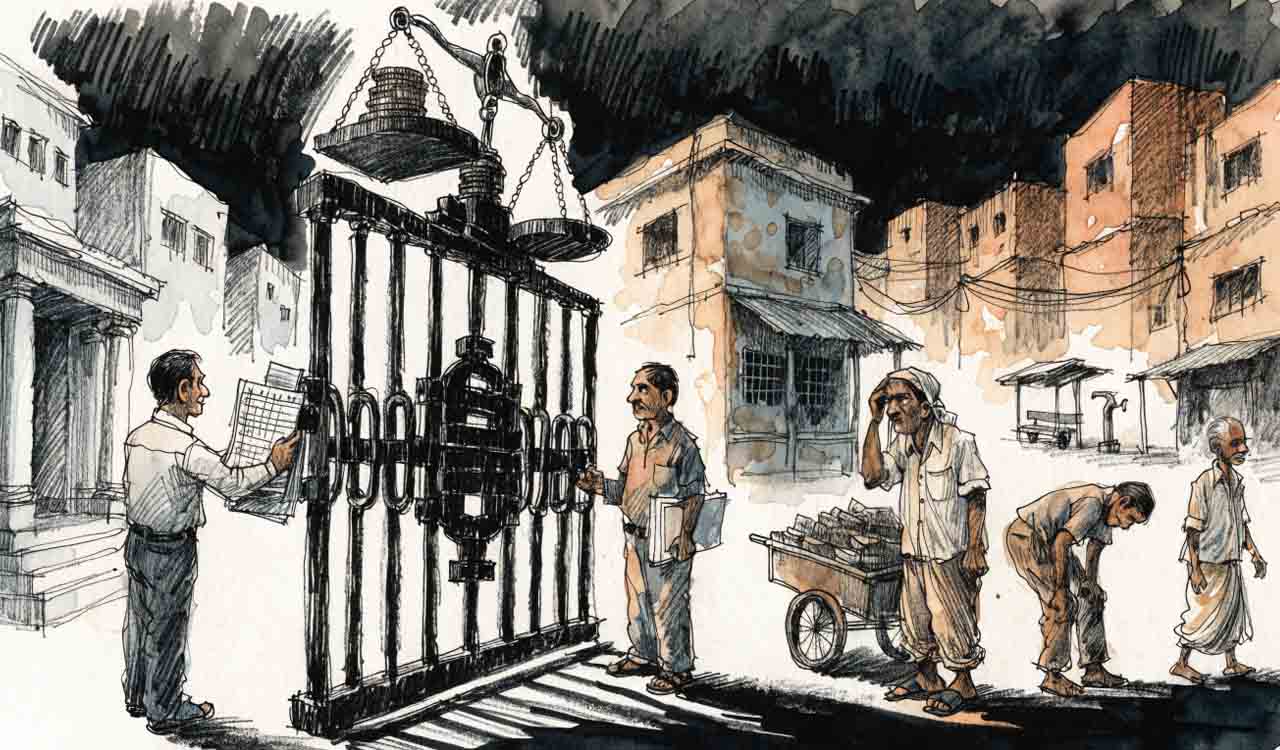
What has been lost in the noise is the deeper civic meaning of the word. Delimitation, properly understood, is not the redrawing of lines on a Lok Sabha map. It is the redrawing of the distance between a citizen and the state. The first kind of delimitation determines how many representatives a State sends to Delhi. The second determines whether the State itself is within reach of the people it governs. The first is constitutional arithmetic. The second is the constitutional purpose.
Redrawing Distance
On the first, the country has been arguing for a fortnight. On the second, one Indian State has spent ten years writing the answer. That State is Telangana. The man who built it is K Chandrasekhar Rao. The party is the Bharat Rashtra Samithi. And what Telangana has done, district by distrmict, hospital by hospital, Tanda by Tanda, is the delimitation that the country is not even discussing.
Begin with the founding act, because everything else flows from it. In June 2014, Telangana inherited ten districts from the combined Andhra Pradesh era. By October 2016, KCR had carved it into 31. By February 2019, into 33. The 459 mandals became 612. The 8,368 Gram Panchayats became 12,769, an addition of 4,401 new units of local self-government in a single phase, the largest such reorganisation independent India has seen.
This was not an administrative tweak. It was a rearrangement of where the State physically lives. Before 2016, a citizen in old Adilabad travelled six to eight hours to reach a Collector. After, she reached a Collector, a Superintendent of Police, and a complete administrative machinery within an hour. KCR placed the State there. He did not amend the Constitution to do so. He did not seek a Delimitation Commission. He received not a single Union grant for the new collectorates. The reordering was paid for, executed, and held together by the state alone. It was the most consequential exercise of state power in independent India that the Centre had no part in. Once the new districts existed, everything else became possible.
The Three Things
Three things became possible that had not been before. First, medical education. In 2014, Telangana had five government medical colleges. By the end of KCR’s tenure, it had 26in operation, with eight more sanctioned, funded, and submitted to the National Medical Commission to complete his vision of a government medical college in every district. MBBS seats grew from 2,850 to over 9,000.
In the academic year 2023 to 24 alone, Telangana accounted for 34% of all new government MBBS seats added across India. A single State with under 3% of the country’s population contributed nearly half the nation’s expansion of doctor training capacity in one year. This was possible because the new colleges were attached to the new district hospitals. Without 33 districts, there would have been no 33 colleges.
Second, the local employment compact. In 2021, after years of negotiation with the Centre, Telangana secured Presidential assent for a new zonal system that replaced the 1975 Presidential Order. Under it, 95% of all State government jobs are reserved for locals, defined by the redrawn district boundaries. The Telangana movement was, at its core, a movement against displacement. KCR did not legislate the grievance away. He built a structural answer to it, and that answer rested on the new districts, because the zonal system could not exist without them.
Representation can be delivered through a collectorate brought to the citizen’s district, a medical college brought to her town, a tap brought to her kitchen, a sarpanch elected from her own Tanda, and jobs protected within her zone
Third, tribal self-rule. Of the 4,401 new Gram Panchayats KCR created, 3,146 were tribal Tandas and Gudems, hamlets that had stood for generations without their own sarpanch, without a budget for a road or a streetlight. They now elect 24,682 ward members of their own. When the Centre delayed Presidential assent for years on the 2017 Bill raising the Scheduled Tribe reservation from 6% to 10%, KCR did not wait. On 1 October 2022, the BRS government issued an executive order under its own constitutional authority and made the enhancement immediately applicable. The Lambada and Koya communities, governed for centuries by distant officials, were finally governed by themselves.
Two flagship missions completed the geography. Mission Bhagiratha laid over 1.4 lakh kilometres of pipeline across more than 24,000 rural habitations at a cost of Rs 45,000 crore, connecting every household in the State, including the remotest tribal settlement, to a piped surface water supply. NITI Aayog praised it. Eleven other States announced plans to replicate it. None of that mattered as much as one fact: that a Lambada woman in Adilabad, who once walked three kilometres before sunrise to fetch water from a contaminated tank, now opens a tap in her own kitchen.
Mission Kakatiya restored over 22,000 of the minor irrigation tanks that the Kakatiya kings had built across the dry uplands of Telangana eight centuries ago, and that successive governments since had let silt over. Rythu Bandhu, the first direct cash transfer scheme to farmers in independent India, reached 70 lakh farmers across every district, regardless of where the rains fell. From 1 January 2018, Telangana became the only State in India to deliver round-the-clock free power to its agriculture sector. These were not welfare schemes. They were geography corrections. A farmer in Mahabubnagar received the same water, the same investment, and the same power as a farmer in canal-fed Khammam. Where rainfall could not deliver equality, the state delivered it instead.
Flawed Assumption
This is what makes the Southern position in the parliamentary debate not just righteous, but constitutional. The Northern claim is that population alone is the democratic basis of representation, and that any deviation from headcount is undemocratic. That claim rests on a single hidden assumption, that Parliament is the only meaningful site of representation, and, therefore, seats must follow people.
Telangana’s decade demolishes the assumption. Representation can be delivered through a Collectorate brought to the citizen’s district, a medical college brought to her town, a tap brought to her kitchen, a sarpanch elected from her own Tanda, and a job protected for her zone. There are richer, more sophisticated tools for representation than seat count, and one Indian state has built every one of them in a decade.
Once the assumption falls, the Northern argument loses its moral force. The South is not asking to be exempt from democracy. The South is asking democracy to recognise what democracy actually is. States that invested for 50 years in education, healthcare, urbanisation, and women’s empowerment, and that thereby stabilised their populations, did not weaken Indian democracy. They strengthened it. They built the very institutions of proximity that make a citizen’s representation real. To punish them now, by reducing their share in the only chamber that retains formal federal voice, would not be a correction of democracy. It would be the dismantling of its deeper architecture.
And this is where Telangana matters most. The federal voice the South seeks to preserve is the voice that built the work in the first place. Take away the seats, and the work itself is endangered, because federal funds, central laws, and central schemes flow through the chamber that allocates representation. The South’s seats and the South’s work are not two separate arguments. They are the same argument made in two registers, the institutional and the constitutional. Telangana is the bridge between them. KCR did not build a model for one State. He built the strongest evidence the South possesses, that there is a richer way to think about representation, and that the States which already practice it deserve, at minimum, the federal voice to defend it.
Federal Voice
This reverses the cause and effect on which the parliamentary debate has rested. The Lok Sabha share is not what protects the Southern States. The Southern States, through 50 years of work, are what created the federal voice now expressed as their Lok Sabha share. The seats are an expression of the work. They are not a substitute for it, and they are not a favour granted in compensation for it. They are the constitutional acknowledgement of what the South has already built. To threaten that share is to threaten the recognition of the work the country has benefited from.
That is what real delimitation looks like. That is what democracy is for. KCR did not redraw lines on a Lok Sabha map. He redrew the distance between his people and the state, district by district, hospital by hospital, Tanda by Tanda. Telangana is not asking the nation to be fair. Telangana is showing the nation what fairness looks like. The South should walk into the next round of the debate carrying that example, not as one Southern claim among many, but as the constitutional foundation of the federal argument itself.
(The author is an MBA graduate, public policy observer, and entrepreneur based in Hyderabad)

Related News