Comets brought carbon to Earth, Mars: Study
"Carbon is key to learning about the origins of life," said the paper's lead author, Charles Woodward, Professor at the University of Minnesota in the US.
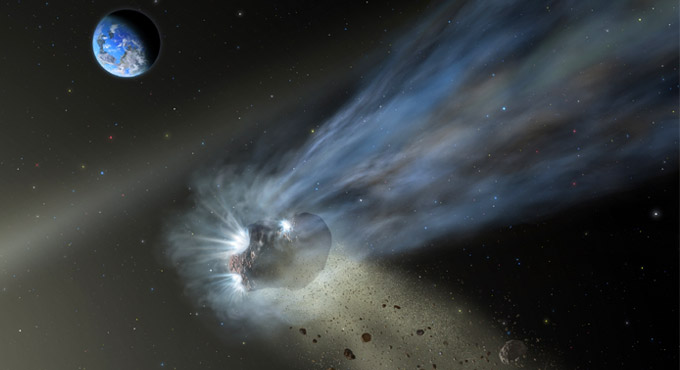


Washington: Comets could have been an essential source of carbon on planets like Earth and Mars during the early formation of the solar system, says a new study.
“Carbon is key to learning about the origins of life,” said the paper’s lead author, Charles Woodward, Professor at the University of Minnesota in the US.
“We’re still not sure if Earth could have trapped enough carbon on its own during its formation, so carbon-rich comets could have been an important source delivering this essential element that led to life as we know it.”
The new results are based on observations by a telescope on an airplane called Stratospheric Observatory for Infrared Astronomy (SOFIA), a joint project of NASA and the German Aerospace Centre, and were published recently in the Planetary Science Journal.
For the study, the researcher studied comet Catalina.
As the icy visitor from the edge of our solar system hurtled past Earth in early 2016, it briefly became visible to stargazers as comet Catalina before it slingshot past the Sun to disappear forevermore out of the solar system.
Among the many observatories that captured a view of this comet was SOFIA. Using one of its unique infrared instruments, SOFIA was able to pick out a familiar fingerprint within the dusty glow of the comet’s tail — carbon.
Originating from the Oort Cloud at the farthest reaches of our solar system, comet Catalina and others of its type have such long orbits that they arrive on our celestial doorstep relatively unaltered.
This makes them effectively frozen in time, offering researchers rare opportunities to learn about the early solar system from which they come.
SOFIA’s infrared observations were able to capture the composition of the dust and gas as it evaporated off the comet, forming its tail.
The observations showed that Comet Catalina is carbon-rich, suggesting that it formed in the outer regions of the primordial solar system, which held a reservoir of carbon that could have been important for seeding life.
While carbon is a key ingredient of life, early Earth and other terrestrial planets of the inner solar system were so hot during their formation that elements like carbon were lost or depleted.
While the cooler gas giants like Jupiter and Neptune could support carbon in the outer solar system, Jupiter’s jumbo size may have gravitationally blocked carbon from mixing back into the inner solar system.
So how did the inner rocky planets evolve into the carbon-rich worlds that they are today?
Researchers think that a slight change in Jupiter’s orbit allowed small, early precursors of comets to mix carbon from the outer regions into the inner regions, where it was incorporated into planets like Earth and Mars.
Comet Catalina’s carbon-rich composition helps explain how planets that formed in the hot, carbon-poor regions of the early solar system evolved into planets with the life-supporting element.

Related News