Current solar cycle intensity to peak in 2024, may impact Earth’s satellites, find researchers
It is known that roughly every 11 years, the intensity of solar activity reaches its peak, which manifests as violent disturbances in space weather such as solar magnetic storms or coronal mass ejections, impacting Earth's satellites and telecommunications.
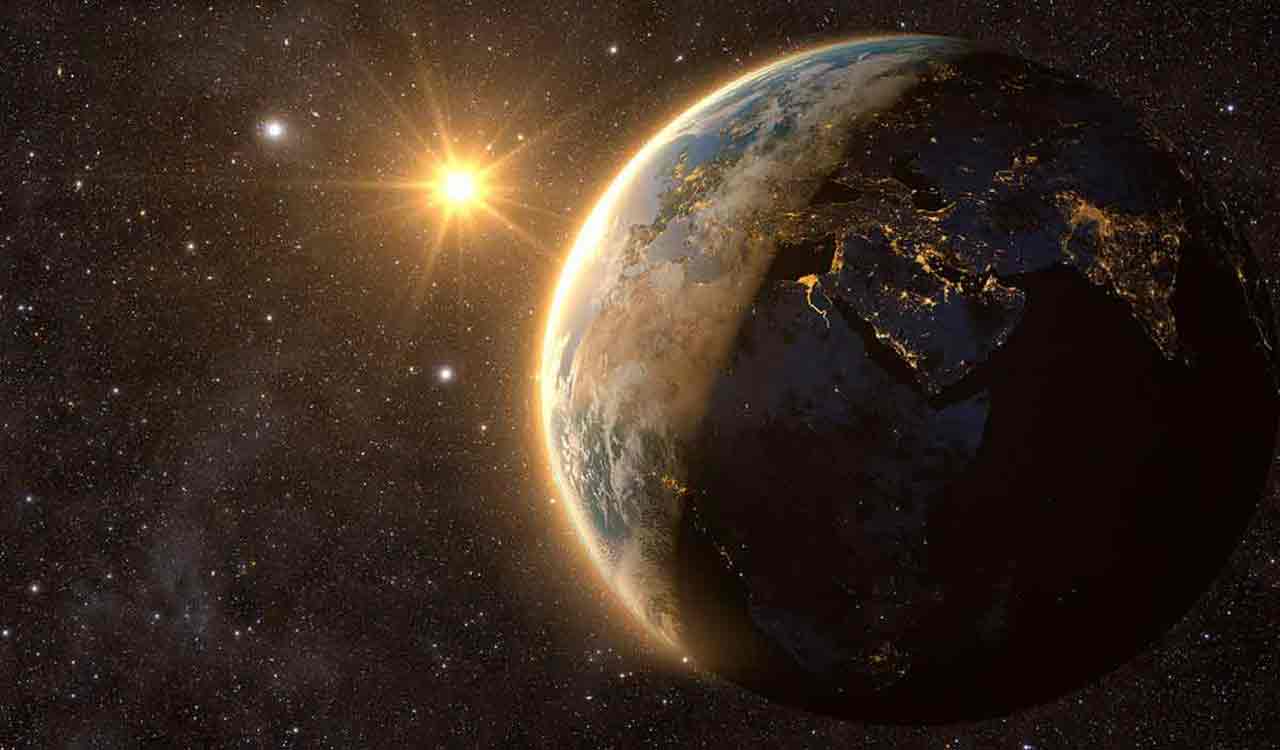


New Delhi: The current ongoing solar cycle is likely to peak its intensity in 2024 and can potentially impact Earth’s space weather, according to researchers at the Indian Institute of Science Education and Research (IISER), Kolkata.
It is known that roughly every 11 years, the intensity of solar activity reaches its peak, which manifests as violent disturbances in space weather such as solar magnetic storms or coronal mass ejections, impacting Earth’s satellites and telecommunications.
Also Read
“During intense solar storms, the Earth’s upper atmosphere expands outwards, thereby introducing friction on the low-Earth satellites. The friction can lead to a decay in the satellites’ orbits and reduce their lifetime. Thus, they are able to live in space for a much shorter time than they were originally supposed to,” Dibyendu Nandy, the study’s corresponding author and Professor of Physics and Head, Center of Excellence in Space Sciences India, IISER, Kolkata, told PTI.
The researchers also said that the most intense of these storms can cause serious damage to orbiting satellites, electric power grids and telecommunications when directed at Earth.
In their study appearing in the journal Monthly Notices of the Royal Astronomical Society Letters, the researchers discovered a new relationship to help predict the occurrence of peaks in solar cycles, which are produced by an internal dynamo mechanism, harnessing energy from plasma flows inside the Sun.
Using decades-old data archives from ground-based solar observatories worldwide, they found that the ongoing solar cycle 25 is related to the Sun’s magnetism activity, which they said manifests as sunspots cycle and recycling of the large-scale solar dipole magnetic field.
The sunspots, or dark spots on the Sun, are comparable to the size of the Earth and their magnetism intensity is about 10,000 times stronger than the Earth’s magnetic field.
The research team found that the solar dipole magnetic field – stretching from one pole of the Sun to another in a way similar to the Earth’s – waxed and waned in strength, flipping its polarity periodically, with the ongoing sunspot cycle.
Specifically, the rate of decrease in the Sun’s dipole magnetic field is related to the rate of rise of the ongoing solar cycle, the researchers said in their study. Swiss astronomer Max Waldmeier had discovered in 1935, that quicker the rise of a solar cycle, the greater its strength. This meant that stronger cycles would take lesser time to reach their peaks.
This discovery complemented the Waldmeier effect, the researchers said.
Their findings connecting the two primary components of the solar magnetic field support the theory that the evolution of sunspots are integral to the functioning of the solar dynamo process rather than being a mere symptom of it, they said.
Their findings open up a new window for forecasting the timing of the peak of solar cycles – when the most intense activity and most frequent space weather disturbances are expected, they said.

Related News