DRIP-II and III to cover 736 dams across India
India is implementing one of the world’s largest dam rehabilitation programmes under DRIP, covering 736 dams across states and central agencies. The Jal Shakti Ministry said ageing infrastructure, climate variability and storage loss have increased focus on dam safety, resilience and digital monitoring systems


New Delhi: India is implementing one of the world’s largest dam-rehabilitation programmes under the Dam Rehabilitation and Improvement Programme (DRIP), with rehabilitation proposals worth Rs 5,053 crore for 191 dams already approved and major physical-rehabilitation work completed at 43 dams till March 31, 2025, according to the Jal Shakti Ministry.
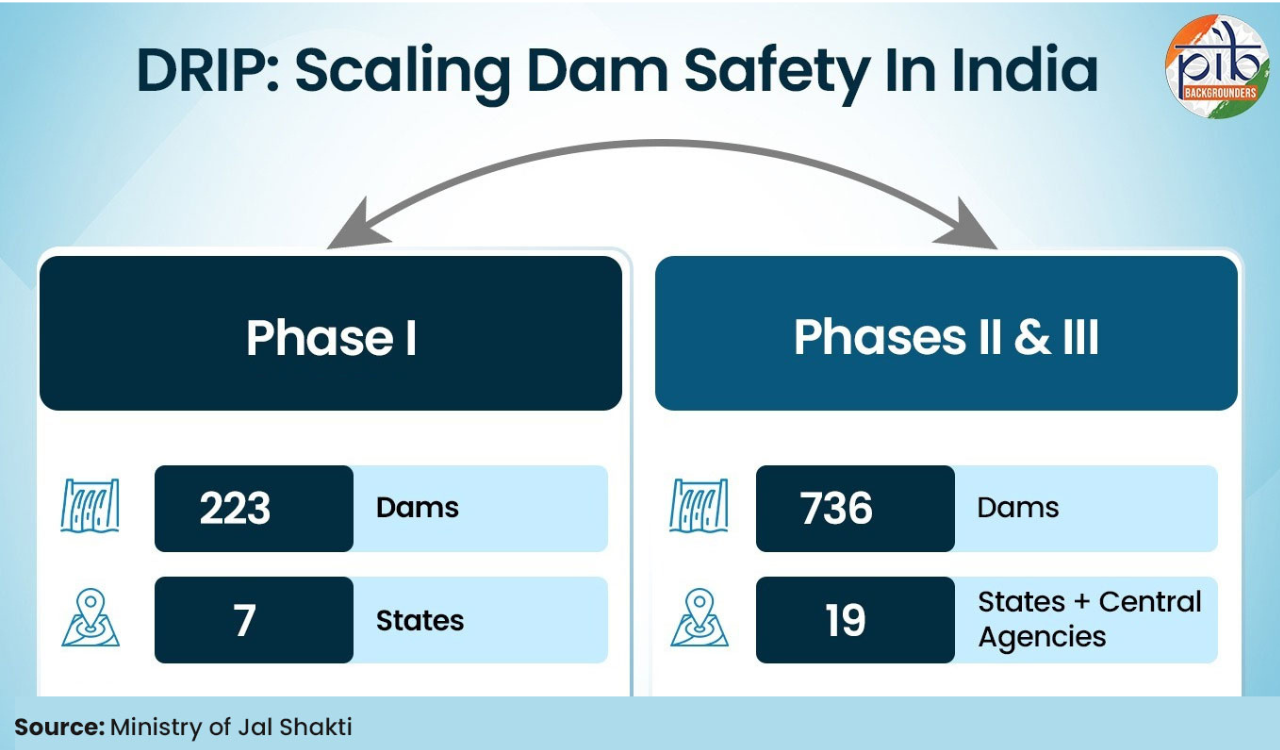
The ministry said the second and third phases of the DRIP, operationalised in October 2021, together cover 736 dams across 19 states and three central agencies — the Central Water Commission (CWC), the Bhakra Beas Management Board (BBMB) and the Damodar Valley Corporation (DVC). Major dams planned for safety improvement under the second and third phases of the project include the Bhakra Dam (Himachal Pradesh), the Ranjit Sagar Dam (Punjab), NTR Sagar (Telangana), the Nagarjuna Sagar Dam (Telangana), the Gandhi Sagar Dam (Madhya Pradesh), the Kadana Dam (Gujarat), the Jirgo Dam (Uttar Pradesh), the Imphal Barrage (Manipur), the Myntdu Leshka Dam (Meghalaya) and the Silabati Barrage (West Bengal), among others.
The total project outlay for DRIP-II and III is Rs 10,211 crore — Rs 5,107 crore for Phase-II and Rs 5,104 crore for Phase-III. Of this, Rs 7,000 crore are being provided as external loan assistance, while Rs 3,211 crore are being borne by the participating states and central agencies. The Phase-II scheme is co-financed by the World Bank and the Asian Infrastructure Investment Bank (AIIB). “Phase II and III together will last for 10 years, each phase continuing for six years with two years overlap,” the ministry said.
It added that DRIP-II and III are structured around four major components — rehabilitation of dams and associated structures, institutional strengthening, revenue-generation measures to support sustainable operation and maintenance, and project management for effective implementation.
India currently manages one of the largest dam portfolios globally and ranks third in the world with 6,628 specified dams, of which 6,545 are operational and 83 are under construction. The gross water-storage capacity of these dams is about 330 billion cubic metres and they are critical for ensuring national food, energy and water security.
The ministry said more than 26 per cent of these dams, or 1,681 structures, are over 50 years old, including 291 that are more than 100 years old, while another 42 per cent fall in the 25-50 years age bracket.
“Ageing infrastructure, sedimentation, changing hydrological patterns and increasing climate variability have highlighted the need for systematic rehabilitation and safety management,” it said. According to an analysis of 439 reservoirs by the CWC, reservoirs in India have suffered an average 19 per cent loss of gross storage capacity, with the average annual loss estimated at 0.74 per cent, equivalent to about 1.81 MCM per reservoir per year.
Describing the DRIP as “among the largest dam rehabilitation programmes globally”, the ministry said the initiative reflects India’s shift towards a “systematic and risk-based approach to dam safety management”. The programme is being implemented in three phases to improve the safety and operational performance of the existing dams through structural repairs, modernisation of spillways and gates, and the installation of advanced monitoring systems. DRIP Phase-I was launched in April 2012 with support from the World Bank and continued till 2021.
The programme covered 223 dams across seven states — Jharkhand, Karnataka, Kerala, Madhya Pradesh, Odisha, Tamil Nadu and Uttarakhand. The ministry said the programme contributed significantly to strengthening dam-safety practices and institutional capacity in the participating states and agencies. Under DRIP-I, design flood reviews, dam-health inspections and the finalisation of rehabilitation proposals for all 223 dams were completed, while rehabilitation work was awarded for 144 dams.
The first phase focussed on the rehabilitation and modernisation of dam structures, dam-safety inspections and evaluations, developing emergency action plans (EAPs) and capacity building and training programmes.
One of the major outcomes of DRIP-I was the introduction of the Dam Health and Rehabilitation Monitoring Application (DHARMA), a digital platform for dam-safety monitoring and data management.
The ministry said digital platforms, such as DHARMA, along with instrumentation systems and early-warning systems, are strengthening real-time monitoring and data-driven dam-safety management.
Among the key achievements listed by the ministry are the registration of all 6,628 specified dams on the DHARMA platform, the conduct of around 13,000 dam inspections annually with records maintained digitally and the implementation of rapid risk screening for 5,553 specified dams across the country.
“India’s extensive dam network, built over decades, continues to underpin critical sectors of the economy. As these assets age and operate under increasingly variable climatic conditions, the focus has shifted from expansion to safety, resilience and lifecycle management,” the ministry said.

Related News
-

12th BRICS Parliamentary Forum to be inaugurated in Parliament House complex today
-
Harmanpreet Kaur, Deepti Sharma centuries power India to ODI series win over Zimbabwe
-
India’s men and women win at Commonwealth Kabaddi Championship 2026
-
Pratika Rawal’s century, Shafali Verma’s 64 power India to win over Zimbabwe