Editorial: Cometh the hour, cometh Carney—Canada draws a red line against Trump’s tariffs
Canadian Prime Minister Mark Carney’s stand could become a test for middle powers and offers lessons for India on trade diversification, resilience and strategic autonomy
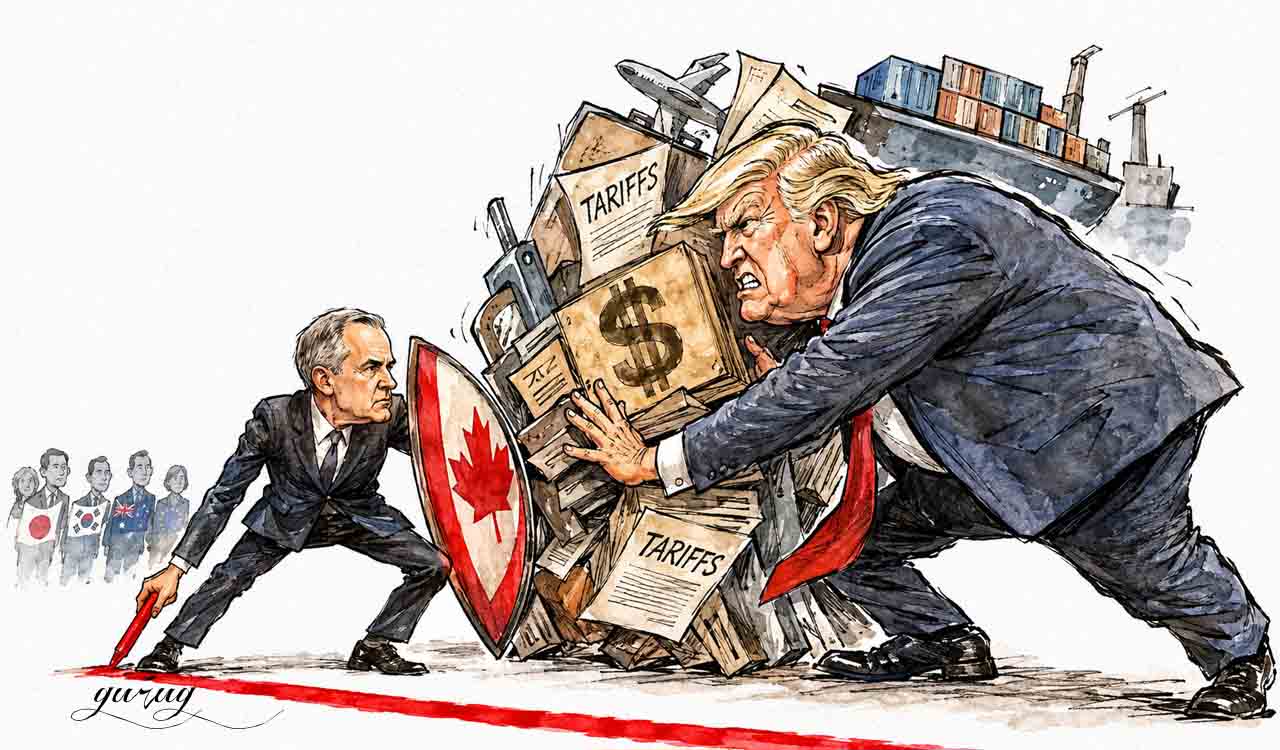


In his stirring address at the Davos summit in January this year, Canadian Prime Minister Mark Carney took the gathering by storm when he spoke about how the rule-based international order was being undermined by great powers and issued a clarion call for middle powers to reduce their excessive dependence on any one great power. Seven months later, his bold decision to retaliate “dollar for dollar” against United States President Donald Trump’s 50% tariffs has sent ripples across the global trade circles. By walking away from trade talks with the United States and launching a counter-attack, Carney has drawn a red line against Trump’s policy of weaponisation of tariffs. Despite Canada’s economic vulnerability vis-a-vis America, the banker-turned-politician, who came to power in last year’s national election on a promise to stand up to Trump’s threats, has taken a courageous stance. The new US tariffs cover roughly $20 billion of Canadian goods. Should Carney proceed with Canada’s retaliation from September 8, there will be risks for his country, both political and economic. But the popularity of the “Buy Canadian” campaign—an expression of economic nationalism triggered by Trump’s tantrums and open threats—has already shown that many Canadians support their government’s challenge to the US President. Carney will now have to convince them that the costs of confrontation are worth paying. He has done the right thing by rejecting an unequal trade relationship.
In doing so, he is also following up on his call, made during the Davos summit, to restore the rule-based international order. Canada’s revolt against a bullying neighbour raises a larger question: how should middle powers respond when the world’s dominant economic and military power uses market access as an instrument of coercion? Carney is effectively challenging the proposition that America’s enormous economic weight gives Washington unlimited leverage over its allies. The US and Canada have deeply integrated supply chains. Yet, Carney has calculated that accepting repeated unilateral American demands would carry a greater long-term cost than resisting them now. That makes the confrontation a test case for other middle powers. If Canada can withstand American pressure without being forced into major political concessions, countries such as Japan, South Korea, Australia and European states may feel more confident about resisting similar economic pressure. Conversely, if Canada eventually has to capitulate because the economic costs become unbearable, Washington could conclude that tariffs are an extraordinarily effective instrument of foreign policy. The US-Canada standoff holds a lesson for India too in dealing with a transactional and unpredictable United States. For its part, New Delhi must ensure that America’s economic leverage never becomes America’s political leverage over India. That means diversifying trade, strengthening domestic manufacturing, cultivating alternative markets, building coalitions with other middle powers and—above all—maintaining the confidence to say no when an American demand crosses the line from legitimate trade negotiation into coercion.
Also Read

Related News