IIIT Hyderabad develops wearable device for industrial worker safety
Researchers at IIIT Hyderabad have developed GoldAid, a wearable safety device that alerts supervisors during industrial accidents. The system detects falls, gas exposure, and vitals in real time and has been tested at power plants and construction sites.
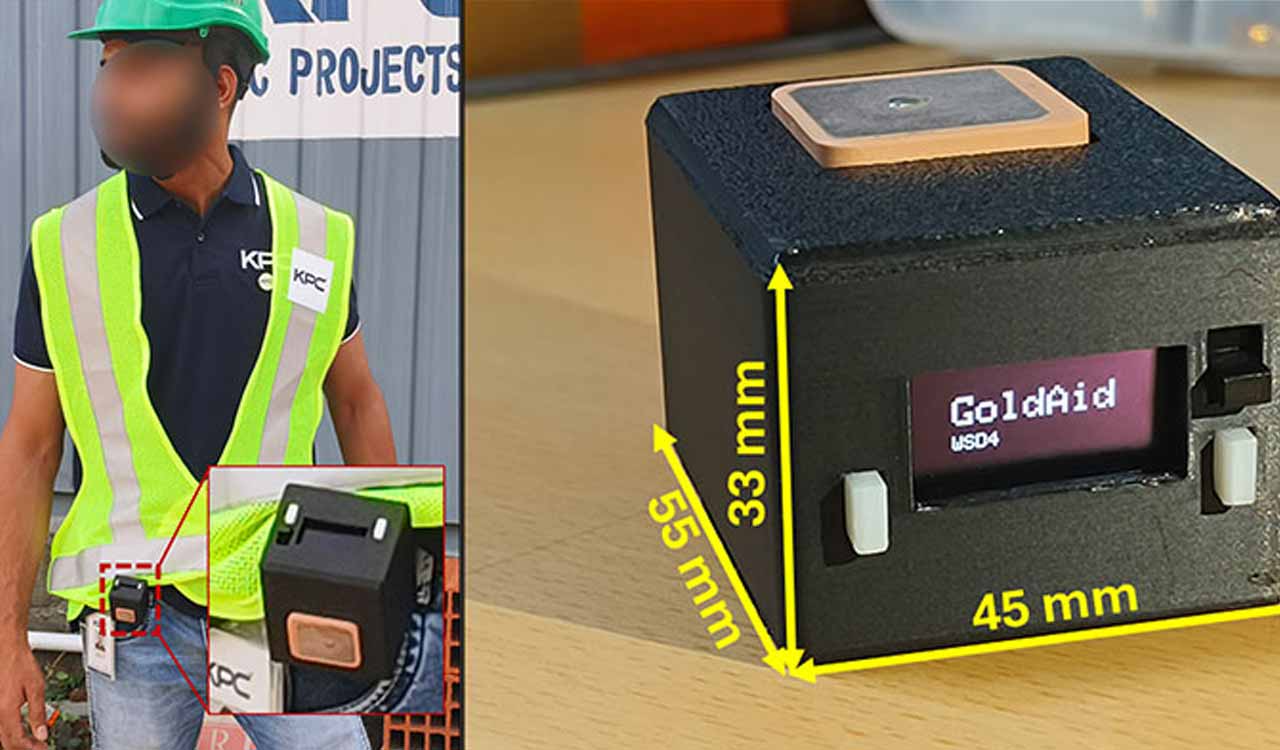


Hyderabad: For industrial and construction workers, safety not just depends on the gear but also on how fast help arrives in case of an emergency.
In a move to address emergency reporting in case of industrial accidents, a team of researchers at the International Institute of Information Technology (IIIT) – Hyderabad, led by Prof Abhishek Srivastava, has developed a wearable safety device to instantly alert supervisors and management when an accident occurs at the working space.
GoldAid system, which is currently designed as a compact belt-mounted unit, is paired with a base station and a central monitoring system for a continuous communication loop between workers and supervisors. In addition to location monitoring, the system detects hazardous gas detection, and falls beside monitoring of vitals.
If an accident occurs, say, a fall from a height, the device automatically sends an alert to the base station within seconds. “The base station, in turn, is connected to a central monitoring station where there is continuous monitoring of each worker on a displayed screen. Anything that goes wrong will lead to a beep/alert sound. In this way, timely medical help can be provided,” said Prof Srivastava.
Using a combination of motion sensors such as accelerometers and gyroscopes, along with lightweight machine learning models, the device, as per the team, can interpret the nature of a fall. It distinguishes between everyday slips, like a stumble while walking or climbing stairs, and more dangerous incidents, such as a fall from a significant height.
The system has already been tested in real-world conditions, including a major thermal power plant in Ramagundam as well as multiple construction sites in Hyderabad. In these environments, workers used the devices as part of their daily routines, allowing the team to observe how the system performs under real operational pressures.
Backed by the Department of Science and Technology (DST), the project has reached an advanced stage of development, bringing it close to real-world deployment.

Related News