IIT Hyderabad cuts reliance on Manjeera water with 33 borewells and recycled water
IIT Hyderabad has reduced its water consumption from 2,000 kilolitres to 700 kilolitres, cutting its monthly water bill to Rs 42 lakh. Rainwater harvesting, treated wastewater reuse and 33 borewells have helped the institute tackle water scarcity


Sangareddy: The Indian Institute of Technology-Hyderabad (IITH) is showing a way in tackling the El Nino weather pattern induced changes and shortage of drinking water supply from Manjeera by restricting its consumption to less than 50 per cent.
The premier institute, which used to pay over Rs one crore per month as water bill to the Hyderabad Metro Water Supply and Sewerage Board (HMWSSB) until 10 months ago, had now managed to reduce the bill to Rs 42 lakhs per month. Since there was not enough water in Singur and Manjeera reservoirs to meet the needs of the drinking water for the summer, the HMWSSB General Manager A Ramakrishna (Transmission) suggested institutes like IITH to make alternative arrangements to meet their needs to maximum possible extent until the next monsoon.
IITH, which had three 650 Kilo Liter Per Day (KLD) sewage treatment plants, had started putting the treated water to optimum utilisation. The institute connected the treated water to flush tanks apart from using it for gardening needs. The rainwater conservation system built by the IITH also came to their rescue as the institute had sufficient groundwater tables now.
Reducing the water consumption from HMWSSB 2,000 Kilo Liters to 700 Kiloliters within 10 months, the engineering staff of IIT were utilising water by operating the 33 borewells wherever it required. The institute had adopted a nature-led engineering system. Located in a region characterised by hard rock geology, IITH had adopted a science-driven, nature-integrated approach to water management.
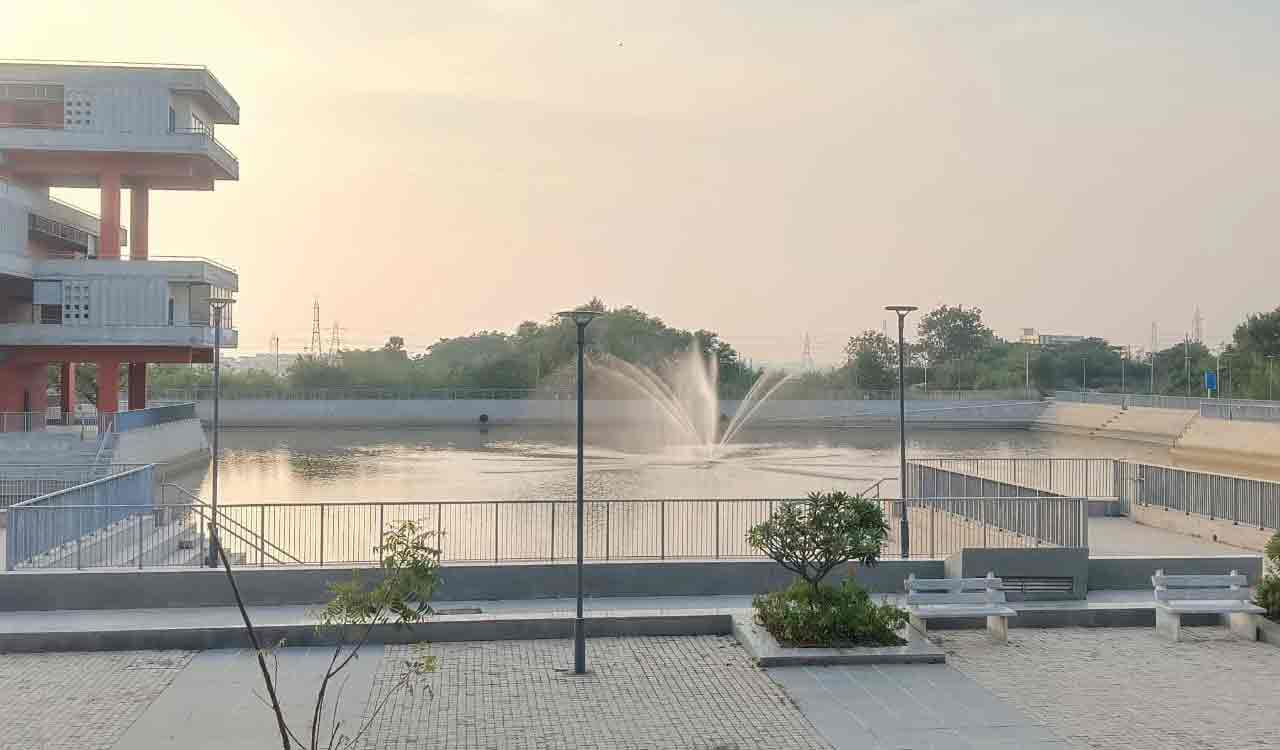
The campus seamlessly blends natural contours with engineered infrastructure to capture monsoon runoff, recharge groundwater and support non-potable reuse. A network of lakes, bio-swales and artificial ponds anchors this system. The lake located at the international guest house functions as both a storm water storage and groundwater recharge structure, while an extensive bio-swale network spanning nearly 14.84 km slows runoff, filters sediments and enhances percolation.
Together, these systems would provide a combined water storage capacity of over 4.79 crore litres, significantly reducing reliance on external water sources. Beyond functionality, the IITH PRO Vinay Kumar said these water bodies have evolved into ecological assets—supporting aquatic life, attracting birds and regulating the campus microclimate. The ideal location of IITH between Kisan Sagar lake and Chimna Sagar lake is also helping to keep the groundwater level at ideal level at a time when the ground table in Sangareddy district was depleting considerably.
Speaking to ‘Telangana Today’, Assistant Engineer Rajababu said that the institute has 7,300 residents, including 1,000 staff, while the institute also gets a number of visitors every day. Apart from arresting the leakages with the support of residents, Rajababu said that they educated the students and staff to restrict the wastage of water in the wake of prevailing situation.
Since the population in IIT is expected to increase considerably in the coming years, the institute was preparing to continue to restrict the water consumption from external sources. HMWSSB GM Ramakrishna called upon the institutes such as BHE, BDL, ODF and other government institutes to draw inspiration from IITH in rainwater harvesting and utilising the treated water.

Related News