India ranks 131st in Global Gender Gap Index 2026
India retained 131st position in the World Economic Forum’s Global Gender Gap Index 2026, with its gender parity score improving slightly. Iceland topped the 145-country index, followed by Finland and Norway, while the global gender gap reached 69.2 per cent
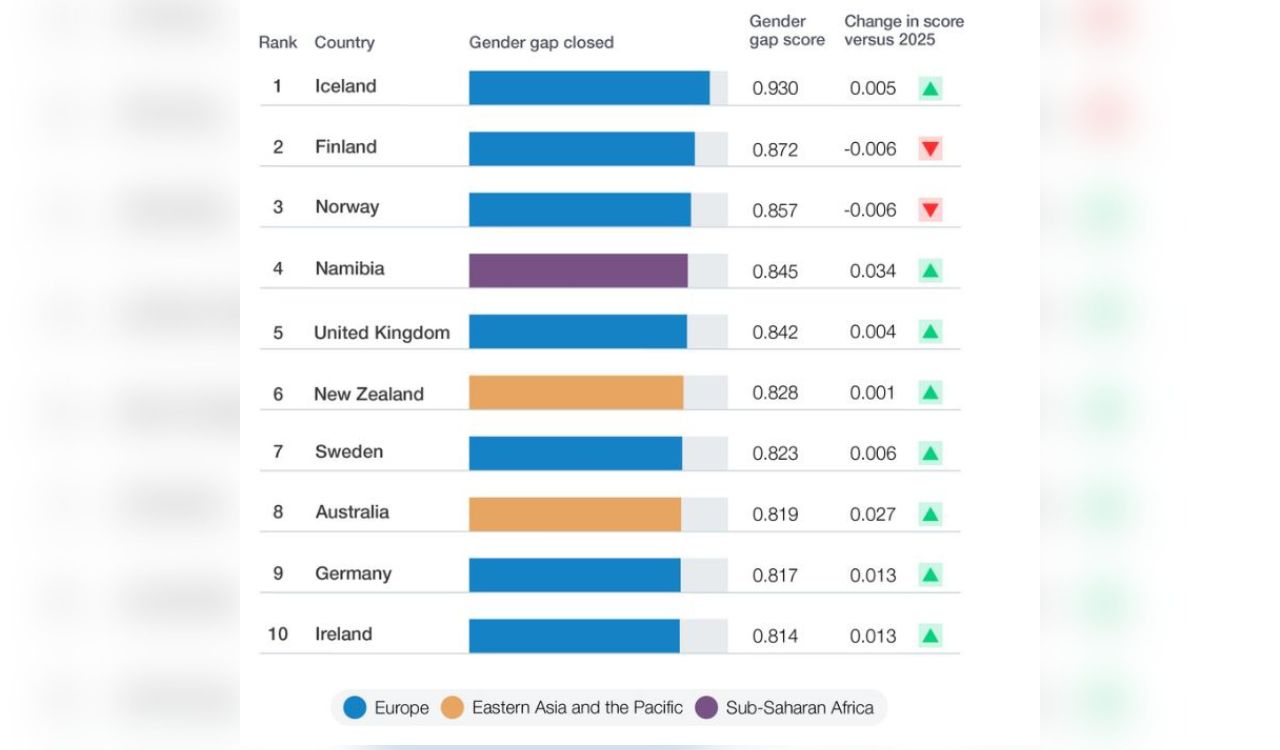


New Delhi/Geneva: India retained the 131st rank in the Global Gender Gap Index 2026 released by the World Economic Forum on Wednesday, with Iceland, Finland and Norway retaining their top three positions, respectively.
Only 14 countries ranked below India in the index of 145 countries. These included Papua New Guinea, Kuwait, Oman, Qatar, Tajikistan, Saudi Arabia, Egypt, Morocco, Mali, Algeria and Congo.
Chad was the lowest-ranked country in the index, with Iran and Pakistan joining it in the bottom three.
The Geneva-based WEF said nearly every economy tracked since 2006 by the index has advanced gender parity, but noted that full parity is still 120 years away.
Globally, 69.2 per cent of the gender gap has now been closed, up 0.4 percentage points over the last year, the WEF said, with 100 per cent representing full parity.
In India, the world’s most populous country with approximately 1.5 billion people, progress towards gender parity stood at 64.5 per cent, below the global average.
While India’s score improved slightly over the last year, its global ranking remained unchanged at 131st.
Overall, India’s gender parity increased by 4.3 percentage points since 2006, primarily due to gains in educational attainment.
In the Economic Participation and Opportunity subindex, India reported a 41.2 per cent parity score, 0.5 percentage points higher than in the previous edition but 3.5 percentage points lower than its best result in 2013.
Strong advances in professional and technical workers doubled parity from 26.6 per cent in 2006 to 49.9 per cent in 2026 in India.
Representation among legislators, senior officials and managers also improved by 10 percentage points since the 2006 edition, but remained comparatively low at 13.1 per cent.
Parity in labour-force participation saw a marginal improvement over the past two decades, standing at 44.1 per cent in 2026.
In the Educational Attainment subindex, India posted a 96.6 per cent parity score, though it fell by 0.5 percentage points from last year.
In Health and Survival, India improved its score from last year’s edition, reaching 95.6 per cent parity.
Despite an upward trajectory since 2017, India’s sex ratio at birth in 2026 continued to stand nearly one percentage point lower than in 2006.
Political Empowerment was India’s highest-ranked subindex in 2026, with 24.5 per cent of the gap closed and a global rank of 67th.
India had one of the highest starting parity scores on the head-of-state indicator, at 42.9 per cent in 2006, which increased to 72.3 per cent over the index’s first decade, reflecting many years of female leadership within the indicator’s rolling 50-year reference period.
However, since 2021, the indicator’s score has declined to its present 40.7 per cent.
Across other indicators, parity remained comparatively lower in India, the WEF said.
In Parliament, a 16.1 per cent gender gap was closed in 2026, marking an overall gain of 7 percentage points since 2006.
At the ministerial level, India has made an overall advance of 2.4 percentage points, from 3.5 per cent in 2006 to 5.9 per cent in 2026. However, this was sharply below the country’s highest score of 30 per cent in 2019.
According to the report, political empowerment globally has seen the largest gains since 2006, but has been on a reversal since 2016.
The share of economies led by a woman peaked in 2022, but has now fallen back to 2016 levels, the WEF report noted.
Women have reached the C-suite and Cabinets but are underrepresented in roles carrying the greatest economic and political influence.
The report said women hold 19.1 per cent of chief executive officer roles, while only one in 10 ministerial portfolios held by women is considered to be of high influence.
Women accounted for fewer than one in five AI engineers and were underrepresented at every level in AI firms, it added.
Southern Asia was the lowest-scoring region in economic participation and opportunity.
In its 20th year, the index benchmarked 145 economies across four dimensions: economic participation and opportunity, educational attainment, health and survival, and political empowerment.
“Twenty years of data show that gender parity is achievable. Economies at every income level have made progress, so the barrier is not a lack of resources,” said Saadia Zahidi, managing director, World Economic Forum.
“Parity is a foundation for growth and competitiveness, but it is not inevitable. To accelerate, governments and employers need to learn from the policies that work and apply them faster. A new economy demands a new approach to talent,” she added.
In the top 10, Namibia climbed four places to fourth, the highest-ranked country in Sub-Saharan Africa, followed by the United Kingdom, New Zealand, Sweden, Australia, Germany and Ireland.
Australia entered the top 10 for the first time.
Four economies have appeared in every top 10 since 2006: Iceland, Finland, Norway and Sweden.
Iceland was the only country to have closed more than 90 per cent of the gender gap, at 93 per cent.

Related News