ISRO gearing up for Gaganyaan mission’s first abort test of crew escape system
Preparations are going on. All vehicle systems have reached Sriharikota. Final assembly is progressing. We are getting ready for launch by the end of October, Director of Vikram Sarabhai Space Centre S Unnikrishnan Nair told media


Bengaluru: ISRO plans to undertake an inflight abort test of the crew escape system by this month-end using a test vehicle developed as part of the country’s ambitious maiden human spaceflight venture Gaganyaan.
“Preparations are going on. All vehicle systems have reached Sriharikota (for the launch). Final assembly is progressing. We are getting ready for launch by the end of October,” Director of Vikram Sarabhai Space Centre (VSSC) S Unnikrishnan Nair told PTI on Thursday.
“(With) this crew escape system, we will demonstrate (validate) in different conditions like high dynamic pressure and for transonic conditions,” Nair added Thiruvananthapuram-based VSSC is the lead centre of ISRO under the Department of Space.
An ISRO official said the crew escape system (CES) is the most important element in Gaganyaan.
According to ISRO officials, this month’s launch of the test vehicle TV-D1 would be the first of the four abort missions of the Gaganyaan programme. It would be followed by the second test vehicle TV-D2 mission and first uncrewed mission of Gaganyaan (LVM3-G1).
The second series of test vehicle missions (TV-D3 & D4) and LVM3-G2 mission with robotic payload is planned next. The crewed mission is planned based on the outcome of the successful test vehicle and the missions in which no crew is on board, they said.
The test vehicle is a single-stage rocket, based on liquid propulsion, developed to validate the CES performance at different critical Mach numbers but Nair said it can be used for many purposes including space tourism.
“We are taking (the test vehicle) to transonic conditions. That means crossing the Mach number of one. We will go to something like Mach number of 1.2. That reaches around 12 km altitude. From there, the escape system will be activated, and that will go some 20 km, and from there the crew module will be released,” he explained.
“This vehicle can be used for space tourism, if any industry is interested. Same vehicle can take a crew module to 100 km and then come back. That’s possible. If anybody is interested, this vehicle can be used for that,” Nair said.
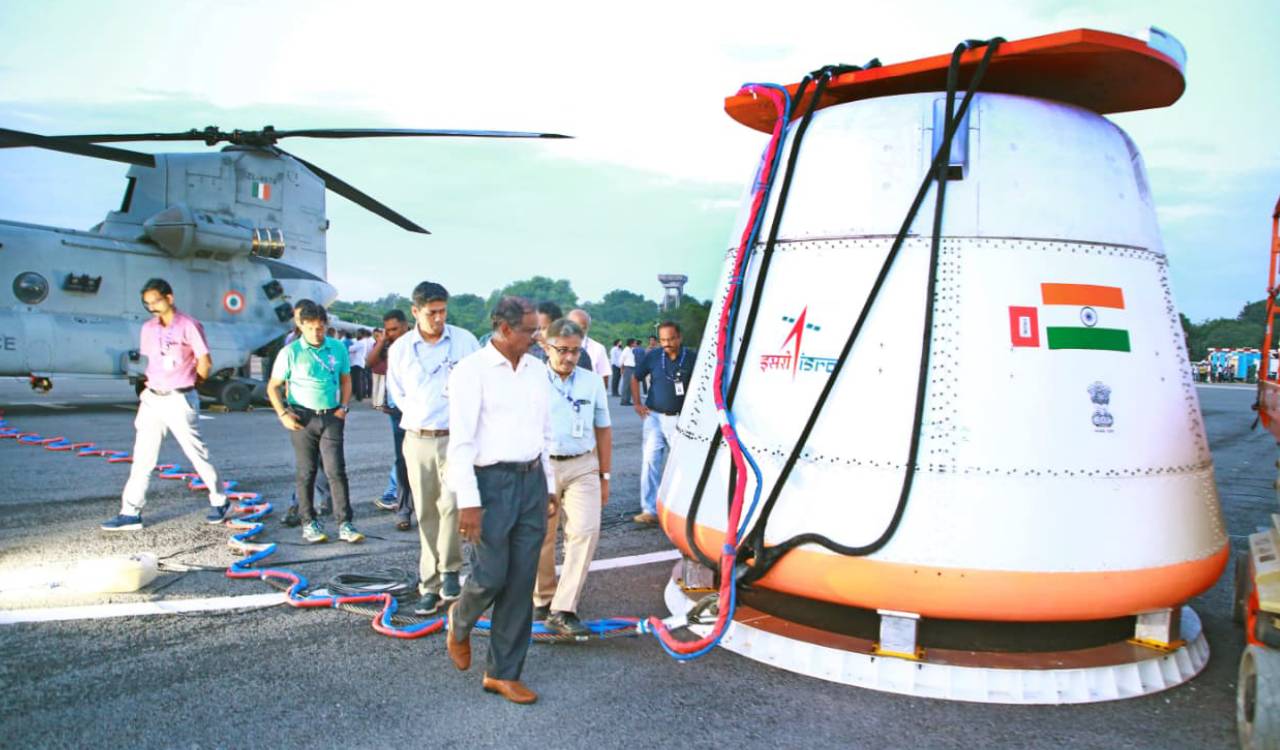
The Crew Module is habitable with Earth-like environment in space for the crew. It is of double-walled construction consisting of a pressurised metallic inner structure and unpressurised external structure with thermal protection system.
It houses the crew interfaces, human centric products, life support system, avionics and deceleration systems. It is also designed for re-entry to ensure safety of the crew during descent till touchdown.
According to ISRO officials, the Gaganyaan project would demonstrate India’s capability of taking a crew of two to three members to a circular orbit of about 400 km around the earth for a one-to-three days mission and bring them back safely to earth, by landing in a designated location in Indian sea waters.
The LVM3 rocket, the heavy lift launcher of ISRO, is identified as the launch vehicle for the Gaganyaan mission. It consists of solid stage, liquid stage and cryogenic stage. All systems in LVM3 are re-configured to meet human rating requirements and christened Human Rated LVM3 (HLVM3).
Nair said the LVM3 cannot be used for conducting tests to validate CES, saying it’s an expensive rocket.

Related News
-

Editorial: Diluting institutional autonomy may boomerang
-
Incredible to watch capability ISRO is developing in science missions: Indian-American NASA senior official
-
India, France step up space cooperation with new private-sector deals
-
ISRO says remains at centre of India’s space programme, refutes media reports as ‘baseless’