Rewind: Gulliver’s Travels at 300 — of Beasts, Men and Others
Three centuries after its publication, Gulliver’s Travels remains a sharp satire on human follies, vanities and moral depravities, reminding us that the Other helps us understand who we are, and that without the Other, there is no us


By Pramod K Nayar
A young man. A journey. Adventures. Strange encounters. Self-discovery in the process of discovering the world. Enchantment and disenchantment. Establishing these as ur-tropes for generations of literary authors, travel writers and even conquerors were two pioneering works of fiction, one of which celebrates 300 years in 2026.
Written by a disaffected and mostly misanthropic Dean of Divinity, a book reprinted thrice in the year of its publication with Dutch, French, and German translations within a year, Gulliver’s Travels appeared in October 1726. Jonathan Swift’s acerbic tale of different cultures and their follies and that of Europeans remains to this day one of the most widely read English novels. The second pioneering work of fiction with these themes is, of course, Daniel Defoe’s Robinson Crusoe (1719).
The English nation’s voyages to Asia, the Americas, and other parts of the world, documented by Richard Hakluyt (1589), followed by Samuel Purchas (1625), had already enabled a taste for accounts of different regions, introducing English and European readers to distant places, cultures and peoples.
- Swift points to the construction of norms, whether of looks or behaviour — so that the norms are then used to include or exclude people
With the development of technologies of visual exploration like the microscope and the telescope, the biological unit, the cell, and the skies, were opened up to the human eye as well. Shipping, trading and the slave voyages ensured that the world was crisscrossed by Europeans.
These explorations introduced different people to European eyes and imaginations, and racial discourses of differences emerged, consigning the non-Europeans to the lower end of the social and evolutionary order. Novelists like Swift and Defoe were responding to these social and cultural developments. Ostensibly a novel about beasts and men, Gulliver’s Travels is an allegory of the human condition, and of the necessity of the Other in understanding oneself.
Travel/Knowledge and the Comic
Gulliver’s Travels casts Lemuel Gulliver’s voyage as a journey of discovery. Indeed, it has been argued that the novel is a novel of education because Gulliver acquires a knowledge of other cultures that then enables him to turn a critical eye on his own. But this knowledge-seeking and knowledge-acquisition is cast as a comic experience. Swift focuses on foibles, ego and follies as a way of pointing to certain truths about humanity.
Gulliver himself is far from the conquering and heroic European male. He is usually in trouble, is mocked, laughed at, captured in the alien lands, and is often anxious. This is not the prototype of the European discoverer. There is also only a minimal ‘wonder’ at the worlds he sees (wonder, the critic Stephen Greenblatt argues, was central to the Columbian ‘discovery’ of the ‘New World’)
The strange creatures Gulliver meets during the course of his voyages generate the comic effect but they also disturb. They approximate to the grotesque with their odd semi- or nonhuman forms. Thus we have the highly intelligent horses in the land of the Houyhnhnms and the savage Yahoos, the tiny Lilliputians and the gigantic Brobdingnagians. The comic and the grotesque serve the larger purpose of capturing the diversity of life and cultures on the planet. It teaches Gulliver and us that what we understand as ‘normal’ is a set of rigid social conventions that enables the powerful to prescribe norms of beauty, body shapes, intelligence and behaviour.
- The novel is a masculine fantasy — of leaving home and domesticity, and travelling the world as an unattached man
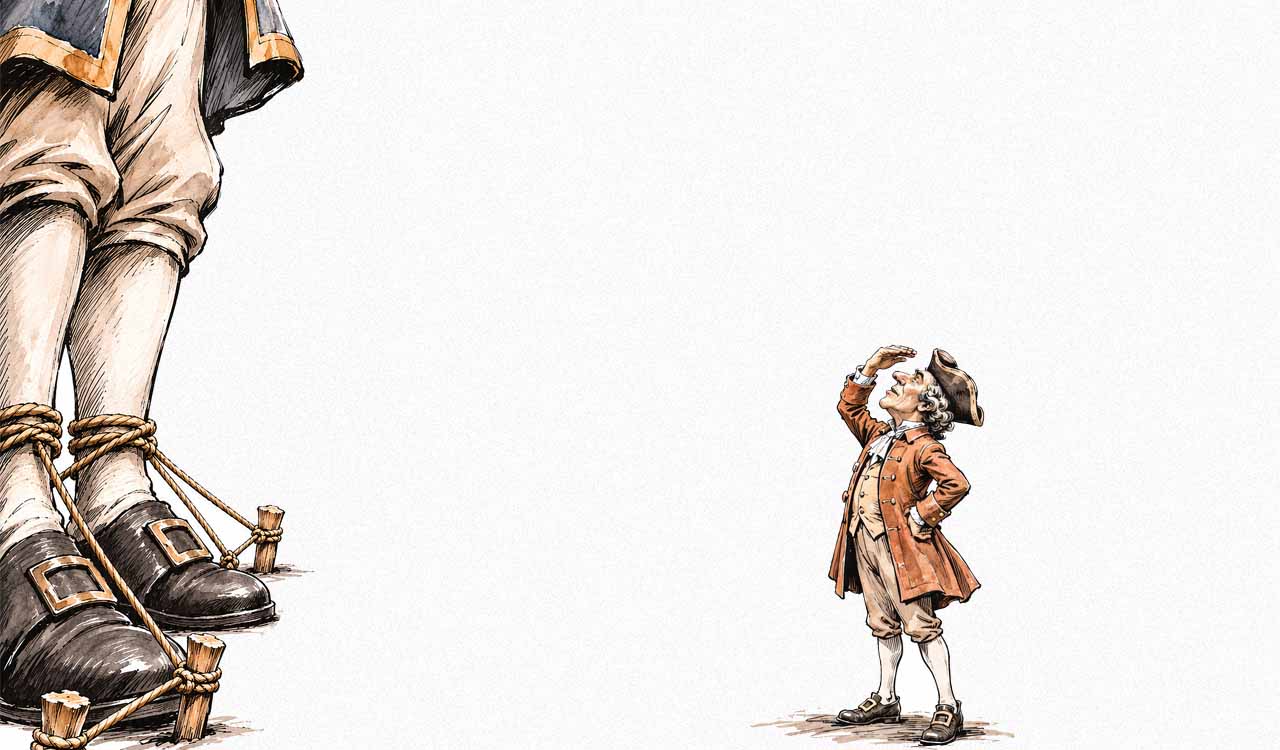
In Lilliput, Gulliver discovers that smaller-than-human people can also possess power. Among the Brobdingnagians, he is smaller, and feels powerless, although the 40-foot girl, Glumdalclitch, takes care of him. Appearances and size are not indicative of moral qualities or power, suggests Swift.
The novel also draws our attention through Gulliver’s multiple, and comic, encounters to the fact that people different from the normal ‘us’ are not necessarily evil or stupid (which is how racism operated and continues to operate). See how Swift describes the Yahoos, who resemble humans:
I observed, in this abominable animal, a perfect human figure; the face of it indeed was flat and broad, the nose depressed, the lips large, and the mouth wide. But these differences are common to all savage nations…
Gulliver discovers that those resembling humans are more savage and animal-like. Whereas the Houyhnhnms, who are horse-like, are in fact intelligent and more ‘civilised’. Their language, says Gulliver, ‘approaches nearest to the High Dutch or German… but is much more graceful and significant’ — thereby pointing to a civilisational hierarchy in which Europe is lower than the Houyhnhnms.
Gulliver also shows how the other cultures are equally curious. Thus, we are told that the Houyhnhnm ‘master’, as Gulliver refers to the creature in whose house he stays, showed ‘great signs of curiosity and admiration’ and ‘took up all my clothes in his pastern, one piece after another, and examined them diligently’. Like the European, then, the horse-creature is also curious and seeks knowledge!
A Masculinist Fantasy
Critics have noted that Swift’s novel is a masculinist fantasy — of escaping the responsibilities of home and family, and exploring the world. Travel as the privilege of the male while avoiding the duties of father/husband ensures that the wife is the primary caregiver, and for many critics this is a misogynistic theme.
Gulliver’s wife occupies practically no space in the text. The novel is divided between the almost invisible home and the world outside which Gulliver explores. The economy of the house in his absence is never made clear.
Among the Houyhnhnms, women and property are communally owned. Restrictive conditions for women exist everywhere. In Lilliput, ‘among people of quality, a wife should be always a reasonable and agreeable companion’ and ‘In the nurseries of females of the meaner sort, the children are instructed in all kinds of works proper for their sex’, thus predestining women to specific professions.
Reflections on Human Condition
Swift employs satire to reflect on human foibles, whether these are about government, trade, knowledge or morals so that the novel is a comment on the slow erosion of human values and modes of thinking. In the Age of Reason, Swift shows how humanity is not reasonable at all.
Gulliver often dismisses the other cultures as ‘degenerate’ but also refers in an early chapter to the ‘degenerate nature of man’. In books 1 and 2, Swift satirises English customs, and in 3 and 4, he expands the satire to include human conditions in general.
Take the mockery of morals and spectacles of governance Swift documents in the Lilliputs. Ministers and others receive favour based on how high they can jump over a rope. The forms of oath-taking in court involve contortions:
which was to hold my right foot in my left hand, to place the middle finger of my right hand on the crown of my head, and my thumb on the tip of my right ear.
The satire suggests that rituals and customs are invented to enforce conformity and would appear absurd to a culturally different Other. These ceremonies, whether at school assemblies, or openings of even academic and official programmes, are formalised structures that make little sense outside that culture, and rarely even within. The human penchant is for empty rituals where even the morally depraved and the irremediably corrupt swear integrity or loyalty pledges — often made mandatory by the state in our time.
- Swift satirises the human penchant for empty ceremonies and rituals where even the morally depraved swear oaths and functionaries believe in spectacle over integrity
Gulliver satirises courtiers, employees of the government, lawyers — the latter he describes as ‘biased all their lives against truth and equity … under such a fatal necessity of favouring fraud, perjury, and oppression’. No profession, it would seem, is safe from moral depravity.
War and Empire
Human behaviour is driven by greed, visions of personal gain and need for power. When Gulliver destroys the Blefuscu navy, it is a clear instance of the misuse of power against a people who have never harmed him — and an allegory of conquest and war in the contemporary period, or in human history itself. Laputa for example, threatens to shut off sunlight as a way of intimidating their neighbours.
In Swift’s account of war, we find this description of the effects:
I gave him a description of cannons, culverins, muskets, carabines, pistols, bullets, powder, swords, bayonets, battles, sieges, retreats, attacks, undermines, countermines, bombardments, sea-fights; ships sunk with a thousand men, twenty thousand killed on each side; dying groans, limbs flying in the air, smoke, noise, confusion, trampling to death under horses’ feet; flight, pursuit, victory; fields strewed with carcases left for food to dogs, and wolves, and birds of prey; plundering, stripping, ravishing, burning, and destroying.
One of the sharpest criticisms Swift makes of the human race occurs towards the end of the tale. Gulliver does not wish to enlighten his own king about the dominions he has seen, for he suspects that the king would immediately want to conquer that land. In a passage that does not attract enough attention, Swift writes:
I had another reason which made me less forward to enlarge his Majesty’s dominions by my discoveries. To say the truth, I had conceived a few scruples with relation to the distributive justice of princes upon those occasions. For instance, a crew of pirates are driven by a storm they know not whither, at length a boy discovers land from the topmast, they go on shore to rob and plunder, they see an harmless people, are entertained with kindness, they give the country a new name, they take formal possession of it for their king, they set up a rotten plank or a stone for a memorial, they murder two or three dozen of the natives, bring away a couple more by force for a sample, return home, and get their pardon. Here commences a new dominion acquired with a title by divine right. Ships are sent with the first opportunity, the natives driven out or destroyed, their princes tortured to discover their gold, a free licence given to all acts of inhumanity and lust, the earth reeking with the blood of its inhabitants: and this execrable crew of butchers employed in so pious an expedition, is a modern colony sent to convert and civilise an idolatrous and barbarous people.
Thus begins an Empire.
Then, to avoid sounding unduly harsh about his own king, he adds:
But this description, I confess, doth by no means affect the British nation, who may be an example to the whole world for their wisdom, care, and justice in planting colonies; their liberal endowments for the advancement of religion and learning; their choice of devout and able pastors to propagate Christianity; their caution in stocking their provinces with people of sober lives and conversations from this the mother kingdom; their strict regard to the distribution of justice, in supplying the civil administration through all their colonies with officers of the greatest abilities, utter strangers to corruption; and to crown all, by sending the most vigilant and virtuous governors, who have no other views than the happiness of the people over whom they preside, and the honour of the king their master.
Gulliver suggests a benevolent colonialism but cautions the greedy European too:
Those countries which I have described do not appear to have any desire of being conquered, and enslaved, murdered or driven out by colonies, nor abound either in gold, silver, sugar, or tobacco; I did humbly conceive they were by no means proper objects of our zeal, our valour, or our interest.
Gulliver’s Travels continues to entertain and educate us in its allegory of human follies, vanities and moral depravities. It is a moot point whether a novel satirising governments, the various professions and above all rituals and ceremonies would have been possible in this day of autocratic democracies and the near-erasure of freedom of creative expression.
Seeing other cultures enables Gulliver to reflect upon his own. Gulliver’s Travels shows us that the cultural Other is a mirror in which Gulliver sees himself. To ‘reflect’, as in a mirror, is to ‘bend something backwards’. Thus, as philosophers argue, to bend backwards is to self-reflect, to look backwards at oneself. The Other is the silver plate/paper, or tain, behind the mirror that enables the mirror to reflect. Every culture then is the tain that allows us to reflect, as Gulliver does in the above passages, on ourselves.
Without this tain, we can never understand ourselves: the Other helps us know who we are. Without the Other there is no us.

(The author is Senior Professor of English and UNESCO Chair in Vulnerability Studies at the University of Hyderabad. He is also a Fellow of the Royal Historical Society and The English Association, UK)

Related News