ISRO’s PSLV successfully places two satellites of European Space Agency into orbit
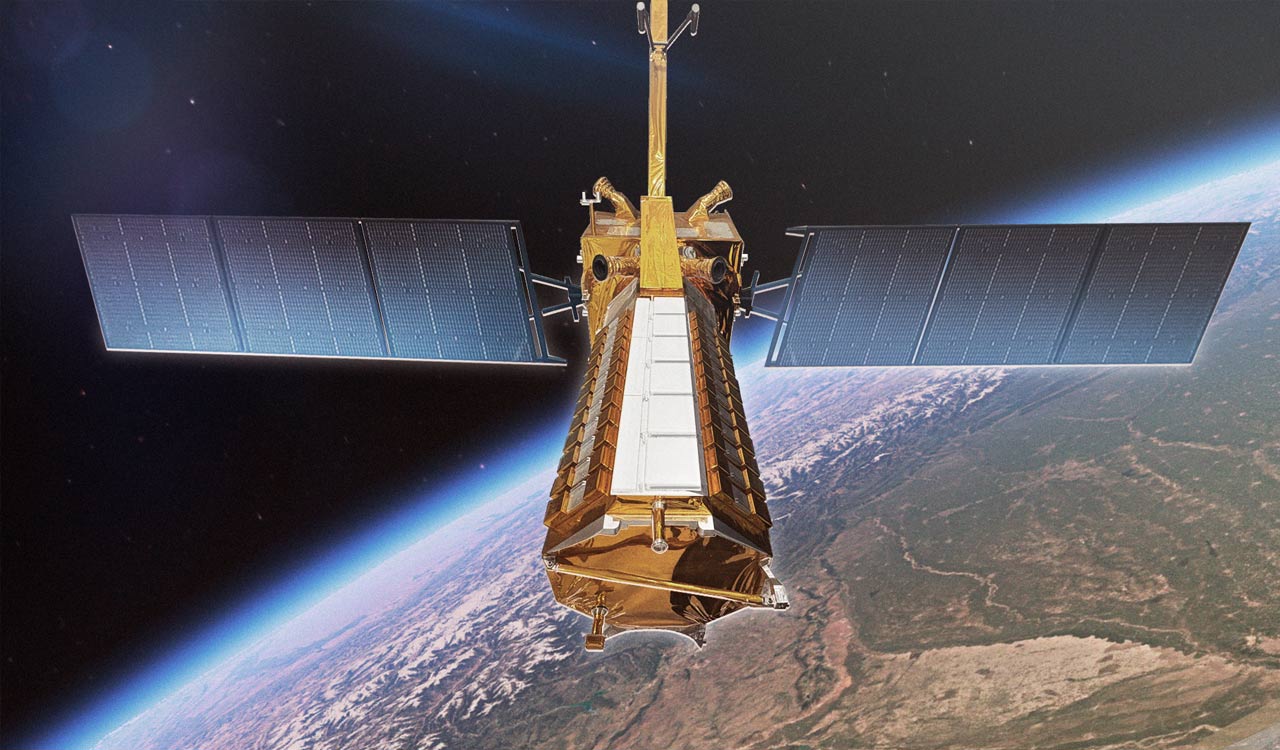
The Proba-3 (Project for Onboard Autonomy) mission consists of twin satellites in which two spacecraft (placed inside the satellites) would fly together as one, maintaining a precise formation down to a single milli-metre to study the Sun's outer atmosphere.
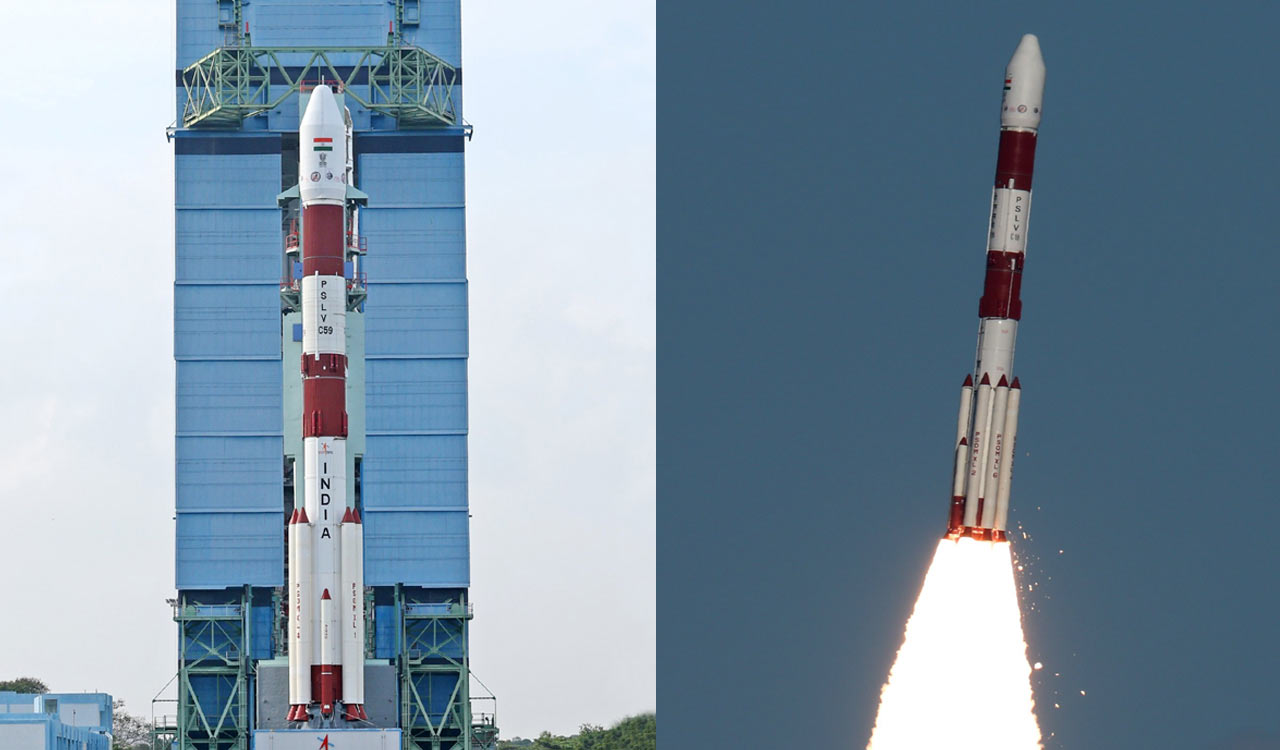


Sriharikota: ISRO on Thursday successfully launched the Proba-3 mission onboard a PSLV-C59 rocket, a solar experiment undertaken by the European Space Agency.
Around 18 minutes after lift-off, the two satellites were placed into the ‘right orbit’, said ISRO Chairman S Somanath.
The Proba-3 (Project for Onboard Autonomy) mission consists of twin satellites in which two spacecraft (placed inside the satellites) would fly together as one, maintaining a precise formation down to a single milli-metre to study the Sun’s outer atmosphere.
Addressing the scientists at the Mission Control Centre after the launch, Somanath said, “The satellites have been placed in the right orbit which is a very high elliptical orbit of almost 600 km perigee, that is the closest point to the Earth and 60,000 km at its apogee, that is the farthest point with an inclination of 59 degree.” “It (The mission) has been precisely achieved in the 61st mission (of Polar Satellite Launch Vehicle). So, congratulations to the entire PSLV project team as well as the Proba-3 team. We wish all the very best to Proba-3 team for their further operations and in achieving the mission goals,” he said.
Earlier, in a social media post, ISRO said, “Mission success. The PSLV-C59-Proba-3 mission has successfully achieved its launch objectives, deploying ESA satellites into their designated orbit with precision. A testament to the trusted performance of PSLV, the collaboration of NSIL and ISRO and ESA’s innovative goals.” “The PSLV-C59-Proba-3 mission reflects the dedication of NSIL, ISRO and ESA teams. This achievement highlights India’s critical role in enabling global space innovation. Together we continue building bridges in international space collaboration” ISRO added.
NewSpace India Ltd (NSIL), the commercial arm of ISRO has bagged the order from ESA for the launch.
NSIL Chairman and Managing Director D Radhakrishnan extended his greetings to team ISRO for giving the customer European Space Agency a ‘beautiful launch’ and said, “Let me tell you, this is the first time that the PSLV has gone into such an elliptical orbit (of about 60,000 km).” “I have seen PSLV missions going to GTO (Geostationary Transfer Orbit) or sub-GTO, but reaching 60,000 km orbit for ESA is really special. As you have heard, the Proba-3 satellite is a single stacked which has two spacecraft onboard which will get separated in the coming months,” he said.
“The Proba-3 mission would take up precision formation flying in the coming months and it would also do a very interesting scientific experiment of solar coronagraphy,” he said.
The mission objective of PSLV-C59 is to demonstrate precise formation flying and the two spacecraft inside the satellites–Coronagraph (310 kg) and Occulter (240 kg) would be launched together in a stacked configuration after the desired orbit level is reached in the coming days.
At the end of the revised countdown which commenced at about 8.05 am on Thursday, the 44.5 metre tall PSLV-C59 rocket on its 61st flight and the 26th with PSLV-XL variant lifted off at the prefixed 4.04 pm from this spaceport here.
After soaring into the skies on an 18-minute journey, the rocket successfully separated the two satellites into intended orbit which would be later positioned at the desired orbit by the scientists of ESA in Belgium.
The satellites, as planned, reached the high earth elliptical orbit and would fly 150 metres apart (as one large satellite structure) in tandem so that the ‘Occulter’ spacecraft would block out the solar disk of the sun, enabling ‘Coronagraph’ to study the Sun’s corona or the surrounding atmosphere, for scientific observation.
The ‘Occulter’ spacecraft would line up in front of the other, around 150 metres away, to cast its shadow precisely onto the other. The shade provided by the first spacecraft (Occulter) would cover the fiery face of the Sun so that its faint surrounding ‘Coronal’ atmosphere becomes visible.
According to the European Space Agency, the corona is much hotter than the Sun itself and it is where space weather originates. It is also a topic of widespread scientific and practical interest.
The pattern of blocking the solar disk of the Sun occurs during solar eclipses and that too for a few minutes. However, the European Space Agency said, with Proba-3, the mission would be able to create “solar eclipses on demand.” For ISRO, this launch would provide key insights on taking up scientific experiments on the Sun after its maiden mission–Aditya-L1, which was successfully launched in September 2023.
Referring to the Aditya-L1 Mission, Somanath said, “All of you know that we have a solar mission, the Aditya-L1 mission, which is working along with the satellite. It will give a fantastic outcome in the days to come.” The Proba-3 is a technology demonstration mission funded via the General Support Technology Programme.
The instruments onboard the satellites would travel closer to the solar rim for up to six hours at a time and each spacecraft would take up approximately a 19-hour orbit around the Earth.

Related News
-

Editorial: Diluting institutional autonomy may boomerang
-
Incredible to watch capability ISRO is developing in science missions: Indian-American NASA senior official
-
India, France step up space cooperation with new private-sector deals
-
ISRO says remains at centre of India’s space programme, refutes media reports as ‘baseless’