NASA’s newest space telescope blasts off to map entire sky
The $488 million Spherex mission aims to explain how galaxies formed and evolved over billions of years, and how the universe expanded so fast in its first moments
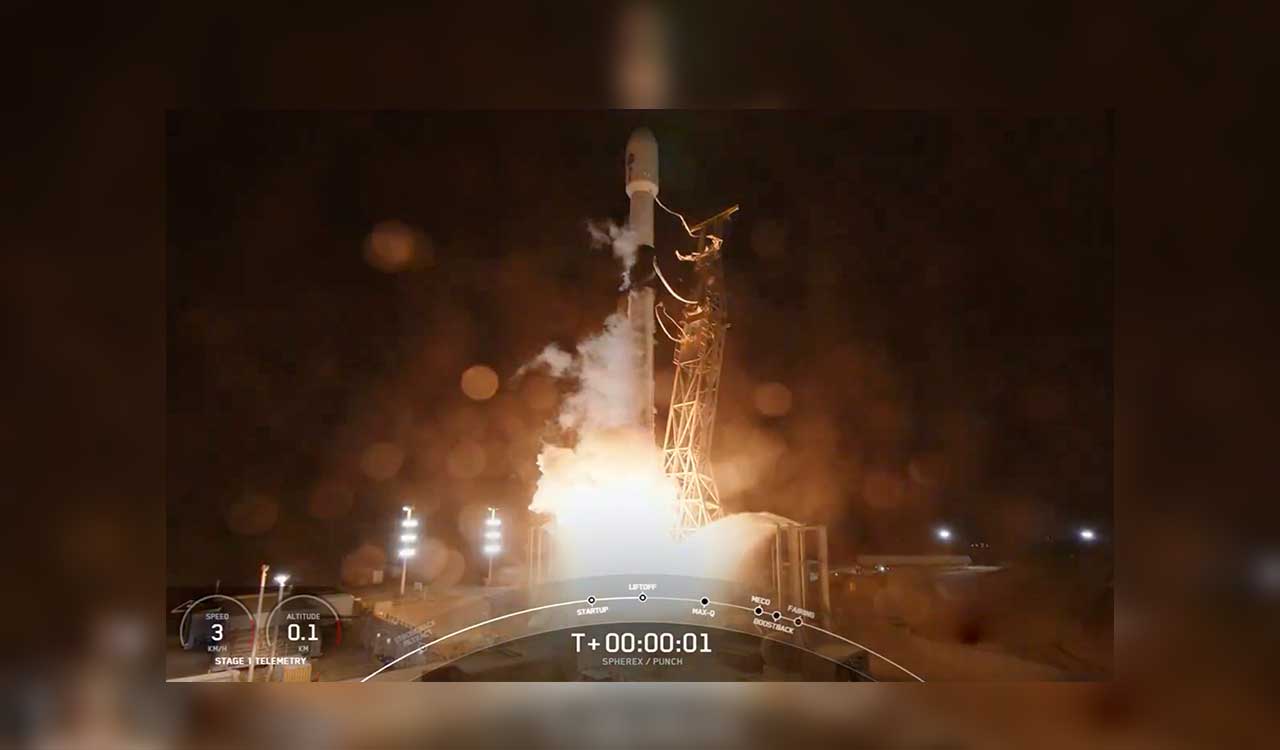


Vandenberg Space Force Base: NASA’s newest space telescope rocketed into orbit Tuesday to map the entire sky like never before — a sweeping look at hundreds of millions of galaxies and their shared cosmic glow since the beginning of time.
SpaceX launched the Spherex observatory from California, putting it on course to fly over Earth’s poles. Tagging along were four suitcase-size satellites to study the sun. Spherex popped off the rocket’s upper stage first, drifting into the blackness of space with a blue Earth in the background.
The $488 million Spherex mission aims to explain how galaxies formed and evolved over billions of years, and how the universe expanded so fast in its first moments. Closer to home in our own Milky Way galaxy, Spherex will hunt for water and other ingredients of life in the icy clouds between stars where new solar systems emerge.
The cone-shaped Spherex — at 1,110 pounds (500 kilograms) or the heft of a grand piano — will take six months to map the entire sky with its infrared eyes and wide field of view. Four full-sky surveys are planned over two years, as the telescope circles the globe from pole to pole 400 miles (650 kilometers) up. Spherex won’t see galaxies in exquisite detail like NASA’s larger and more elaborate Hubble and Webb space telescopes, with their narrow fields of view.
Instead of counting galaxies or focusing on them, Spherex will observe the total glow produced by the whole lot, including the earliest ones formed in the wake of the universe-creating Big Bang. “This cosmological glow captures all light emitted over cosmic history,” said the mission’s chief scientist Jamie Bock of the California Institute of Technology. “It’s a very different way of looking at the universe,” enabling scientists to see what sources of light may have been missed in the past.
By observing the collective glow, scientists hope to tease out the light from the earliest galaxies and learn how they came to be, Bock said. “We won’t see the Big Bang. But we’ll see the aftermath from it and learn about the beginning of the universe that way,” he said.
The telescope’s infrared detectors will be able to distinguish 102 colors invisible to the human eye, yielding the most colorful, inclusive map ever made of the cosmos. It’s like “looking at the universe through a set of rainbow-colored glasses,” said deputy project manager Beth Fabinsky of NASA’s Jet Propulsion Laboratory.
To keep the infrared detectors super cold — minus 350 degrees Fahrenheit (minus 210 degrees Celsius) — Spherex has a unique look. It sports three aluminum-honeycomb cones, one inside the other, to protect from the sun and Earth’s heat, resembling a 10-foot (3-meter) shield collar for an ailing dog.
Besides the telescope, SpaceX’s Falcon rocket provided a lift from Vandenberg Space Force Base for a quartet of NASA satellites called Punch. From their own separate polar orbit, the satellites will observe the sun’s corona, or outer atmosphere, and the resulting solar wind. The evening launch was delayed two weeks because of rocket and other issues. AP

Related News