Opinion: Bringing women back into workforce
By Rajendra P Mamgain Since the turn of the millennium, women have been leaving the workforce in India. Over 40.4 million fewer women are in paid work today than in 2004. Despite making up nearly half of India’s population, women represent less than one-third of the workforce. But the spiral can turn around, and India […]



By Rajendra P Mamgain
Since the turn of the millennium, women have been leaving the workforce in India. Over 40.4 million fewer women are in paid work today than in 2004. Despite making up nearly half of India’s population, women represent less than one-third of the workforce. But the spiral can turn around, and India has a strong economic incentive to ensure it does.
India’s GDP over the past two decades could have been 43% larger if women had the same work participation rate as men, Oxfam estimates. And India’s international standing is suffering: the country ranks 135 among 146 in the 2022 Global Gender Gap Index, owing largely to low work participation rates among women and poor health indicators.
Pushing into Poverty
The decline in women’s work is pushing all age groups and sectors into poverty but the dropoff was particularly pronounced among youth aged between 15 and 24, those with lower levels of education and working in agriculture and construction sectors in rural India. The agricultural sector, a historically strong employer of people with fewer formal qualifications, is relying on less labour as farm mechanisation improves. And while rising enrolment in education among women is encouraging, there remains a shortage of paid job opportunities outside of farming for many who graduate — prompting them to leave the workforce altogether.
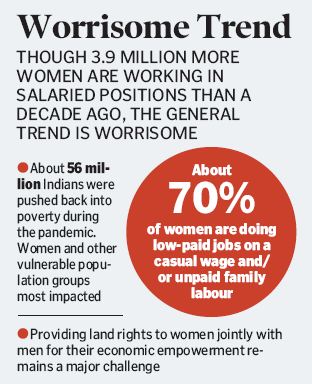
While 3.9 million more women are working in salaried positions than a decade ago, the general trend is worrisome. About 70% of women who work in India are doing low-paid jobs on a casual wage and/or unpaid family labour, and many are still recovering from the shockwaves of the pandemic and its related economic disruptions. About 56 million Indians were pushed back into poverty during the pandemic, with women and other vulnerable population groups most impacted.
Turning it around relies not just on more work being available, but better quality work. Central and State governments have been active in trying to fix the problem, launching several programmes that promote self-employment and wage employment.
Utilising Schemes
The Deen Dayal Upadhya-National Rural Livelihood Mission is aimed at promoting self-employment through self-help groups, small groups of workers who receive government assistance to take up income-generating activities. Another programme, the Mahatma Gandhi National Rural Employment Guarantee Scheme, guarantees 100 days’ manual wage employment to participating unskilled workers.
Self-help groups have a record of alleviating poverty and empowering women. The Rural Employment Guarantee Scheme has greatly helped lift household incomes and granted some women more financial autonomy.
But even the scheme, a success story, had clear cases of gender and class-based inequalities with its implementation: work was generally allocated with no consideration of different gender realities, such as “responsibilities for child care and differences in physical strength”.
Policymakers can learn from what has worked in these initiatives. Targeting resources towards growth industries, particularly in roles that can sustainably employ and upskill workers with low levels of education is a blueprint that has worked elsewhere.
Lessons from Countries
In China, women-focused public programmes such as training, cooperatives, and extending women’s lines of credit helped reduce poverty faster and improve the livelihoods of poor households. Bangladesh considerably raised its labour force participation rates among women by focusing on creating demand for female labour in the textile industry.
Rural Indians in particular are reliant on the government to improve the range and quality of infrastructure in their reach, mostly in education and health. Young people especially would benefit from investment in their foundational education and skill training, helping the next generation of Indian workers adapt in a fast-changing and demanding skill landscape.
This transformative journey would be much easier, faster and inclusive by augmenting the capacities and capabilities of local level institutions, such as Panchayat Raj Institutions (village-level local bodies) on a sustained basis. This requires large public investment at least over the next five years, along with incentivising private investment in rural areas in a big way.
Providing land rights to women jointly with men for their economic empowerment would be a critical advancement, but it remains a major challenge generating domestic support. Self-help groups can be promoted for land pooling and cooperative farming, as has been successful in the case of Kudumbashree in Kerala and the Deccan Development Society in Telangana. Programmes like the Rural Employment Guarantee Scheme could be more successful if the government took a page from many countries that provide childcare and flexible working arrangements to assist women engaging in work. India’s maternity Act, amended in 2017, mandates large employers to provide childcare facilities (crèche) at the workplace; the follow-through is still lacking.
India’s next chapter of economic development will hinge on whether it can get the follow-through right on many of the targeted, gender-sensitive reforms on the table. There are clear incentives to bring women back into the workforce, but the pathway relies upon a considered policy that accounts for the unique challenges women face.

(The author is Professor and Head of Department, Economics, Doon University. Views are personal. 360info)

Related News