Opinion: Economy up, jobs down
Instead of changing course of manufacturing from capital to labour-intensive, the govt is indulging in mere tokenism


By Arun Sinha
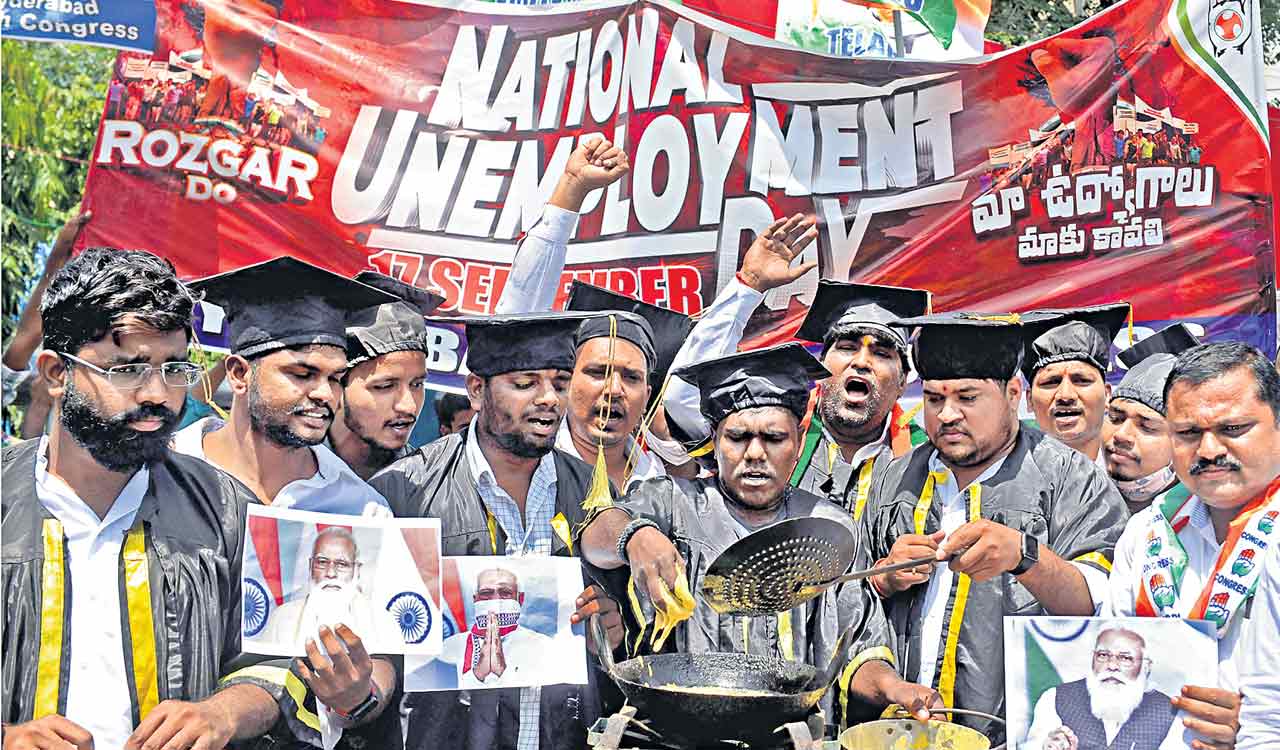
Hyderabad: Remember Asha Bhosle’s classic song, ‘Padhoge likhoge hoge nawab/Jo kheloge kudoge hoge kharab’ from the 1958 film ‘Malik’? It conveyed a simple message to the children of newly independent India: Education is the road to a good life. In today’s India, millions of educated youth find it is not true. To have a good life they must have a good job with a good salary, and they just do not find it anywhere. The more educated you are, the less is the possibility of you getting a job. According to the Centre for Sustainable Employment at Azim Premji University, unemployment among graduates and above is thrice the national average.
No wonder, the educated unemployed are desperate. They and their families have invested a lot of money and time in their education. They want to start earning. Something is better than nothing. So they apply for jobs that require much less education.
Strange Paradox
In 2018, the Uttar Pradesh police advertised for 62 posts of telephone messengers, whose job was to carry documents from one police station to another on a bicycle. Anyone who had passed the fifth standard was eligible. As many as 93,000 persons applied. The selection board was shocked to find that there were 50,000 graduates (even BTechs), 28,000 postgraduates (even MBAs) and 3,700 PhDs among them. The same year, the Railway Recruitment Board advertised for about 63,000 ‘Level 1’ vacancies — the lowest level, including posts such as gangman, gateman and porter — the eligibility for which was tenth standard. As many as 1.9 crore applied, most of them graduates and postgraduates.
In 2019, 12 of the 13 waiters selected for a Maharashtra government canteen were graduates. The minimum qualification was fourth standard. The job profile included cutting vegetables, cleaning tables, washing utensils and sweeping the floor.
Why do the well-educated swoop in hordes to plunder the jobs of the less-educated? Because there are not enough jobs. We are living in a paradox in which the economy is expanding but employment is shrinking. According to a joint study of the Centre for Monitoring Indian Economy (CMIE) and the Centre for Economic Data and Analysis (CEDA), the number of people employed in the manufacturing sector plunged from 5.1 crore to 2.7 crore, almost by 50%, between 2016-17 and 2020-21. What was worse, most of the employment shrinkage happened in labour-intensive sectors such as textiles, construction material (like tiles) and food processing. Jobs in textiles dropped from 1.26 crore in 2016-17 to 55 lakh in 2020-21, and in construction material firms from 1.14 crore to 48 lakh.
Wrong Direction
The experience in western countries was that when the economy grew, labour moved permanently from agriculture to manufacturing. But in India, the reverse is happening. Labour from manufacturing is moving back to agriculture. The CMIE-CEDA study found that during the four years between 2016-17 and 2020-21, the number of people employed in agriculture went up. And people employed in agriculture included not only the uneducated but also the educated who got no jobs or were laid off by the manufacturing sector.
It is clear that the Indian economy is going in the wrong direction. Instead of becoming more and more labour-intensive (more labour, fewer machines) as the economy in a country with the world’s greatest ocean of labour should, it is turning more and more capital-intensive (more machines, fewer labour). Neither the UPA nor the NDA government did anything to reverse the direction in the past two decades because the GDP was growing. After all, investment added to the GDP. Even the Make in India and the Production-Linked Incentive schemes encourage capital-intensive manufacturing.
However, GDP is not everything. The joy about India racing to become one of the world’s fastest-growing economies cannot hide the deepening sorrow about the country’s jobless growth. What is the use of the economy growing and the people not growing? Nearly half of India’s population is below the age of 25. According to ‘The Wall Street Journal’, every year 1.2 crore of them join the labour force, but only 55 lakh get jobs. According to the Periodic Labour Force Survey, youth unemployment was 25.5% for the 15-29 age group in the April-June quarter of 2021. India’s young population — known as the demographic dividend — is said to be a boon. But without the economy generating employment for youth, the boon may turn out to be a curse.
Deal with Unemployment
It is worrying to see that the government, instead of changing the course of manufacturing from capital-intensive to labour-intensive to generate adequate employment for the young population, has been indulging in mere tokenism. For example, it announced in mid-2022 that it will recruit 1 million youth in its ministries and departments in the next one-and-a-half years. In a country where over 10 million persons would be seeking jobs from mid-2022 to end-2023, giving one million of them government jobs would not mitigate unemployment even during the period, leaving aside the huge numbers that are unemployed from previous years and would be so in the following years. Public employment cannot be the answer to the country’s unemployment problem, only private employment can be.
Here is a four-pronged strategy India must follow to effectively deal with unemployment. First, the government must reorient its policies and incentives to encourage labour-intensive industries (such as textiles, garments, leather and footwear, food processing, wood manufacturing and furniture). In May 2023, the government announced PLI schemes also for labour-intensive sectors, which is a good step.
Second, the government must make its skilling programme — Pradhan Mantri Kaushal Vikas Yojana (PMKVY) — truly meaningful. Reviews have found major deficiencies in training and placement in PMKVY.
Third, the industry must share the responsibility of skilling. Companies like Google and IBM run their own training programmes to get the skills they need. Indian industry too must do it.
Fourth, education must serve as a bridge between school/college and the workplace. Courses must be aligned with careers and combined with work-based learning.


Related News
-

2nd Test: India fight back with three wickets as New Zealand reach 131/4 at tea
-
MailMyCard Helps Families Send Digital Birthday Cards With a Voice Note and Photos to Relatives Anywhere
-
Vaibhav Sooryavanshi credits Yuvraj for record knock
-
Lowy Institute ranks PM Modi second among Asia’s most effective leaders