Opinion: Encounter killings — when state shoots first, and courts arrive later
Encounter policing is increasingly being normalised as governance and risks replacing judicial accountability with executive power


By Geetartha Pathak
The two reports — one analysing Uttar Pradesh’s “Operation Langda” policing model and the other on the recent Assam police encounter involving a Muslim youth accused of murder — raise disturbing questions about the direction in which criminal justice is moving in parts of India. The issue is no longer about isolated “encounters.” It is about the gradual institutionalisation of extra-judicial punishment as a model of governance.
Also Read
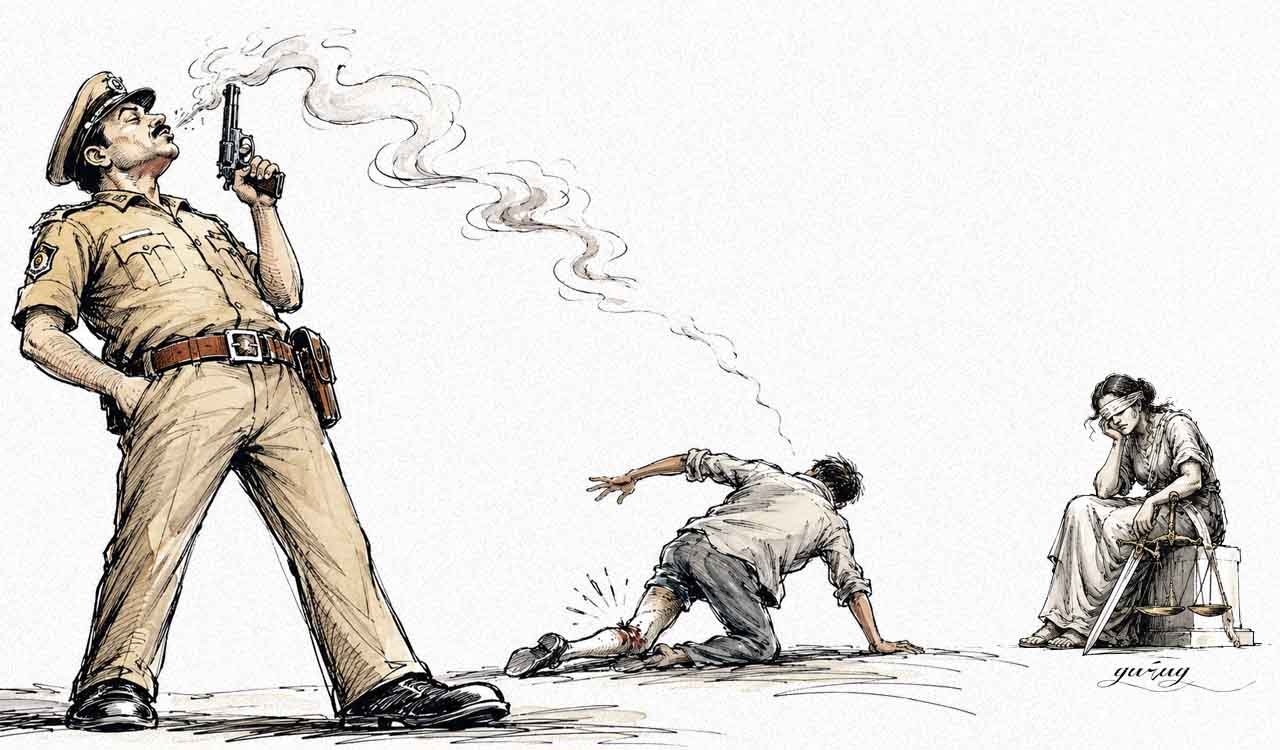
Uttar Pradesh has transformed encounters from exceptional events into a routine administrative practice. According to official data, the UP Police recorded more than 16,000 encounter operations between 2017 and 2025, with around 97% resulting in accused persons surviving with bullet injuries to the leg. The State projects this as “shoot-to-disable” rather than “shoot-to-kill,” thereby attempting to create an appearance of legality.
Constitutional Question
But the core constitutional question remains unchanged: under what law can the police punish a citizen before trial?
India’s Constitution does not permit the executive to become judge, jury and executioner. The police may use force only in immediate self-defence or to prevent imminent danger. Punishment can only follow due process, a fair investigation, legal representation, and judicial determination. Even the most dreaded criminal has rights under Article 21.
The Supreme Court, particularly in the People’s Union for Civil Liberties vs State of Maharashtra, has laid down strict guidelines mandating an independent investigation into encounter deaths. The court made it clear that encounters cannot become a substitute for criminal justice. Yet, in States such as UP and Assam, encounters increasingly appear not as unavoidable exceptions but as a political performance of “strong governance.”
Encounter Politics
The attraction of encounter politics is obvious. It is immediate, dramatic, and media-friendly. Court trials take years; an encounter creates instant headlines. It projects decisiveness and masculine authority. For governments seeking electoral advantage through polarisation and fear, this becomes a powerful tool.
In Uttar Pradesh under Yogi Adityanath, encounters have been openly celebrated as proof of “zero tolerance.” Police officers involved in such operations often receive political praise and public glorification. Once promotions, prestige, and political approval become linked to encounter statistics, legality becomes secondary.
The “Operation Langda” doctrine is especially troubling because it attempts to normalise permanent bodily punishment without trial. A bullet to the leg is still state violence outside judicial sanction. Calling it “non-lethal” does not make it constitutional. A democracy cannot allow the police to decide who deserves crippling injuries.
Assam Case
The pattern in Assam under Himanta Biswa Sarma also deserves scrutiny. Since 2021, Assam has witnessed multiple police encounters in which many of the accused killed or injured have reportedly been Muslims. Official figures placed before the Assam Assembly indicate the scale of the phenomenon.
The State government informed the House that between May 2021 and November 2025, 80 people died either in police encounters or in police custody, while at least 223 others sustained injuries during police firing and encounter-related operations. The number of injuries peaked at 79 in 2022 alone, following 67 in 2021.
A petition before the Supreme Court cited 171 alleged encounter incidents in Assam since May 2021 involving deaths and injuries. In 2025, the Supreme Court directed the Assam Human Rights Commission to examine the allegations and invite evidence from victims and their families, reflecting judicial concern over the pattern of police actions.
The repeated projection of Muslims as criminals in cases involving drugs, cattle trade, robbery, and violent crime gradually manufactures a public perception that criminality itself has a religious identity
The recent case involving the Muslim youth accused of killing a Hindu man during a personal relationship dispute demonstrates how rapidly criminal incidents are being communalised. What appears, from available reports, to be a violent crime emerging from a relationship conflict was quickly reframed in sections of the media as “love jihad.” Such framing serves a political purpose: it transforms an individual crime into a civilisational narrative of Hindu victimhood and Muslim aggression.
Deeply Dangerous
This is where encounter politics becomes deeply dangerous. The police action no longer appears merely about crime control; it begins feeding majoritarian anxieties useful during elections. The repeated projection of Muslims as criminals — whether in cases involving drugs, cattle trade, robbery or violent crime — gradually manufactures a public perception that criminality itself has a religious identity.
Statistics alone cannot prove communal intent. But patterns of representation, media amplification, political rhetoric, and selective targeting together create a climate where suspicion naturally arises.
Several incidents have attracted particular controversy. In July 2021, for instance, 28-year-old Safiqul Islam died after police claimed he attempted to escape custody in Nagaon district.
Similar questions were raised in cases involving alleged cattle smugglers, robbery suspects, and drug accused, where police accounts frequently described attempts to flee or snatch weapons.
Instead of questioning police narratives, many television channels amplify them uncritically.
Encounter stories are packaged like action films. Accused persons are declared guilty before trial. Terms like “love jihad,” “jihadi mindset” or “anti-national” are casually inserted even before investigations conclude.
The normalisation of extra-judicial violence also affects ordinary policing. Once shortcuts are glorified, the quality of investigation deteriorates. Why build scientific forensic systems or strengthen prosecution if public applause can be won through bullets?
Many citizens initially support encounters because they are frustrated with slow courts, corruption, and rising crime. But history shows that extraordinary powers rarely remain limited to “dangerous criminals.” Once legality weakens, anyone can become vulnerable — political dissidents, minorities, protestors, activists or ordinary citizens.
The Assam government’s own figures show that encounter-related injuries and deaths are not isolated occurrences but part of a sustained policing pattern. When a democratic government begins to measure success through encounter statistics rather than conviction rates, forensic capacity or judicial efficiency, the danger is not merely to individual suspects but to the rule of law itself.
Democracy survives not because the state is powerful, but because state power is restrained by law. The response cannot remain limited to outrage after each encounter. Democratic resistance requires sustained institutional work.
Progressive voices must refuse attempts to communalise ordinary crimes. Murder, assault or drug trafficking are criminal acts — not proof of collective guilt of any religion. Courts must act faster in encounter cases. Delayed justice indirectly encourages impunity. Simultaneously, criminal justice reforms are needed so that citizens do not begin seeing extrajudicial violence as a substitute for justice.
The real test of democracy is not how it treats the innocent, but how it treats the accused. A state that bypasses courts in the name of efficiency may appear powerful for a while, but eventually it weakens the rule of law itself. Encounter culture may deliver political dividends and television spectacle, but it carries a heavy long-term cost: the gradual transformation of constitutional democracy into rule by executive force.
(The author is a senior journalist from Assam)

Related News
-

Allahabad HC orders reports from UP, Jaipur Police over accused’s encounter
-
Encounter in Patna: 62 rounds fired between police and extortion gang at Son River
-
Key accused in Baruipur rape-murder case killed in police encounter
-
Baruipur rape-murder case: Accused Pravas Mondal killed in encounter; victim’s father thanks CM Suvendu Adhikari