Opinion: Focus on water economy
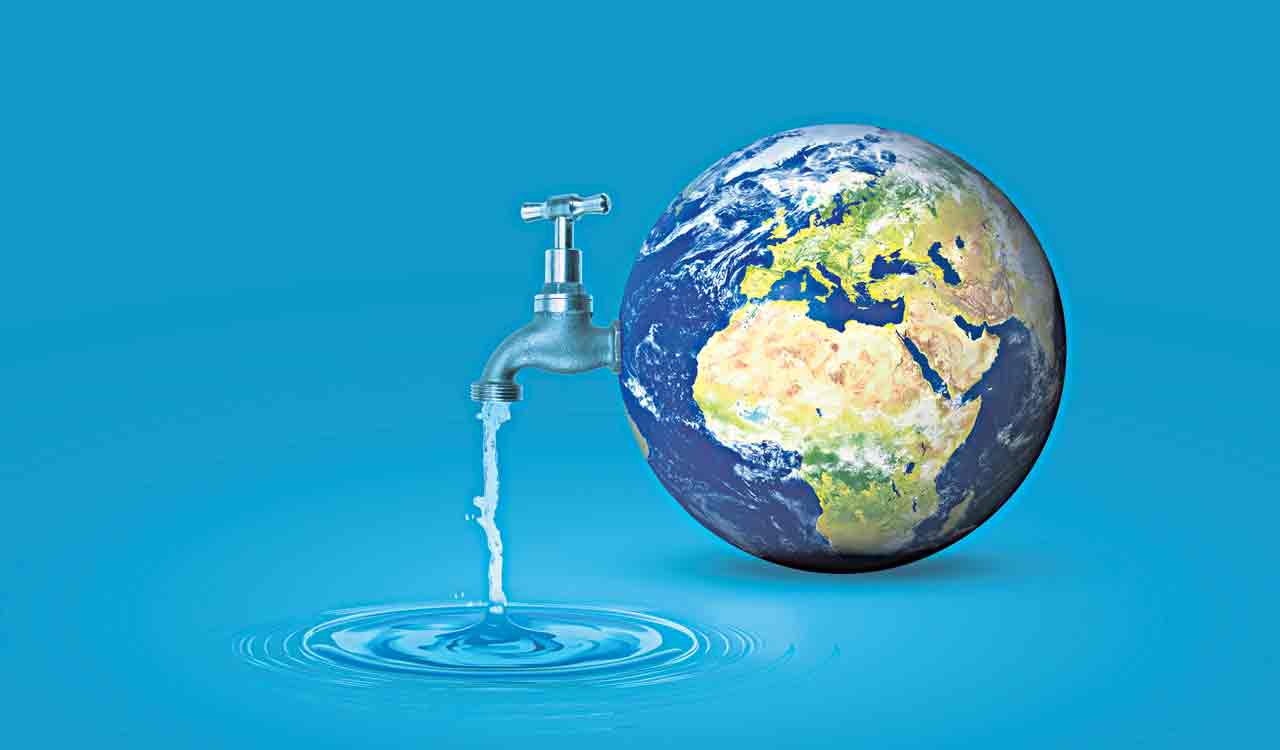
India ranks 120th in water quality out of 122 countries, which shows the urgent need for water management


By Nripendra Abhishek Nrip
Hyderabad: It is estimated that by 2050 one-fourth of the world’s population will probably live in countries with severe and frequent water shortages. Since 1990, 2.5 billion people have had access to better drinking water, but 663 million people are still deprived of it. Between 1990 and 2015, the proportion of the world’s population using an improved source of drinking water increased from 76% to 91%, yet about 1,000 children die every day from diarrhoeal diseases associated with water and sanitation.
The annual rainfall in India is 3,880 billion cubic metres, while only 720 billion cubic metres is used. The rest of the water goes into oceans and rivers. The demand for water supply in India is 843 BCM which will increase to 1,180 BCM by 2050. In such a situation, India has to pay attention to water conservation.
A NITI Aayog report says 75% of the households in India are yet to be connected to a pipeline. Not only this, India’s rank in water quality index is 120th out of 122 countries – with nearly 70% of water being contaminated, which shows how acute the problem of water management is. With 4% of the world’s drinking water, India is among the top 10 countries in water growth. Being an agrarian country, 79% of water is used only for irrigation. There is a need to manage water in such a way that more can be produced with less water. For this, technology can be used.
Waste from Industries
If anything has caused the most damage to the water source, it is increasing water pollution. Though the government has made some efforts to prevent pollution in the rivers, these are not showing any significant results. Sewers were installed for this. Zero discharge was tried in industries so that the waste does not pollute the rivers. In 2017, the National River Conservation Plan said even after these efforts, the river Ganga has become negligibly clean.
According to Central Pollution Control Board data, where Ganga was clean only at 1 point of the 36 before the lockdown, cleanliness was seen at 27 points during the lockdown. It is thus clear that the main cause of filth in rivers is the waste from industries. This is where work needs to be done. For this, we can learn from the Rhine River in Germany.
Poor Sanitation
The overall proportion of households with access to better water sources in India increased from 68% in 1992-93 to 90.6% in 2011-12. Yet in 2012, 59% of rural households and 8% of urban households did not have access to better sanitation facilities. About 600 million people in India defecate in the open which is the highest in the world. The Water Aid India 2018 study shows that around 57.8 lakh toilets built in rural areas were designed incorrectly. These toilets had only one pit or their safety tank design was wrong.
According to data collected by the Centre for Science and Environment in 2018, about 4,077 tonnes of defecation is being dumped in the open near homes. The study was conducted in areas without sewer lines connected to toilets. Two pits have been made, but either the groundwater surface is low or there is a possibility of waterlogging. Not only this, the sewage sludge deposited in the septic tank or pit was being used by farmers as manure in their fields without being treated. As a result, it posed a threat to the health of the people around.
The UN Sustainable Development Goal 6 aims to provide universal and equitable access to safe and affordable drinking water for all by 2030. In addition, by 2030, it aims to greatly promote the economical use of water in all regions and ensure sustainable extraction and supply of fresh water to end water scarcity. By 2030, it also aims to expand the scope of international cooperation and capacity-building to developing countries in activities and programmes related to water and sanitation, including water harvesting, water salinity, water economy, wastewater treatment, recycling and reuse technologies.
The Centre for Science and Environment has given suggestions for safe sanitation and a secure future. These involve providing sanitation facilities at more and more toilet sites and promoting the treatment of sewage and reuse of faecal waste. Financial investment and adequate funds will have to be ensured for sewage management and treatment. Cheap and centralised technology at the local level can be used.
It is also necessary to ensure that sewage from open drains in the heart of the city is treated with bioremediation technology. When it comes to rivers, the environmental flow should be made mandatory in all parts of a river. Cities should reduce their use of water and pay for it. Water conservation technology should be made cheaper and recharge zones be conserved. Strict rules must be implemented to take action against industrial units polluting rivers while encouraging pollution control techniques.
Irrigation Needs
Water management is essential for the bright future of a big country like India. In a country where 78% of water is used in agriculture, we need to go for water management in a big way. For this, we have to pay attention to drip irrigation first as it saves water. As the water is dripped, drop by drop near the roots of the plants, the amount exactly required by the plants is given to them. With the help of this technique, fertilizers are also given along with water.
Water is a limitless natural resource on earth which is created by recycling. But fresh and potable water is our prime need which should be saved for our safe and healthy life. Only the man who has come out of the scorching sun of a desert can tell the real value of water. Therefore, water conservation has to be understood by all individuals. People have started understanding the value of water since it is now sold in bottles.

Related News