Opinion: Spotlight back on millets
With low investment in production, this superfood also proves to be a sustainable and viable income source for small farmers


By Tej Singh Kardam
Hyderabad: A study by the National Academy of Sciences shows that the common millet (Panicum miliaceum) appeared as a staple crop in northern China about 10,000 years ago, suggesting that it might have been domesticated independently in this area and later spread to Russia, India, the Middle East and Europe. In India, in the Yajurveda texts, millets have been mentioned identifying as – priyangava (foxtail millet), aanava (Barnyard millet) and shyaamaka (black finger millet), thus indicating that their consumption was common pre-dating to Indian Bronze Age.
Millets also find mention in Shrimad-Bhagwat, in Krishna-Sudama meeting, where on return from Dwarka, Sudama found his home fascinating and he mentioned that earlier it was difficult for him to even afford grains like Kodo and Sanwa (Barnyard millet) but now have all kinds of delicacies.
Prioritising Millets
Millets are important crops in the semi-arid tropics of Asia and Africa, especially India, Mali, and Niger, with developing countries accounting for 97% of the production. The government of India has been prioritising millets for their potential to generate livelihood, increase farmers’ income and ensure food and nutritional security. In 2018, millets were rebranded as ‘Nutri-cereals’ and the year was declared as National Year of Millets to raise awareness about its health benefits and boost production.
The United Nations General Assembly in 2021, with the initiative by the government of India and supported by more than 70 countries, declared 2023 the International Year of Millets (IYM). The IYM 2023 aims to contribute to the UN 2030 Agenda for Sustainable Development, especially SDG2 – Zero-Hunger, etc.
Decline in Production
Millets have been a part of the Indian food basket for hundreds of years, deeply ingrained in our food systems, culture and traditions. But their presence has reduced significantly over the years due to various reasons. Socioeconomic dynamics resulting from hardy nature of crop relegated them to be grains of the poor. They could grow without much inputs and even in the worst lands, as a result, they were looked down upon. In Madhya Pradesh until early 2000s, there was a slogan, ‘Kodo, Kutki hatao, Soybean lagao’. All these factors led to a decline in millets production and usage, and it became ‘Bhoole Bisre Anaaj’ (long forgotten grains).
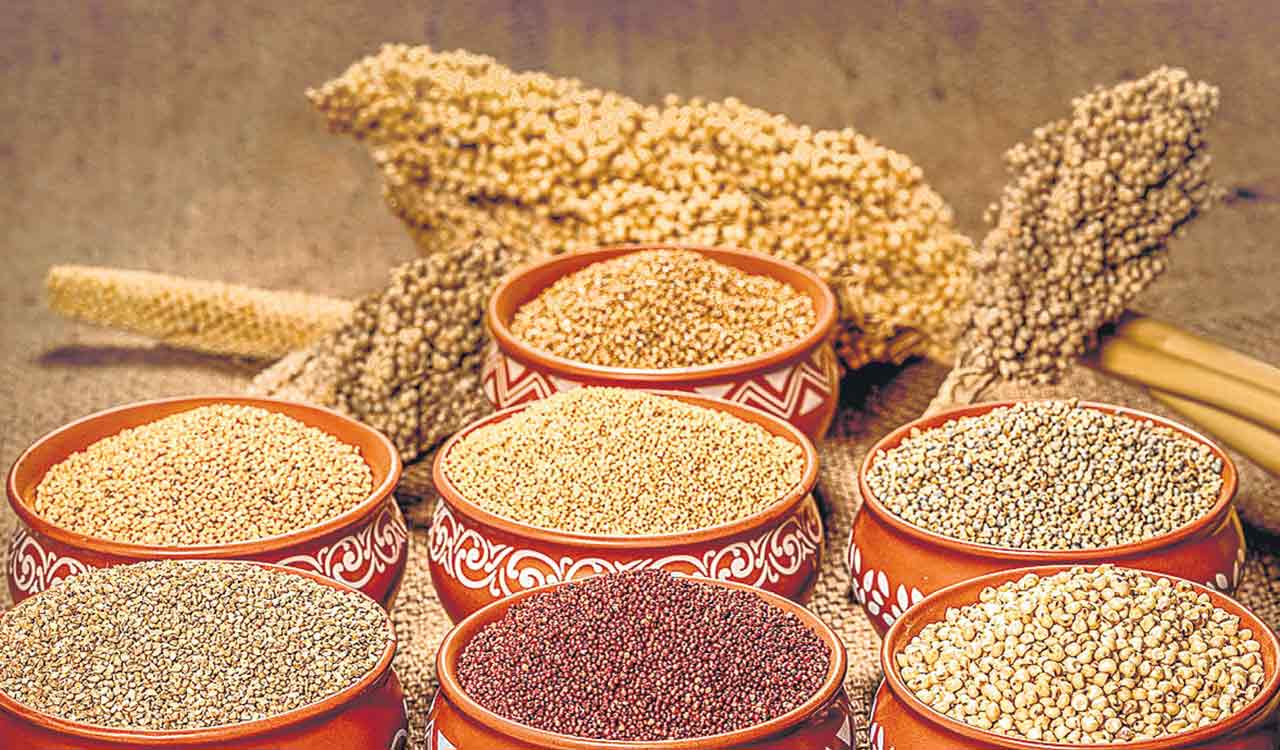
There are two broad categories of millets: major (Bajra – pearl millet, Jowar – sorghum, Ragi/Mandua – finger millet and foxtail –kangani/kakun) and minor (Sanwa-Barnyard millet, Kodo, Cheena-Proso millet, little millet – kutki). India is the largest producer of millets in the world with an annual production of around 17.90 million tonnes in 2020-21, followed by Niger, Mali, Ethiopia and Senegal.
The major millets producing States in India are Rajasthan, Uttar Pradesh, Haryana, Gujarat, Madhya Pradesh, Maharashtra, Karnataka, Tamil Nadu, Andhra Pradesh and Telangana. These States account for the maximum millet production. Rajasthan, UP, and Haryana account for more than 81% of the total production, whereas Rajasthan accounts for half of the total millet production in India. Bajra and Jowar contribute the largest share to total millet production in India.
Mission Mode
Odisha, TN, Assam, Chhattisgarh, Telangana, Jharkhand and AP are in Millet Mission Mode. Odisha Millet Mission is the best model, setting an example at the national level. Chhattisgarh launched its millet mission in 2021 to become India’s millet hub by 2023. Telangana is also making good efforts in popularising millets in the State to eliminate hunger under the decentralised Millet Village Circular Economic Model.
Millets are resilient to climate change as they are pest-free, adapted to a wide range of temperatures and moisture regimes, and demand less inputs. There is an old Indian saying, highlighting the climate resilience of millets, ‘Sanwa Saathi Saath Din, Barkha Barse Raat Din’ — even if it rains day and night, ‘Sanwa’ (Bernyard millet) and ‘Saathi’ (a variety of rice) will grow in 60 days. These crops actually require minimum rainfall for their growth and can even sustain in drought-prone areas.
As low investment is required in the production of millets, they prove to be a sustainable and viable income source for small and marginal farmers. Millets are known to be the storehouse of nutrition as they are a good source of calcium, zinc, magnesium, phosphorus, copper, vitamins, iron, micronutrients, and antioxidants, and provide protection against chronic diseases. The promotion of millets is now considered an effective strategy for tackling malnutrition in the country.
In India, over the years, the production of millets has increased from 14.5 mt in 2015-16 to 17.9 mt in 2020-21 (Department of Agricultural). The Centre launched POSHAN 2.0 in 2021 to tackle malnutrition and popularise the incorporation of millets in the local recipe to enhance the quality of supplementary nutrition. Millets are being incorporated into supplementary nutrition in Odisha, Telangana and Chhattisgarh among others.
Millets will help to overcome issues like water scarcity, desertification, global warming and managing carbon footprints. Millets are rich in fibre contents, and consumption of dietary fibre lowers the absorption of glucose maintaining blood glucose levels and is thus useful in non-insulin-dependent diabetes. Further fibres also bind cholesterol, thus protecting from heart disease.
There are two real problems – decline in area under millet cultivation and low productivity of millets. Over the last decade, production of Jowar has fallen and Bajra too has also stagnated. So is the case of Ragi. Increasing the production of millets and reducing the decline in the area requires multiple steps like scientific inputs, financial incentives etc. There is a need to initially target small and marginal farmers having small holdings in dry land plains and hilly areas who are among the poorest households in rural India, for the cultivation of millets. They will come forward, provided they get good returns. The central and State governments should work in tandem and make sufficient efforts to popularise millets and turn them into a revolutionary movement. As the country is entering ‘Azadi Ka Amrit Kaal’, there is a focus on Jan Bhagidari – people’s movement, to bring the spotlight on this ‘superfood’ and for bringing this ancient food to the centre stage.
There is a necessity to bring these forgotten nutri-cereals to the mainstream of production and consumption. Because local production-oriented consumption will not only have health benefits for the citizens but also help in combating and eliminating malnutrition and hunger in the country.


Related News
-

12th BRICS Parliamentary Forum to be inaugurated in Parliament House complex today
-
Harmanpreet Kaur, Deepti Sharma centuries power India to ODI series win over Zimbabwe
-
Bodies left to decompose at Jadcherla hospital mortuary, Laxma Reddy slams government
-
TG SAFE issues improvement notices to 20 sweet manufacturing and retail establishments