Opinion: GST on laptops is a tax on education
In an AI-driven economy, laptops are essential educational tools, not luxury goods. High GST on digital devices weakens India's AI ambitions by limiting access to modern education


By Ghanshyam Sharma
Artificial Intelligence will be the defining force of the next decades — reshaping societies and deciding who dominates the world. To remain relevant, India needs a large workforce that is proficient in AI and has affordable access to the digital tools required to learn and use it. Unfortunately, modern educational tools, such as laptops, mobile phones, and tablets, are 20-40% more expensive in India than in the US.
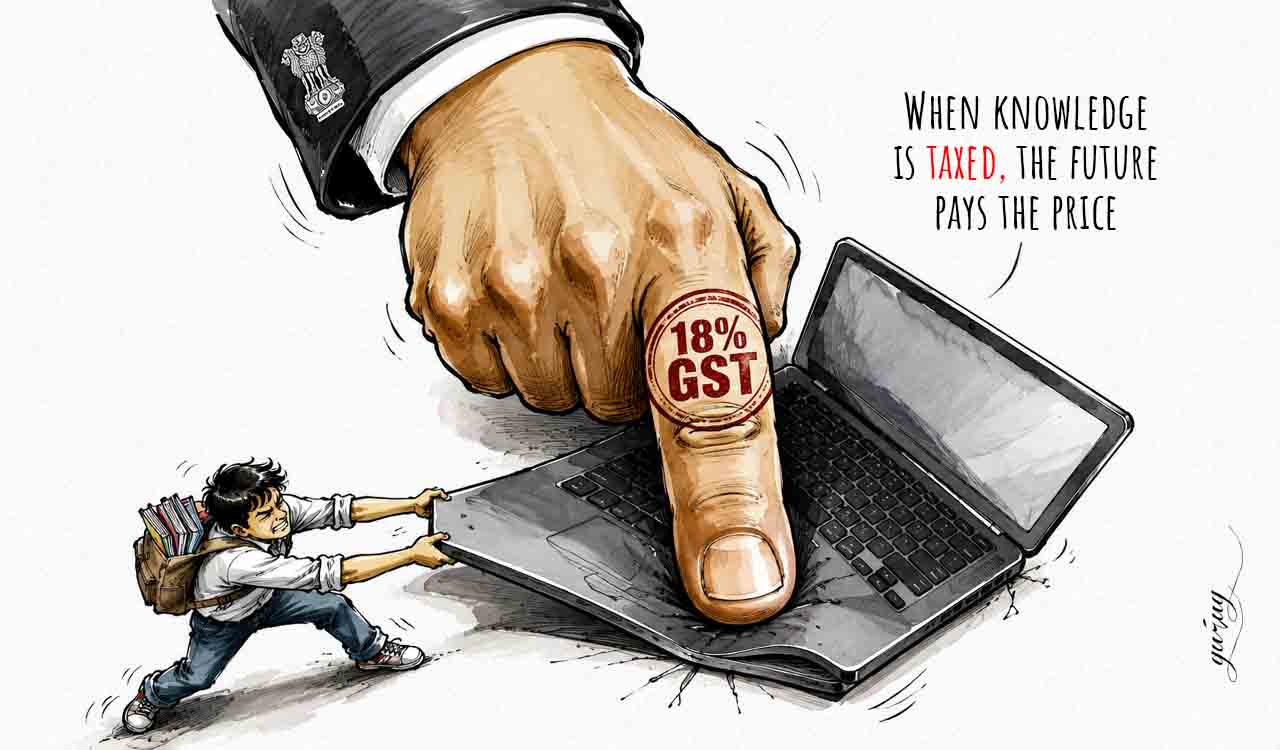
The primary reason why these devices are expensive in India is the 18 per cent GST on such items. For comparison, the US imposes a tax of 0 to 8 per cent on the purchase of laptops or tablets. Canada taxes them at 5 per cent.
Affordability Issue
On a per-capita basis, India is one of the poorest countries in the world. Compared to the US’ GDP per capita of $90,000, India’s GDP per capita is $2,800. If an American has to work roughly 3-4 days to purchase a $1,000 laptop, an average Indian has to work for 6 months to purchase the same laptop. As a result of the income differential, Indians are already at a significant disadvantage.
To make matters worse, an 18 per cent GST creates a significant deterrent for price-sensitive Indian students and young professionals, deepening the affordability gap. A laptop is generally out of reach for most Indians. However, an 18 per cent price escalation, driven by high taxes, kills the digital literacy dreams of those on the margins. Several students are forced to abandon their dreams, while others have to compromise on quality.
The success of the IndiaAI Mission, Digital India, Skill India and StartUp India depends on affordable access to laptops, tablets and smartphones. Rather than focusing only on AI infrastructure, policymakers should prioritise mass digital access to enable millions of students to learn, innovate and participate in the AI economy
While students in rich countries can easily purchase modern educational devices, the Indian state has made these educational devices artificially expensive by imposing high taxes. Salaries of software professionals have stagnated for the last decade and have declined after adjusting for inflation. In the age of big data and AI, these professionals require high-quality laptops to remain competitive.
Terrible Idea
Several reports suggest that India is lagging in the race. Therefore, a tax on modern education devices is a terrible idea for two reasons. First, it’s a tax on the aspirations of young Indian students and professionals. It reduces their competitiveness and productivity. Second, a smaller pool of AI-trained labour force will limit India’s ability as a global player. It will hurt India’s long-term economic growth if sufficient students do not have access to high-quality digital tools.
The Government of India is aware of the critical role that AI can play in the future. Therefore, it launched the IndiaAI mission in March 2024, with a budgetary provision of Rs 10,372 crore. Some of the mission’s objectives include democratising access to AI, building indigenous AI capabilities, and fostering the talent and skills of students and professionals. Besides the IndiaAI mission, the government’s other initiatives include Digital India, Skill India, and StartUp India.
The success of these initiatives depends on widespread access to laptops, mobile phones, and other electronic devices. A high tax on these devices contradicts the government’s objective. Therefore, India’s high taxes on educational devices are surprising because they remove access to educational tools for millions of students and professionals.
Mass Digital Access
A reasonable tax policy is to remove GST on laptops and other educational devices. This could be interpreted as educational support. Rather than designing an AI policy solely through the lens of large compute clusters and institutional grants, the government should also consider mass digital access. A democratised access to laptops and other educational devices will create a wider and more resilient AI ecosystem by enabling millions—not just a few institutions—to learn and participate.
Access to laptops and other educational devices not just improves education and productivity, but also contributes to an inclusive society. Influential studies have indicated that access to social media promotes democratic institutions and reduces corruption.
However, only 50 per cent of Indians have access to the internet, and only 35 per cent use social media. This is partly because electronic devices remain unaffordable.
High taxes on such devices are also regressive. The wealthy households remain unaffected. However, the middle-class and poor households are unable to invest in their children’s education. This will have long-term implications for social mobility and inclusion. In an era where social media trends shape culture and public policy, half of India’s citizens do not have internet access. These groups of citizens are excluded from important conversations.
In the current AI-driven world, laptops are not luxury goods. A tax on a laptop is a tax on education, human capital formation, and inclusive institutions. A forward-looking AI policy should align with the government’s IndiaAI Mission by democratising access to computing hardware rather than making it more expensive. Therefore, the tax on laptops and educational tools should be significantly reduced. While such a policy may result in short-term tax revenue losses, it is likely to generate substantial productivity gains that more than offset these initial losses.

(The author is Associate Professor of Economics, RV University, Bengaluru)

Related News