Opinion: India’s new Labour Codes recognise gig workers but not enforceable rights
The new Labour Codes mark an important legal milestone for gig workers, but key questions over social security, employment status and enforceable protections remain unresolved


Dr Chaitanya Pradeep, Lisa Lalu
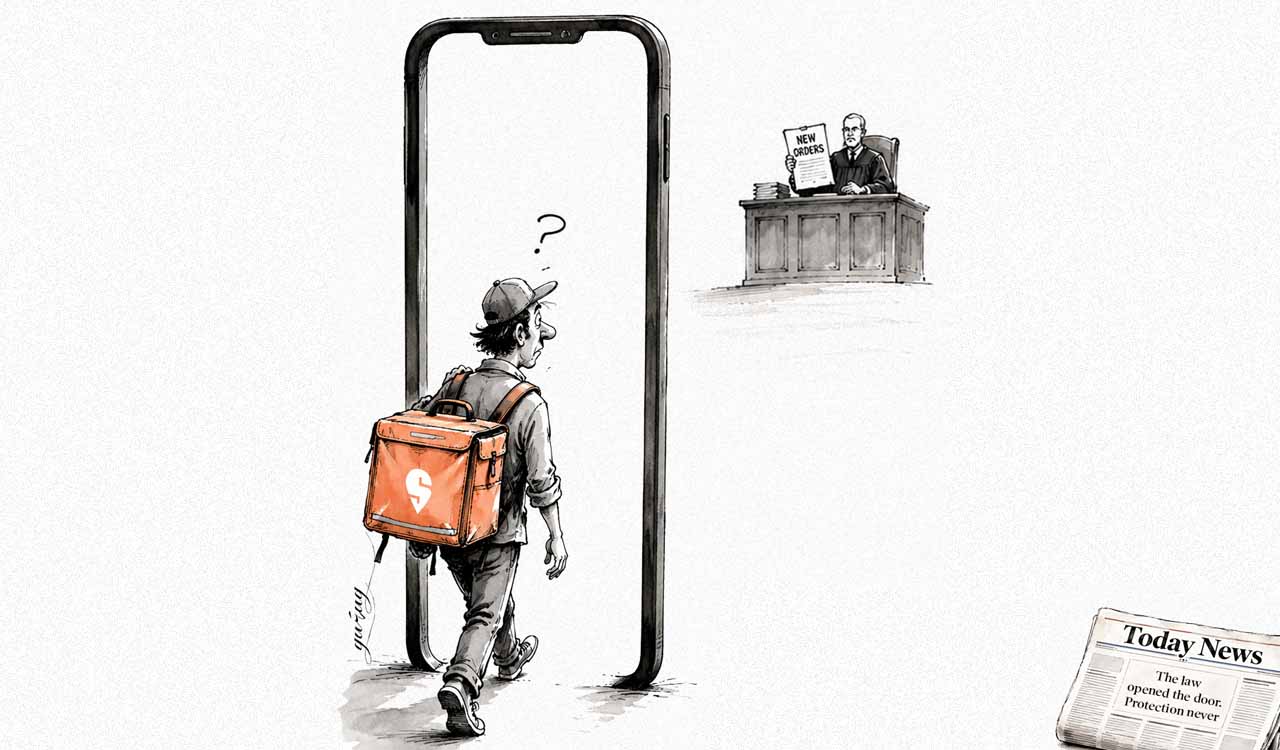
Every morning, a Swiggy delivery partner in Hyderabad unlocks his phone, accepts his first order, and enters a workday that no law fully governs. He is not an employee. He is not a contractor. He is a ‘gig worker’ — a category that India’s new labour architecture has finally named but not yet truly protected.
Also Read
A recent gazette notification by the Union government has directed the full operationalisation of four new labour codes, setting in motion what may be the most significant restructuring of India’s labour framework in decades. For the gig economy’s estimated 7.7 million workers — a number projected to reach 23.3 million by 2030 — this was meant to be a turning point. It is, but not entirely in their favour.
One Worker, Many Definitions
The Code on Social Security defines a “gig worker” as someone who performs work outside a traditional employer-employee relationship — telling us ‘who they are not’ rather than ‘who they are.’ A “platform worker” is further defined as someone who accesses work through an online platform in exchange for payment. The Code clarifies that all platform workers are gig workers, but not vice versa.
This definitional ambiguity is not merely academic. NITI Aayog’s 2022 policy brief treats gig workers as an umbrella term covering both platform and non-platform categories, including freelancers in writing, design, and technology. The law naturally supersedes the policy brief. However, the resulting confusion has already led Karnataka, Bihar, Rajasthan, and Jharkhand to omit the term “gig work” altogether from their State legislation. Telangana, which has drafted its own Bill, must be cautious not to inherit the same ambiguity.
Companies such as Zomato, Swiggy, Uber, Rapido, and Porter are classified under the code as “aggregators” — a term that acknowledges the absence of a traditional employer-employee relationship but also conveniently insulates them from employer-level obligations.
Structurally Excluded
Although the Code defines the organised and unorganised sectors, gig and platform workers are placed in neither. They are a standalone category, classified not by skill, but by the nature of their contract. This single design choice has far-reaching consequences: there are no standardised wage floors, no fixed-term employment rights, and no inclusion in three of the four labour codes. They are, in the words that best describe their situation, included in the law yet structurally excluded from its protections.
States such as Rajasthan, Bihar, Jharkhand, Karnataka, and Telangana have enacted dedicated laws for gig and platform workers, yet ambiguity over the definition of ‘gig work’ continues to undermine legal protection
Some countries have navigated this more decisively. Spain’s Rider’s Law, 2021, granted full employee status to delivery platform workers. Australia’s Fair Work Amendment Act 2024 coined a new term, “employee-like worker”, and ensured minimum standards and protection against unfair deactivation. Malaysia has extended occupational safety and health rights to gig workers as a distinct category. India’s approach, by contrast, creates a new category and then leaves it inadequately protected.
What the Code Pro‘mises’
Section 144 (6) of the Code on Social Security explicitly states that the National Social Security Board and the State Unorganised Workers’ Board constituted under Section 6 (1) shall ‘also’ work for the welfare of gig and platform workers, but this provision remains advisory in nature.
Section 109 (1) and (2) of Chapter IX mandates the Union and State governments to frame welfare schemes covering life and disability insurance, accident insurance, health and maternity benefits, old-age protection, and crèche facilities. Yet, the exact bare operative phrase in Section 114 (1) is “the Central government ‘may’ frame and notify, from time to time, suitable social security schemes…” which stands in stark contrast to Section 109 (1), making these protections entirely discretionary, rather than mandatory.
Further, the operational blueprints outlined in Section 114 (2) offer a clear administrative framework, but the policy catch here is that it will carry legal weight only after the government decides to execute its powers under Section 114 (1).
Section 114 (4) sets the aggregator’s statutory liability towards the Social Security Fund, in which the aggregator must contribute 1% to 2% of their annual turnover (not exceeding 5% of total payouts to workers). This appears robust until one considers that the Code provides no safeguard against aggregators passing these costs on by simply reducing workers’ earnings. In practice, the welfare burden may simply shift downwards.
Further, eligibility itself is conditional. A gig worker must earn income for more than 90 days with a single aggregator or more than 120 days across multiple aggregators. Only days on which actual earnings are made count; merely being logged in and waiting for work does not. Workers whose earnings are algorithmically determined, whose ratings are opaque, and who have no dispute redressal mechanism to challenge either may find themselves excluded from benefits by the very system they power.
The Road Ahead
Recognition without an enforcement architecture is symbolism. Realising this, States such as Rajasthan, Bihar, Jharkhand, Karnataka, and now Telangana — through the Telangana Platform-Based Gig Workers (Registration, Social Security and Welfare) Act, 2026 — have exercised their concurrent legislative powers to enact dedicated laws for gig and platform workers, supported by a tripartite governance model. Yet, these State laws continue to carry the same ambiguity surrounding the term ‘gig work.’
What is needed across the country is clear: a mandatory welfare scheme with operational flexibility among students and part-time gig workers as well as full-time gig workers; greater algorithmic transparency from aggregators; an effective dispute redressal mechanism; mapping of job roles to skill levels; and formal employment status, as Spain has demonstrated, for workers whose labour is not incidental but essential.
The gig economy is not a ‘margin’ of India’s labour market. It is increasingly its centre. The law must catch up before the workers driving this growth once again find themselves waiting for an order that never arrives.

(Dr Chaitanya Pradeep is Assistant Professor, Centre for Public Policy, Governance and Performance, Administrative Staff College of India, Hyderabad. Lisa Lalu is research intern and student of MA Public Policy, TISS, Hyderabad)

Related News
-

Opinion: Politics of India-US trade ties — can strategic convergence survive economic friction?
-
Opinion: Uncounted and Unprotected — India’s seasonal migrants and Digital Census
-
Opinion: Poverty has no caste—the unspoken story of India’s Brahmins
-
Opinion: India’s undersea cable security gap—what China got right