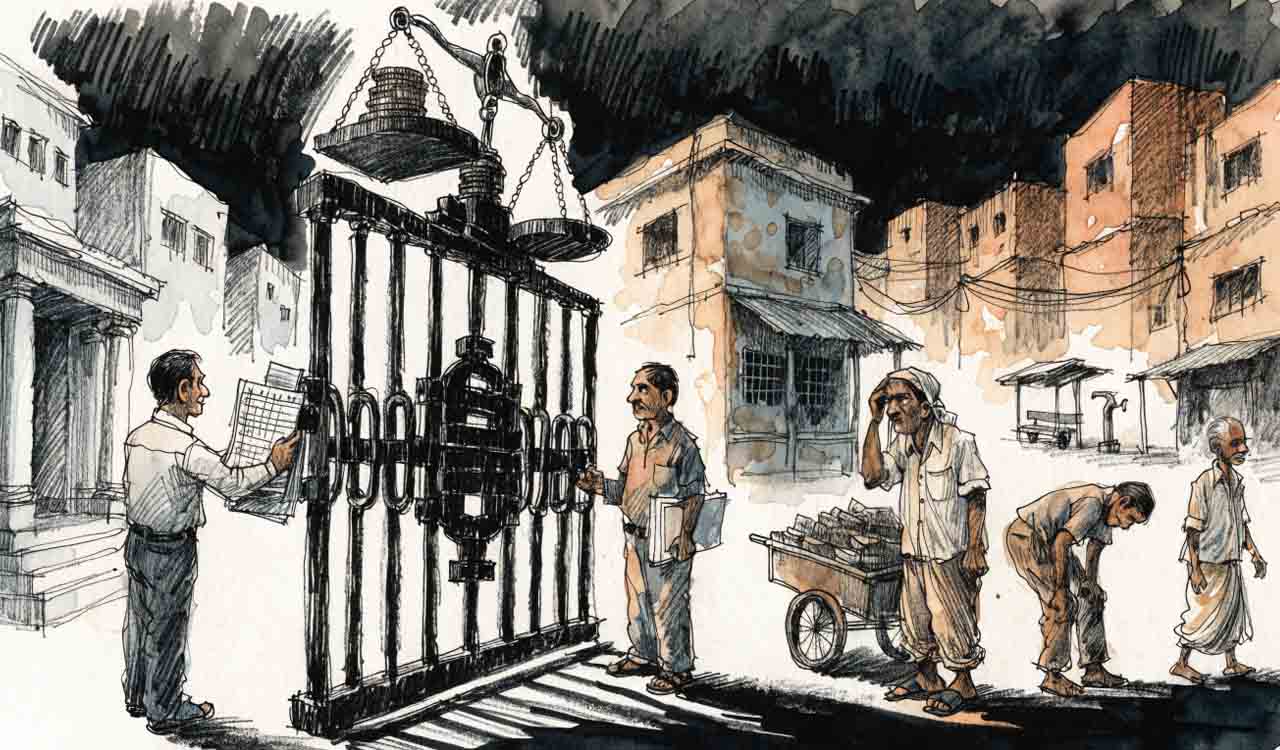
Opinion: 7-point agenda for CJP — the bigger battle for future of India’s youth
Cockroach Janta Party must broaden its mission beyond examination integrity to address education and employment challenges



By T Muralidharan
The resignation of a Union Minister following sustained student protests is much more than a political event. It demonstrates that peaceful, organised youth movements can influence public policy. Perhaps the most inspiring statement came from one of the movement’s leaders: “Don’t make a hero out of me.” Democracies are strengthened not by heroes but by ideas and institutions.
Also Read
The Cockroach Janta Party (CJP) has won its first battle. The greater challenge now is whether it can evolve from a protest movement into India’s most respected youth policy movement. History shows that movements lose direction when they become partisan or rush into electoral politics. The CJP should remain independent, evidence-based, and focused on reforms that improve the lives of students.
3 Cities, 3 Disciplines, 1 Purpose
The three young faces who emerged at the forefront of the movement came from completely different worlds. Abhijeet Dipke studied journalism and public relations and built a career in political communications, including higher studies in Boston. Saurav Das pursued journalism and investigative reporting, focusing on governance and public accountability. Ashutosh Ranka graduated from IIT Kanpur, later specialised in public policy at the London School of Economics, and worked in global management consulting.
They did not grow up in the same city. They did not attend the same school or college. They did not build careers in the same profession. There was no traditional institutional network connecting them. Yet, when a national issue touched millions of students, they found one another, combined their complementary strengths, and transformed public anger into an organised, disciplined, and evidence-based movement.
Equally significant is what they represent. None of them is a doctor, even though they led a movement centred on medical admissions. Their collective expertise lay in communication, journalism, engineering, public policy, and strategy—skills that proved just as critical in influencing national debate. This may well be the new face of India’s Generation Z leadership.
Exam Integrity to Opportunity
The NEET agitation highlighted examination integrity. The next phase must focus on opportunity. Millions of young Indians are not defeated by examinations; they are defeated by the shortage of affordable, high-quality educational opportunities and the growing mismatch between education costs and employment outcomes.
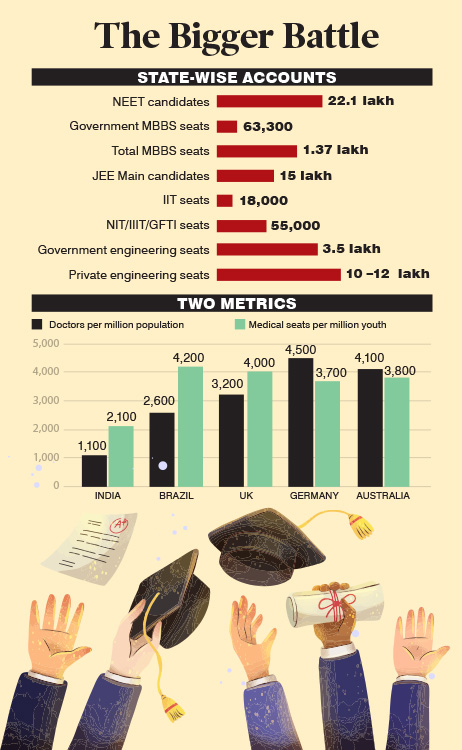
India’s largest youth constituency is not the students who obtain subsidised government seats—it is the much larger group that does not. Every year over 22 lakh students write NEET while only a small fraction obtain government MBBS seats. In engineering too, more than one million aspirants eventually depend on private colleges. The challenge today is therefore not merely capacity—it is affordable access to quality education.
Reform 1: Doubling of medical seats
The first reform must be expansion of medical education. India continues to compare doctors per million population with other countries. That benchmark measures healthcare availability after graduation. It does not measure educational opportunity. A second metric is required—medical seats per million youth (18–22 years), because young people, not the entire population, compete for these seats. India should adopt a national mission to double medical education capacity over the next decade while maintaining quality standards.
Reform 2 : Affordability
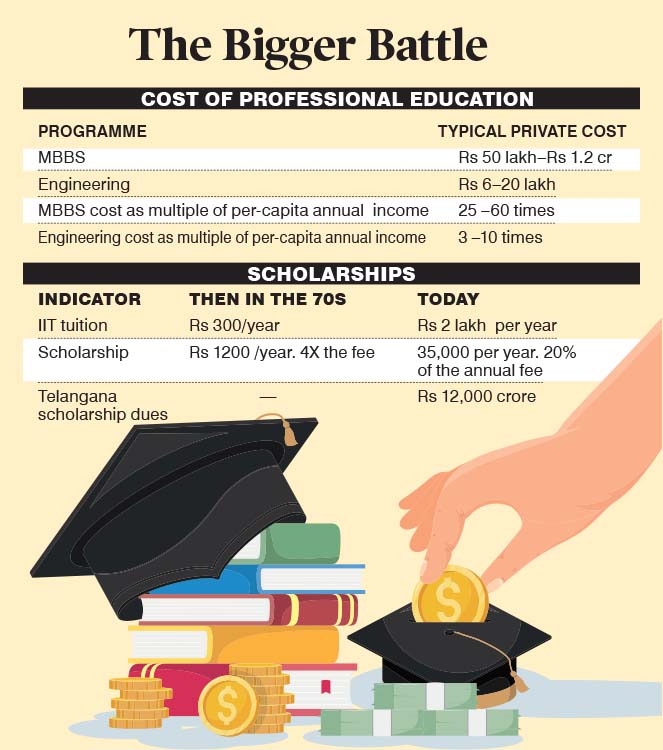
The second battle is affordability. Admission without affordability is not access. Private MBBS course can cost Rs 50 lakh to over Rs 1 crore, while engineering in private colleges often costs between Rs 6 and Rs 20 lakh. AI-enabled learning, simulation laboratories, and personalised learning can significantly reduce education costs. According to a study, engineering education can be reduced by 30% and medical by 20% after AI and edutech adoption.
Reform 3 : Scholarship and timely payment
When I joined IIT in 1974, my Government of India scholarship of Rs 100 per month exceeded my IIT tuition fee of Rs 25 per month. Today, many lower-middle-class families receive little meaningful support while facing dramatically higher education costs.
Andhra Pradesh and Telangana were among the progressive governments that introduced fee reimbursement schemes in 2009. However, the fee reimbursed per student per year is only Rs 35,000. Moreover, the Telangana government has accumulated over Rs 12,000 crore in pending dues since 2021, causing severe hardship and embarrassment to students and their parents. The scholarship amount should be increased to Rs 70,000 per year, and reimbursements must be released on time.
Reform 4: Education loans
Existing guaranteed education loans are helpful but inadequate compared with today’s cost of professional education. Collateral-free loans are difficult to obtain.
Reform 5 : Jobs after graduation
The fifth battle begins after graduation. Investment-led growth alone cannot satisfy the aspirations of youth. Over 6 million graduates pass out every year, and we are not even creating 1 million graduate jobs. In my estimate, over 25 to 40 million graduates are not working. Employment creation must become a national emergency. Prioritising investment in job-creating service sectors is far more important than pursuing mega projects that may boost GDP figures but create limited annual employment opportunities.
Reform 6 : Wages in the first job
Entry-level professional wages have remained largely stagnant while education costs have multiplied. This creates a very long payback period for many, especially those graduating from high-fee private colleges. The result is increasing financial pressure on families and delayed social mobility.
Seven-point Youth Charter
- Double India’s medical education capacity
- Reduce professional education costs by 50% using AI and technology
- Double scholarship amount
- Ensure timely scholarship and fee reimbursement payments
- Provide government-guaranteed education loans up to Rs 25 lakh
- Adopt employment-led growth as a national emergency
- Create a national framework for fair entry-level professional wages
If the CJP broadens its mission from examination integrity to the seven agendas, it will represent not merely those who protested but millions of young Indians and their parents seeking a fair chance to build a better future. History remembers movements not only for what they opposed, but for what they built.
(The author is founder, TMI Group)

Related News