Opinion: India’s new labour codes prioritise capital over labour
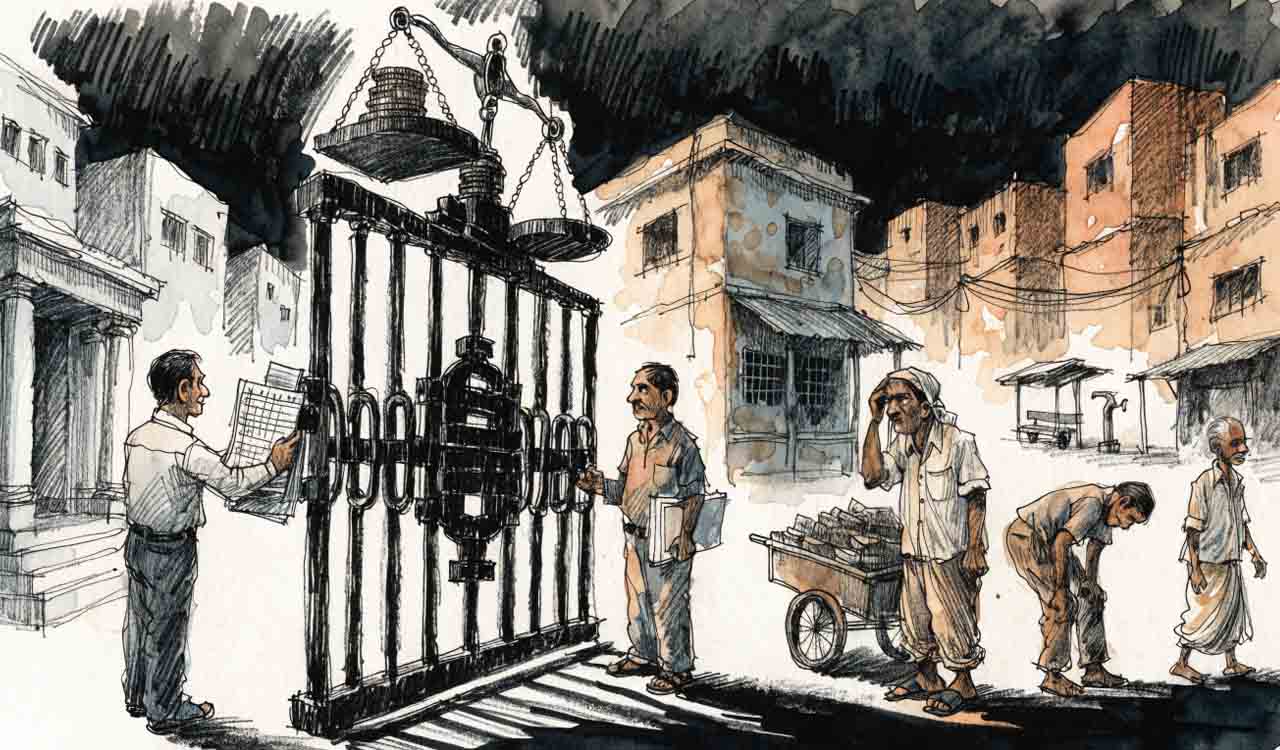
India’s new labour codes promise simplification and economic growth, but gaps in implementation, diluted worker protections and increasing centralisation raise serious concerns



By Vijay Korra
India’s labour landscape entered a transformative era on November 21, 2025, when the government implemented four new labour codes, consolidating 29 outdated central laws into a unified framework. Aimed at boosting economic growth through ease of doing business, these codes — the Code on Wages (2019), Industrial Relations Code (2020), Code on Social Security (2020), and Occupational Safety, Health, and Working Conditions Code (2020) — promise simplification, inclusivity, and flexibility.
Yet, as of January 2026, with only a handful of States, such as Gujarat, Arunachal Pradesh, and Bihar, having finalised rules, their rollout reveals a pattern of prioritising corporate agility over worker protections.
Simplification Vs Centralisation
The codes’ central rationale is consolidation: merging fragmented laws to reduce compliance burdens and foster investment. Proponents argue this addresses India’s rigid labour regime, which allegedly stifles growth by keeping firms small to evade regulations. For instance, a single registration for multisector establishments under the Occupational Safety Code streamlines operations, potentially lowering administrative costs by up to 30%, according to industry estimates. Gender inclusivity is another touted win, with explicit equal pay provisions extended to transgender persons and relaxed night-shift rules for women, backed by State safety mandates.
Without stronger safeguards, these reforms risk deepening inequality, weakening labour rights and increasing precarity for vast informal workforce
Logically, however, simplification masks centralisation of power. Key provisions, such as funding for social security schemes, are deferred to future executive rules, granting the Centre disproportionate control over what should be collaborative federal matters. This deferral creates uncertainty. As of early 2026, draft rules for industrial relations remain under consultation, delaying uniform implementation. Evidence from past reforms, such as the 2016 GST rollout, shows that such ambiguities lead to uneven enforcement, disproportionately affecting smaller States with limited resources.
Moreover, while the codes claim to cover unorganised workers — 93% of the workforce — their reliance on Aadhaar-linked registration excludes millions of migrants without documentation, violating constitutional equity principles highlighted in Supreme Court precedents on privacy and access. Thus, the promise of efficiency falters when it ignores ground realities, potentially informalising labour further rather than formalising it.
Uniformity Without Uplift
The Code on Wages introduces a national floor wage, a uniform definition of “wages” (basic pay plus dearness allowance, capped at 50% of remuneration), and mandates equal pay across genders. This replaces four outdated laws, aiming to curb disparities where States like Kerala pay triple the minimum wage of Bihar. It also extends protections to gig workers, requiring aggregators to contribute 1–2% of turnover to social funds.
Such measures could bridge India’s wage gap, where the bottom 50% earns just 13% of national income, according to the World Inequality Database. Critically, however, the floor wage lacks ambition — it is not mandatory for States to revise upwards, perpetuating interstate inequities. The complex wage formula invites litigation, as allowances exceeding 50% are clawed back, potentially reducing take-home pay for low-wage earners. Enforcement shifts from labour courts to administrative facilitators, weakening judicial recourse; workers, often unrepresented, face stigma in approaching these bodies.
Empirical proof lies in pre-code data: only 30% of minimum wage violations were addressed judicially in 2019, according to Labour Bureau statistics. Post-implementation, without stronger penalties, this could worsen, as decriminalisation of minor offences favours employers with fines over accountability. Equality provisions ring hollow without addressing structural biases. For women, who form 25% of the workforce but earn 20% less, relaxed night shifts expose them to unmonitored risks in a country with rising workplace harassment cases (up 15% in 2024, NCRB data). Thus, the code’s uniformity risks entrenching poverty wages rather than elevating them.
Flexibility’s Double-Edged Sword
The Industrial Relations Code raises the retrenchment threshold from 100 to 300 workers, eliminating the need for government permission for layoffs in smaller firms, and mandates longer strike notices while banning strikes during arbitration proceedings. It introduces fixed-term contracts with benefit parity but no renewal guarantees, and a Reskilling Fund (15 days’ wages per laid-off worker).
Proponents claim this flexibility will spur job creation, citing how rigid laws kept 85% of firms under 100 employees, according to the Economic Survey 2024. Yet, this amplifies job insecurity in a nation with 7% unemployment and 45% informal employment (ILO 2025 report). The threshold hike affects medium enterprises, home to most organised workers, enabling easier closures without oversight. Strike curbs undermine bargaining in a low-union-density context — only 10% of private-sector workers are unionised — tilting power toward employers.
Evidence from comparable nations such as Bangladesh, where flexible laws boosted garment exports but led to 1,100 worker deaths in the 2013 Rana Plaza collapse, shows growth does not equate to welfare. Fixed-term roles bypass protections, fostering a “hire-and-fire” culture. Post-Covid, such contracts surged 20%, correlating with rising gig precarity (CMIE data). The Reskilling Fund, while innovative, is underfunded, with no clear allocation mechanism, risking tokenism. Critically, these changes ignore root causes such as skill gaps and infrastructure deficits. Vietnam’s balanced reforms, supported by strong unions, yielded sustainable 6% annual growth without similar dilutions.
Inclusion’s Incomplete Framework
The Social Security and Occupational Safety Codes extend benefits to unorganised and gig workers, mandating portable provident funds, gratuity after one year (down from five), and safety committees in large firms. They recognise platform workers, requiring aggregator contributions, and mandate medical check-ups in hazardous sectors. This addresses gaps in a system covering only 10% of workers pre-reform, potentially reducing poverty among 400 million unorganised labourers.
However, inclusions are superficial. Aadhaar mandates exclude undocumented migrants — 20% of the workforce — echoing Aadhaar-linked welfare exclusions that denied rations to 3 million during the pandemic (Oxfam 2021). Gig workers are classified as non-employees, absolving platforms of full liabilities despite their control over work conditions. Funding ambiguities — deferred to schemes — centralise decisions, risking under-resourcing.
Safety provisions shift to self-certification, diluting oversight in high-risk sectors such as construction, where 67.7% of establishments are unregistered, and accidents claim 48,000 lives annually (NSSO 2024). For women, the absence of anti-harassment measures beyond vague State rules exposes vulnerabilities, contradicting inclusivity goals amid a 28% female labour participation rate.
While the labour codes offer procedural efficiencies, their critical flaws — diluted protections, exclusionary mechanisms, and implementation hurdles — prioritise capital over labour, threatening social stability. To rectify, India must mandate wage uplifts, strengthen union safeguards, and decentralise funding. Without such measures, the reforms may fuel inequality, undermining the very growth they seek to achieve.

(The author is Associate Professor, Centre for Economic and Social Studies [CESS], Hyderabad)

Related News