Opinion: Our failure to stop our destruction
By Pramod K Nayar Imagining a world without humans, a fictional character says: “It’s not the end of the world at all. It’s only the end of us. The world will go on just the same, only we shan’t be in it. I dare say it will get along all right without us.” This would […]


By Pramod K Nayar
Imagining a world without humans, a fictional character says:
“It’s not the end of the world at all. It’s only the end of us. The world will go on just the same, only we shan’t be in it. I dare say it will get along all right without us.”
This would be decades before Alan Weisman writes his thought-experiment, The World Without Us (2007), in which he would practically paraphrase the above quote, but slanted towards an ecological message: ‘Without us, Earth will abide and endure; without her, however, we could not even be’.
The novel, whose 65th anniversary falls in 2022, spoke poignantly of a world emptied of the human race as a result of nuclear war and consequent radiation sickness. Nevil Shute’s On the Beach (1957) is one of the most popular texts in catastrophe fiction. The novel was published a decade after the Hiroshima-Nagasaki bombings, and three years after the Lucky Dragon disaster in which a Japanese trawler was caught in the ash-and-dust fallout from the Bikini nuclear tests.
With a Whimper
Set in Australia, Shute’s novel describes an earth whose entire populations have died from radiation sickness. Australia, at the foot of the world, is the last and final continent, literally, since the air currents blowing across earth bring radiation last to Australia.
“We’d never have been all right,” he said quietly. “Even if they’d been correct about the heavy particles — the radioactive dust — which they weren’t, we’d still have got the lightest particles carried by diffusion. We’ve got them now. The background level of the radiation here, today, is eight or nine times what it was before the war.”
Waiting for the radiation-filled dust to arrive, says Dwight Towers, American captain of the last functioning submarine in the world, ‘is a period of grace’.
The government, such as it is, has issued capsules, for free, for people to swallow and die a painless death rather than from the extremely agonising radiation sickness. People prepare for death, and the recognition that nothing, absolutely nothing can keep the radiation away is a sobering thought that runs through the novel. Many choose where they want to die.
As Towers says: “now that I’ve got used to the idea, I think I’d rather have it this way. We’ve all got to die one day, some sooner and some later. The trouble always has been that you’re never ready, because you don’t know when it’s coming. Well, now we do know, and there’s nothing to be done about it. I kind of like that…”
When the novel ends, Towers takes out the vessel for its last ‘swim’, and is set to sink it in the waters off Australia. Towers, whose family is assuredly dead in the USA, leaves behind the Australian Moira Davidson, who is in love with him. In the last scene, Moira watches the submarine leave.
“She sat there dumbly watching as the low grey shape went forward to the mist on the horizon, holding the bottle on her knee. This was the end of it, the very, very end.”
As the first spasms of radiation sickness arrive in her body, she opens the bottle of poison pills: “Then she put the tablets in her mouth and swallowed them down with a mouthful of brandy, sitting behind the wheel of her big car.”
The ending, minus any survivor fights or heroic stands, reminds one of TS Eliot’s lines in ‘The Hollow Men’:
“This is the way the world ends
Not with a bang, but with a whimper.”
United Towards End
Shute maps a new geography of disaster, and replays the Global North-Global South divide when he depicts the North dying first. Russia, Europe, the USA have been depopulated. The ship from Australia that goes looking for survivors in the USA, finds nothing, no one. But Shute also notes that the divide is absurd, for when radiation spreads, it does not obey geopolitical borders and national boundaries. The larger point, however, is that there is no safe place in the event of a nuclear war/accident.
Shute, envisioning the consequences of nuclear war and globalisation, portrays a world united in the race towards the end. The foot of the world, Australia, New Zealand, Antarctica, may be the last to receive the radiation-laden air from the North, but they would get it all the same. In short, the world is uniformly afflicted, sooner or later.
Under such circumstances, there was no question of the North/South, enemy and friend. Towers ponders over the concerns in the past over ‘security’:
“Security was now a thing of the past though it took a conscious effort to remember it; with no enemy in all the world there was little but the force of habit in it.”
It was the obsession with security and borders that brought the final destruction – borderless – upon all.
Potential History
Photography critic Ariella Azoulay writes: “Potential history refuses to inhabit the position of the historian who arrives after the events are over, that is, after the violence was made into part of the sealed past…”
For Azoulay, “Potential history is a commitment to attend to the potentialities that the institutional forms of imperial violence—borders, nation-states, museums, archives, and laws—try to make obsolete or turn into precious ruins.”
Shute captures the failure of the world to prevent its own destruction. It is not an explanation for Hiroshima-Nagasaki as a ‘sealed past’ but a forward-looking potential history. Shute’s is a novel that implies more than it states directly. It is a novel to read now.
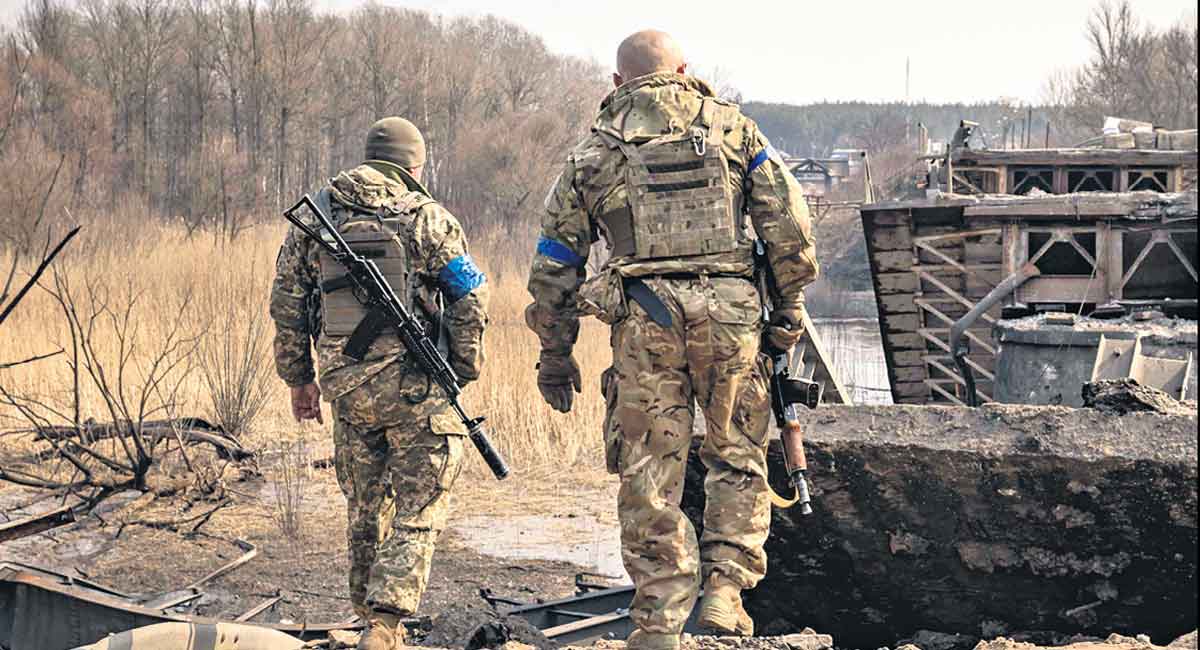
History cannot be used to explain away. Rather, one attends to the potentialities in various structures — NATO, the UN — to seal off parts of the world, such as Ukraine, as always already ruined.
In other words, modern-day institutional structures, including those that are neo-imperialist, carry within them to pronounce, in advance, the turning of regions, people and places such as Ukraine into ‘obsolete…precious ruins’.

(The author is Professor, Department of English, University of Hyderabad)
Now you can get handpicked stories from Telangana Today on Telegram everyday. Click the link to subscribe.
Click to follow Telangana Today Facebook page and Twitter .

Related News