Opinion: Smart Alerts: Shock, safety and survival in Venezuela
Seconds before the earthquake in Venezuela, millions of Android users received an alert, raising a vital question: Can the smartphone in your pocket save lives?


By PK Joshi
A seismic doublet, back-to-back powerful earthquakes, of magnitude 7.2 and 7.5 on the Richter scale, struck the north-central coast of Venezuela, sending strong tremors across the region and leaving millions of people in panic. Within seconds, the ground began shaking, buildings trembled, objects fell, and people rushed to protect themselves.
Also Read
Venezuela lies near the active boundary between the Caribbean Plate and the South American Plate. Eastward movement along the boundary triggered the devastating earthquakes. The friction between these two plates was accommodated by a series of strike-slip faults, causing rock masses to slide horizontally past one another. This slip on these locked fault lines generates powerful shallow earthquakes like the ones recently witnessed. The earthquakes were shallow-focus, occurring close to the earth’s surface, allowing seismic energy to reach buildings with greater force and less weakening.
Device Alert
Earthquakes remain among the most frightening disasters because they arrive without warning, no alarm, no countdown and no visible sign before destruction begins. But moments before the Venezuela quake was felt, something unusual happened. Millions of Android users received a warning on their phones, raising one big question – can this device in pocket actually save life?
Indeed, millions of people in Venezuela received an unexpected alert on their Android phones moments before the powerful earthquakes struck. The notification warned users that shaking was about to begin, giving them precious seconds to react. This is the ‘Golden Hour’ where timely intervention can significantly improve the chances of survival and reduce the severity of injuries, enhancing recovery outcomes.
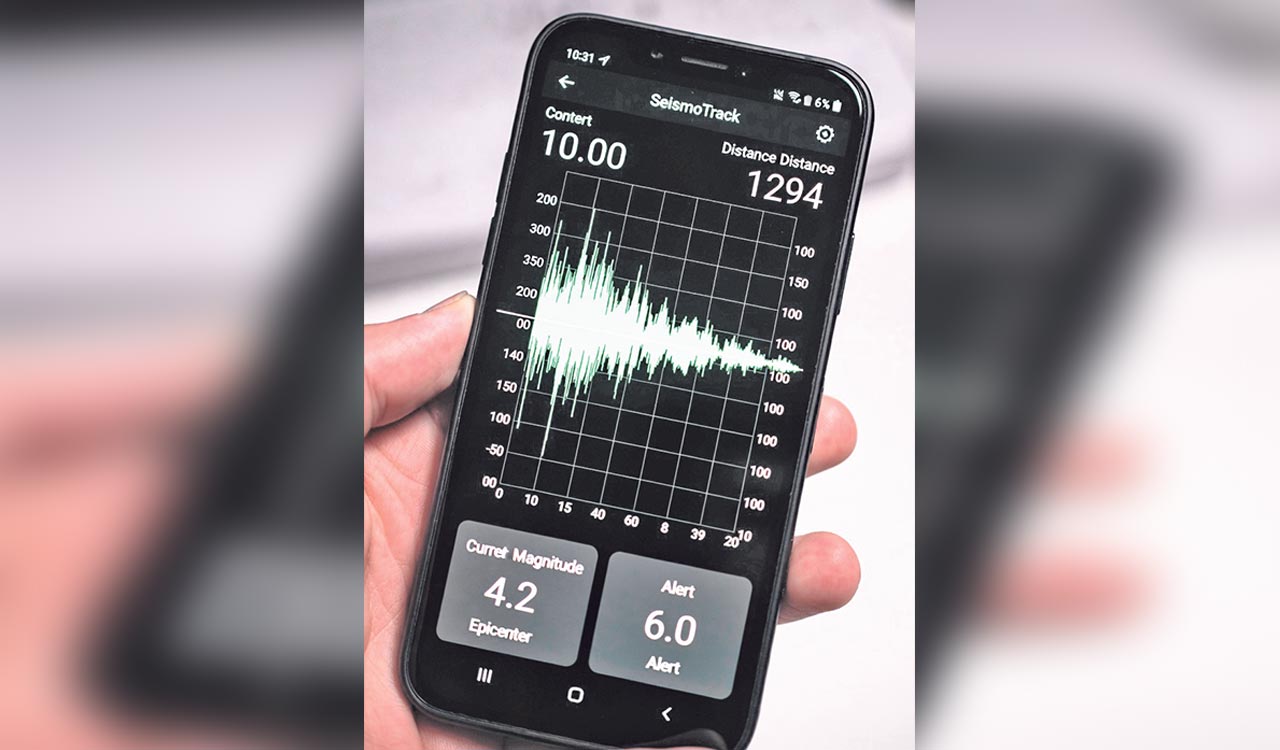
Many people wondered whether Google had somehow predicted the earthquake before it occurred, but that was not the case. Google did not predict the disaster. It detected the first signs of it. The technology behind this is called Google’s Android Earthquake Alert system, which functions as an Earthquake Early Warning (EEW) System. It uses millions of smartphones as a massive earthquake detection network.
Smartphones contain tiny motion sensors called accelerometers that can detect small movements. When several phones in the same area simultaneously register unusual vibrations, Google’s system uses artificial intelligence (AI) and machine learning (ML) to analyse the signals and identify possible earthquake activity.
Seismic Waves
When an earthquake starts, it releases fast-moving seismic waves. The P-waves (primary waves or pressure waves) — one of the two main types, travel faster (around 6-8 km/sec), and hence are the first signals to arrive at affected locations. P-waves may transmit through gases, liquids or solids. These waves arrive much before the stronger and more destructive secondary waves, the S-waves.
The elastic S waves (secondary waves or shear waves) generally transmit through solids with around 3-4 km/sec speed, much slower than the P-waves, but are of high intensity shaking and are the more damaging waves that earthquakes produce.
Smartphones can detect these early vibrations caused by P-waves, and transmit this information to monitoring systems with almost the speed of light (3,00,000 km/sec). In no time, once an earthquake is confirmed, alerts are immediately sent to people in areas where dangerous and destructive shaking is expected to arrive.
The Venezuela earthquake highlights how billions of smartphones can now function as a real-time earthquake warning network, giving people precious seconds to act before destructive shaking begins
The warning time may be extremely short; sometimes, people may get only a few seconds, say 30-40 seconds, before the shaking begins. But during a disaster, even those few seconds matter. People can move away from windows, stop dangerous work, protect themselves, or move to a safer location, thereby making use of the ‘Golden Hour’. In emergencies, even a small warning can make the difference between injury and survival.
Venezuela Example
The Venezuela incident shows how technology is evolving and transforming disaster management. Earlier, earthquake warnings mainly depended on traditional monitoring stations and communication systems. But now, billions of smartphones around the world can work together as a real-time earthquake detection and communication network. A device originally created for communication and later entertainment is slowly becoming a tool for public safety and survival.
However, one must understand that earthquake alerts are not the same as earthquake predictions. To the best of available scientific knowledge, no system in the world can accurately predict when and where an earthquake will occur. However, research using Land Surface Temperature (LST) data derived from Earth Observation System (EOS) and Global Navigation Satellite Systems (GNSS)/Global Positioning System (GPS) offers some hope in these directions.
Though Google’s Android Earthquake Alerts System functions only after the earthquake has already begun, its integration of AI and ML has brought a great degree of respite to global efforts. It detects the first seismic waves and attempts to warn people before the strongest shaking arrives.
Similar technologies could help the world prepare for other disasters. AI/ML, satellites and connected devices could improve early warning systems for floods, storms, fires and extreme weather events. This could serve as a springboard for advancing from alerts to predictions.
As natural disasters become more dangerous, faster information could help save more lives. The earthquake alert in Venezuela lasted only a few seconds, yet it showed a powerful possibility for the future, making our planet more livable and helping people feel safer.
Technology cannot stop earthquakes or control nature. But it can give people something extremely valuable: time, the time to act. One day, the smartphone in our hands may become a warning system capable of saving millions of lives.
(The author is Professor, School of Environmental Sciences, Jawaharlal Nehru University, New Delhi. Views are personal)

Related News