Opinion: Stories writ in stone
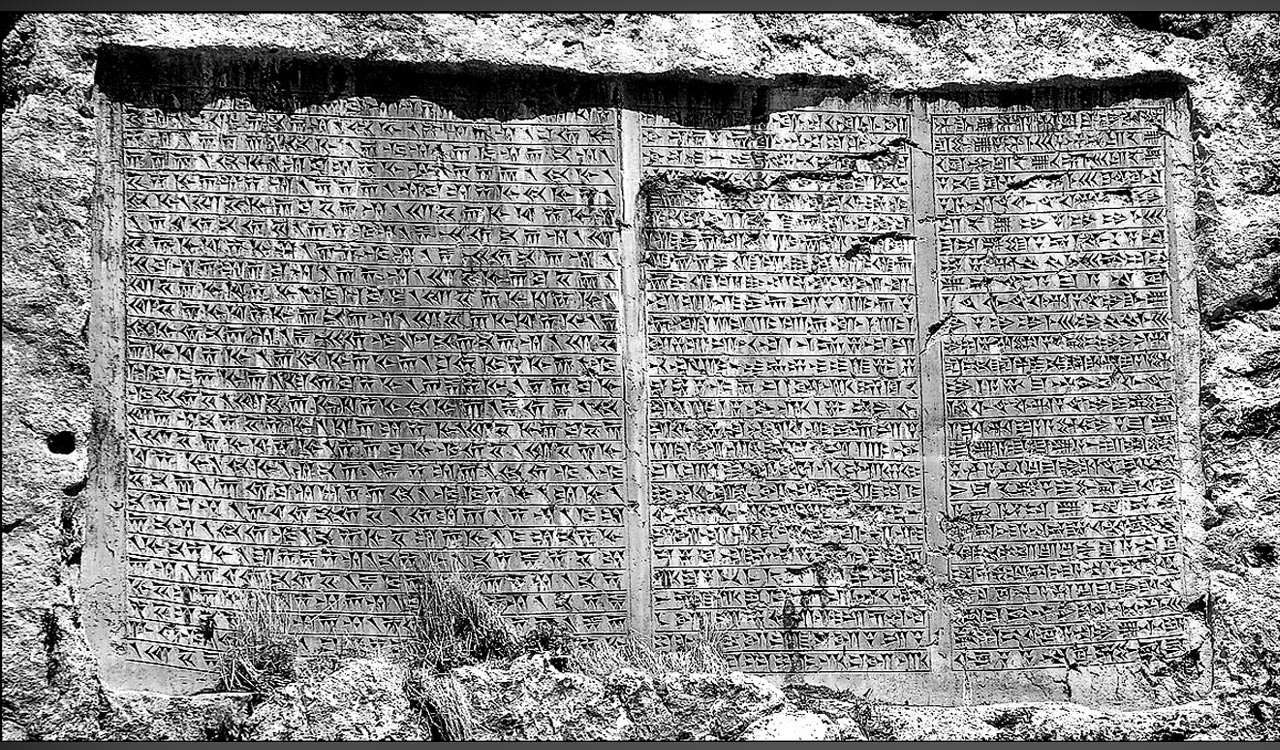
Histories are embedded in stone, although humanity does not always understand the language of stone


By Pramod K Nayar
In Wislawa Szymborska’s unusual poem, ‘Conversation with a Stone’, the speaker attempts to enter a stone:
Also Read
I knock at the stone’s front door
It’s only me, let me come in.
The stone responds:
“Go away,” says the stone.
“I’m shut tight.
Even if you break me to pieces,
we’ll all still be closed.
You can grind us to sand,
we still won’t let you in.”
The speaker persists and the stone, appropriately, remains unmoved:
I knock at the stone’s front door.
“It’s only me, let me come in.
“I don’t have a door,” says the stone.
Stony Rubbish
Before Szymborska, other poets had demonstrated a lapidary, or lithic, imagination. WB Yeats characterised revolutionaries and zealots as lacking any emotion when in ‘Easter 1916’ he writes:
Hearts with one purpose alone
Through summer and winter seem
Enchanted to a stone
To trouble the living stream.
—————————————–
A shadow of cloud on the stream
Changes minute by minute;
A horse-hoof slides on the brim,
And a horse plashes within it;
The long-legged moor-hens dive,
And hens to moor-cocks call;
Minute by minute they live:
The stone’s in the midst of all.
TS Eliot characterises barrenness, sterility and hopelessness in lithic terms in The Waste Land:
What are the roots that clutch, what branches grow
Out of this stony rubbish? Son of man,
You cannot say, or guess, for you know only
A heap of broken images, where the sun beats,
And the dead tree gives no shelter, the cricket no relief,
And the dry stone no sound of water. Only
There is shadow under this red rock,
(Come in under the shadow of this red rock),
And I will show you something different from either
Your shadow at morning striding behind you
Or your shadow at evening rising to meet you;
I will show you fear in a handful of dust.
Thus, stone and its cognates like rock, are tropes for something simultaneously profound — one thinks of the environmentalist Aldo Leopold’s famous ‘thinking like a mountain’ — and unknowable (like the zeal that drives Yeats’ revolutionaries) and harsh realities (like Eliot’s wasted lands). There is hopelessness, fear and uncertainty around the stone and the stony.
However, for critics like Jeffrey Jerome Cohen, “stone discloses queer vivacity, and a perilous tender of mineral amity… Because of its ardor for unconformity, stone sediments contradiction, there to ignite possibility, abiding invitation to metamorphosis. It offers a stumbling block to anthropocentrism and a spur to ceaseless story.”
The lapidary imagination may be defeated by the supposed immutability — stone does metamorphose, although very, very slowly — of stone but remains, like Yeats’ revolutionaries, enchanted by it.
Past the first stone?
The lapidary imagination — the ‘ceaseless story’ comes from this — works to various ends. For many poets, stone and its cognates represents a primordial state, one that pre-exists humanity and will probably outlive humanity. Aboriginal poet Oodgeroo Noonuccal writes in ‘Stone Age’ of this present and past of humankind:
White man, only time is between us.
Once in the time long gone you lived in caves,
You used stone axe, you clothed yourself in skins,
You too feared the dark, fled the unknown.
————————————————————
White superior race, only time is between us —
As some are grown up and others yet children.
We are the last of the Stone Age tribes,
Waiting for time to help us
As time helped you.
From the caves, the Europeans expanded outward, and plundered. Here ‘Stone Age’ bespeaks a proud, resilient lineage, and not the vulnerability of the Aboriginals. They, like stone, will outlast the white race, their time will come.
The Australian poet John Kinsella writes in the opening verses of the volume Jam Tree Gully:
A sheen of mica and feldspar configuring
A sandstone past, a declaration
of origins; what grows in what
was here before?
What past lies in the stone of a place, wonders Kinsella. Humans wish to build, notes Kinsella, on stable ground:
The space of building-into is already
flat and covered in gravel — beneath,
is clay and stone, a lot of stone.
Kinsella identifies human intervention — now identified as a dangerous geological force initiating a whole era, the Anthropocene — for its true nature:
a layer that redresses wood and soil and stone
to claim another way of making history
where history is an imposition.
This is human history which imposes upon the earth, altering it irrevocably. Sometimes, stone speaks of a history of inhuman behaviour, as Nigerian poet Tanure Ojaide’s writes in ‘The Island’:
Bodies strapped to stone
discharged from copters
tell a dumb tale
of the triumph of warrior-kings.
Ojaide’s juxtaposition of the trope of silent stones and dead bodies with the telling of a ‘dumb tale’ gestures at how even the presumably silent do speak, or can be made to speak as Percy Shelley’s famous poem ‘Ozymandias’ tells us, where even the sculpture’s ‘shattered visage’ does tell a story of the king’s reign (The ‘speaking’ of bodies is of course the premise of numerous Human Rights fiction such as Michael Ondaatje’s Anil’s Ghost).
Poets whose provenance lies in far older cultures treat stones as offering something else. For the Inuits who used stone figurines — called Inukshuk — as signs to help travellers or assist hunters, stones are signposts in an otherwise inhospitable land. In Inupiaq-Inuit poet dg nanouk okpik’s ‘Tingivik Tatqiq: September Moon’, she writes of such a stone-organised landscape:
Early Fall Moon when
the birds fly south Inukshuk:
A scarecrow rock structure made
by piling up stones in order to
steer caribou in a certain direction.
Thus stone enables survival. The poetry of stone is also — like sculptures are clichédly described — poetry in stone. Stories and histories are embedded in stone, although humanity does not always understand the language of stone.
But environmental messages are read into stone. Therefore, as the environment gets eroded, the lapidary imagination argues that only the stones remember how it was. The Native American poet Simon Ortiz writes in ‘Old Hills’:
These hills are pretty old.
Some have worn down to flat desert valley.
Some stones remember being underwater
and the cool fresh green winds.
And we conclude with Kinsella:
How has the stony earth
so effectively hidden the bones
of the people who came first?
Maybe the stones
are those bones
and we can’t distinguish —
or won’t — the sounds of native birds
accompanying our words,
fulfilling our wishes.
Sometimes, to communicate unpalatable stories of colonialism and anthropogenic ruinations of the earth, poets need to see meanings writ in stone, as stone. The lithic mode, like its object of attention, its source, survives.

Related News