Opinion: The end of American hegemony in West Asia?
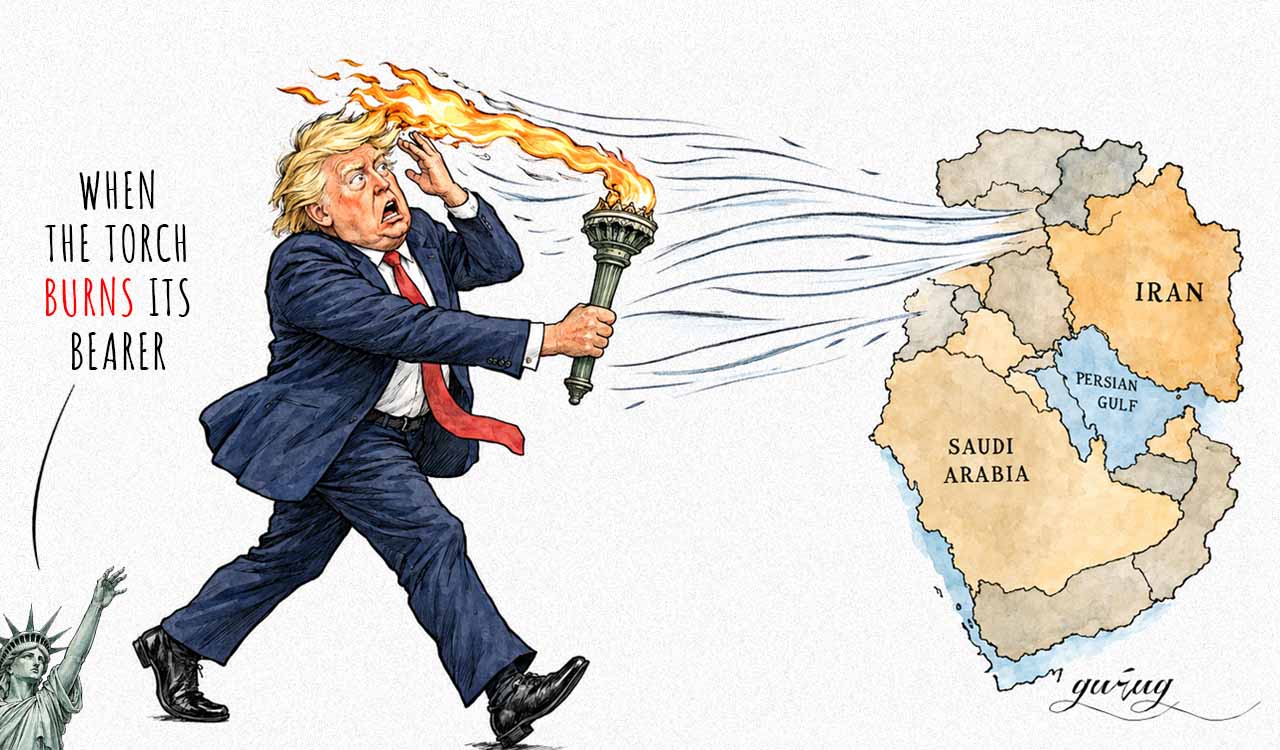
The war with Iran has exposed the limits of Washington’s security guarantees, raising the prospect of a more volatile and strategically fragmented West Asia


By Brig Advitya Madan
In 1991, the United States emerged from the Gulf War at the height of its influence in the Middle East. Iraqi forces had been expelled from Kuwait, the Soviet Union was nearing dissolution, and preparations were under way for the Madrid peace conference. Washington appeared capable of shaping the regional order. Thirty-five years later, can America still guarantee regional security?
Also Read
The war with Iran has exposed the limits of that capacity. What was expected to be a short campaign has become a costly confrontation, threatening energy supplies, shipping, and the security of America’s Gulf partners. Washington may reduce its military commitments, but the more consequential change would be the erosion of its role as the region’s principal security architect. American power will endure; its ability to determine regional outcomes may not. This is a strategic, not merely military, shift.
American Interventions
The record of American interventions helps explain this predicament. The invasion of Iraq removed Saddam Hussein but also eliminated a principal counterweight to Iran, enabling Tehran to expand its influence. Interventions in Libya and Syria failed to produce stable political orders, while the Yemen conflict exposed the limits of military superiority in securing political outcomes.
Arab governments have also questioned Washington’s consistency, from its handling of Hosni Mubarak’s departure in Egypt to its changing regional priorities. These episodes differed, but they illustrate a persistent problem: military dominance does not automatically deliver a durable political settlement.
The breakdown of the interim understanding between Washington and Tehran has left both sides seeking leverage. Iranian pressure on shipping through the Strait of Hormuz threatens global energy markets, while American sanctions seek to restrict Tehran’s economic connections. Oil prices have become an instrument of pressure on President Donald Trump, particularly ahead of the November midterm elections. Tehran may calculate that prolonging the conflict will raise the domestic political cost for Washington.
Instability around the Red Sea compounds the problem. Houthi advances in Yemen, and attacks on Saudi territory underline the vulnerability of Gulf infrastructure and transport networks. The monarchies face an uncomfortable dilemma: continued conflict damages energy revenues, tourism and investment, but a rapid American withdrawal would leave them exposed.
Washington, meanwhile, must weigh the costs of maintaining regional bases against their vulnerability to drones and inexpensive missiles. Aircraft carriers and Diego Garcia cannot fully offset the risks to its forward presence.
Exploiting Space
A reduced American role would not necessarily produce a stable regional balance. Three powers may exploit the resulting space, but their ambitions are unlikely to be compatible.
Iran has developed formidable missile capabilities and networks of allied armed groups across the region. Its survival would preserve its capacity to influence Iraq, Syria and Lebanon. My experience as a commanding officer in Lebanon after the 2006 war underscored the depth of Iran’s regional networks. Tehran is likely to seek their reconstruction and could revive its nuclear ambitions.
Europe lacks comparable military capacity, Russia remains constrained by its war in Ukraine, and China shows little appetite for regional hegemony, leaving no clear successor to Washington in the region
A serious move towards acquiring a nuclear weapon would sharpen the prospect of renewed American or Israeli intervention. Iran may gain leverage over Hormuz, but using a vital international waterway for coercion would invite resistance.
Türkiye combines military capabilities with expanding commercial and diplomatic relationships. Its engagement with Syria and Iraq, interest in trade corridors and water supplies, and security ties with Pakistan and Saudi Arabia reflect a pragmatic effort to extend its influence. Support for Islamist movements is only one dimension of Turkish policy; defence and construction interests also matter.
Israel, meanwhile, remains a formidable military and intelligence power. Following the October 7 attacks, its determination to eliminate perceived threats has reinforced its security-first outlook, while the Abraham Accords have deepened its ties with the United Arab Emirates.
Regional Order
None of these powers, however, is positioned to establish an uncontested regional order. Israeli-Turkish tensions in Syria, the unresolved confrontation between Israel and Iran, and the historic rivalry between Tehran and Ankara will complicate accommodation. Their competition could make the region less stable.
Arab states risk becoming the principal losers. Iraq and Syria remain burdened by conflict, while Egypt’s former regional leadership has diminished. Saudi Arabia, the UAE and Qatar are pursuing ambitious economic transformations, but their business models depend on regional security. Their rivalries, including in Yemen, undermine responses to shared threats.
The weakening of the Arab League and Gulf Cooperation Council is more than an institutional problem: it leaves regional states less able to manage competition without external intervention.
Nor is there an obvious successor to Washington. Europe lacks comparable military capacity, Russia remains constrained by its war in Ukraine, and China has little appetite for regional hegemony. Beijing depends heavily on Gulf energy but understands the financial, military, and human costs of America’s decades of engagement. It prefers economic influence without becoming the principal security provider.
Meanwhile, Washington is increasingly focused on strategic competition with China and rebuilding its own capabilities. A more selective American presence is plausible, even if complete withdrawal is not.
For India, the decisive question is not whether American bases will close, but whether Washington can still be relied upon to contain a crisis. A weaker security framework could accelerate military competition, encourage shifting alignments and expose Indian energy supplies, trade routes, expatriates and economic interests to disruption.
India must assess the region without assuming that any single external power can guarantee stability. The end of American hegemony, if it comes, will not necessarily usher in a new order. It may instead leave a Middle East where power is dispersed, rivalries harder to manage, and strategic uncertainty the defining condition.
(The author commanded 15 Punjab in Lebanon under United Nations Flag, 27 Sector as DIG in Churachandpur, and was Brigadier, Operational Logistics in HQ Western Command. He is currently an analyst on geopolitics, international and defence affairs)

Related News