Opinion: When one cyclone follows another — gaps in India’s coastal preparedness
Back-to-back cyclones Arnab and Murasu highlight the need for better forecasting, climate-resilient infrastructure and stronger community preparedness, with recovery plans accounting for successive disasters, not just individual storms


By PK Joshi
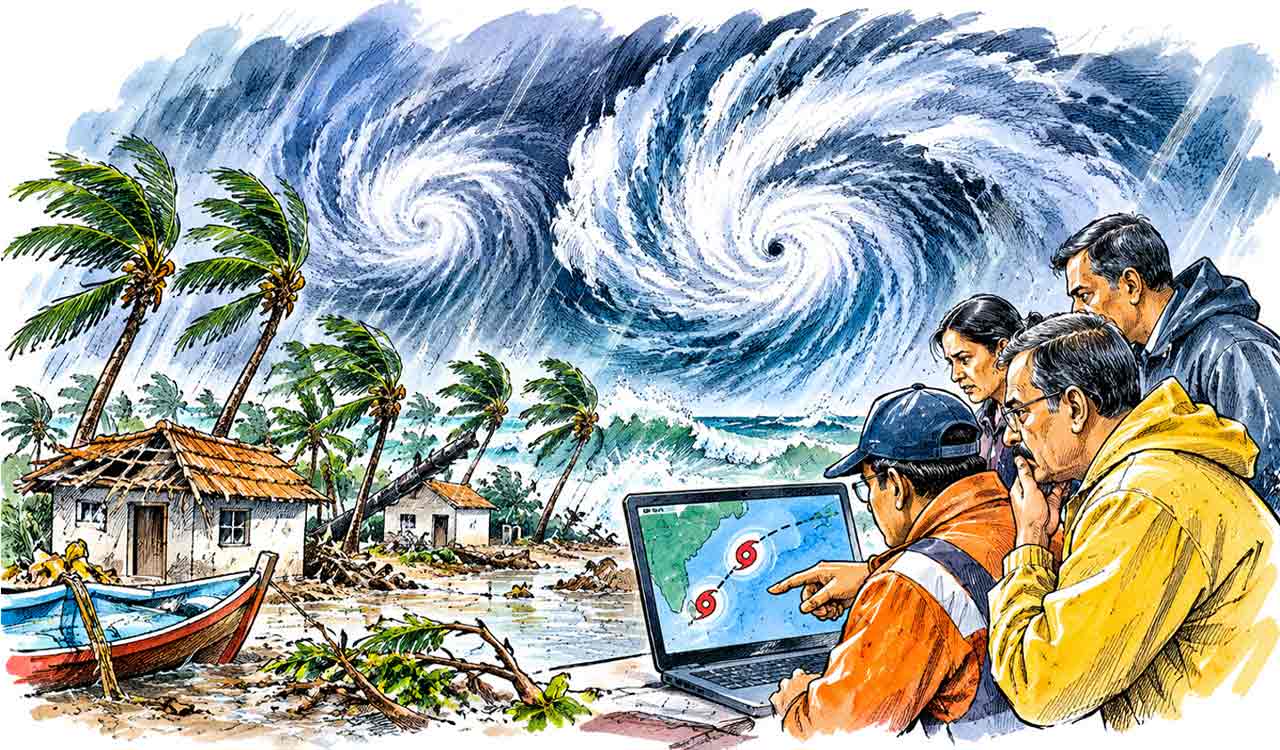
A double whammy of back-to-back powerful cyclones, with wind gusts of up to 180 km/hr (Arnab) and 120 km/hr (Murasu), struck the eastern coast of Andhra Pradesh, bringing heavy rainfall and strong winds across the region and leaving millions of people in panic. These occurrences within less than a week constitute an important meteorological and environmental event. They raise questions not only about the unusually rapid succession of cyclones but also about changing ocean–atmosphere interactions, coastal vulnerability and disaster preparedness.
Also Read
Both events originated in different parts of the Bay of Bengal: Arnab over the east-central Bay and Murasu farther south, over the southwest and adjoining southeast Bay. They primarily affected Andhra Pradesh and Odisha, while also impacting several other States of eastern and southern India, and extending the fear of impact as far away as Madhya Pradesh and Uttar Pradesh.
Factors that Work
Normally, a mature cyclone disturbs its surrounding ocean and atmosphere through strong winds, vertical mixing, changes in sea-surface temperature and atmospheric circulation, making conditions less favourable for another cyclone to develop. However, in this case, meteorological and climatological factors worked in tandem to overcome these inhibiting conditions.
The Bay of Bengal is a naturally favourable cyclone basin, with two principal cyclone seasons: pre-monsoon (April–June) and post-monsoon (October–December), with November being particularly favourable for cyclone development. High ocean heat content and warm surface waters (26.5°C or higher) facilitate the transfer of heat and moisture from the ocean to the atmosphere, supporting cyclone development.
A useful initiative would be to develop a Cyclone Sequence Early Warning System that accounts for the possibility of a successive cyclone developing before the affected region has recovered from the previous one
A second cyclone may still intensify when its genesis region is geographically separated from the first cyclone’s track, warm water extends sufficiently deep, the upper ocean remains strongly stratified, and ocean heat content is adequate. These conditions can be further supported by the eastward-moving tropical atmospheric disturbance known as the Madden–Julian Oscillation (MJO), and low differences in wind speed and direction at different atmospheric heights.
Growing Concern
Such back-to-back cyclones do not, by themselves, establish a climate change trend. However, climate change alters the background environmental conditions in which cyclones develop, intensify and cause damage. Although there is no simple, uniform global increase in cyclone frequency, regional and seasonal changes vary.
Nevertheless, increasing cyclone intensity remains a growing concern in a warming climate. A warmer atmosphere can hold more moisture, while sea-level rise increases the potential consequences of storm surges. The most concerning aspect is not necessarily the occurrence of two cyclones within a short period, but their cumulative impacts, which can produce a disaster much larger than the sum of their individual impacts.
Cyclone Arnab underwent rapid intensification before making landfall, and its unusual circulation resulted in heavy rainfall across adjoining areas. According to reported estimates, Arnab inundated around 4,50,000 hectares of crops across Coastal Andhra, Konaseema, West Godavari and Kakinada. It caused around nine reported fatalities. Initial property losses were estimated at Rs 4,800 crore. Andhra Pradesh sheltered around 85,000 people across 290 relief centres. In Odisha, torrential rainfall triggered floods and landslides in Ganjam, Gajapati and Kandhamal, marooning over 1,000 villages and destroying 1,672 houses.
Murasu, however, resulted in at least two deaths in Bapatla district due to building collapses. More than 12,230 people were moved to rehabilitation centres in Guntur, Bapatla and Palnadu districts. It added another 52,459 hectares of newly damaged or inundated crops to the losses caused by Arnab.
In Odisha, Murasu largely spared the region from direct destructive winds, although southern districts experienced persistent heavy rainfall, delaying recovery from Arnab’s extensive flooding. Both cyclones caused widespread uprooting of trees, power outages and seawater ingress into low-lying coastal zones.
The National Disaster Response Force (NDRF) and State Disaster Management Authorities (SDMAs), supported by Indian Navy helicopter sorties, provided prompt response and assistance. Inter-Ministerial Central Teams are assessing the damage, while State authorities have announced ex gratia compensation of Rs 4 lakh per death in Odisha and Rs 5 lakh in Andhra Pradesh and are evaluating cumulative infrastructure and agricultural losses running into thousands of crores.
The India Meteorological Department (IMD) played a crucial role through its network of high-wind-speed recorders along the Indian coastline, enabling the recording of representative sustained wind speeds using three-minute averages.
This contrasts with the US Navy’s Joint Typhoon Warning Center, which relies on satellite and scatterometry data, without the same level of direct, ground-based measurements available through the IMD network. Back-to-back cyclones can overwhelm agricultural systems, increase economic losses, prolong ecosystem recovery, damage infrastructure, affect public health and livelihoods, and intensify social vulnerabilities.
Building Better
Such hazards demand improved ocean–atmosphere coupled forecasting models. A useful initiative would be to develop a Cyclone Sequence Early Warning System (EWS) that considers the possibility of a successive cyclone developing before the affected region has recovered from the previous one. Similarly, evacuation plans must recognise multi-hazard hotspots and account for communities that may have already been evacuated or displaced by an earlier event.
Ecosystem-based Disaster Risk Reduction (Eco-DRR) and Nature-based Solutions (NbS) should become integral to cyclone-risk reduction. Climate-resilient agriculture and livelihoods are equally important.
The principle of Build Back Better should be upheld, but such experiences must also guide us towards building better across all sectors. There is an opportunity to use this event to develop a more sophisticated approach to disaster risk reduction.
Vulnerability atlases should incorporate the dynamic nature of both individual factors and the system as a whole. State-of-the-art Earth observation systems and geospatial analysis must evolve towards GeoAI-based predictive models and digital twins of vulnerable coastal districts to simulate cyclone tracks, storm surges, rainfall, inundation and infrastructure failures.
Ecosystem health monitoring and management should become consistent practices, while community-centred resilience and preparedness should become cultural attributes. The real challenge is not merely to predict when the next cyclone will arrive, but to understand and ensure that our coastal ecosystems, infrastructure and communities are sufficiently prepared to withstand it.
(The author is Professor with School of Environmental Sciences, Jawaharlal Nehru University, New Delhi. Views are personal)

Related News