Opinion: Why India still needs reservation
The debate should focus not on withdrawing reservation, but on whether the policy is being implemented effectively, as significant gaps in representation, education, employment and social conditions persist despite decades of affirmative action


By Dr Jadhav Chakradhar
Every few years, the debate over reservation in India returns with renewed force. Some argue that reservation has served its purpose and should now be reduced, capped, or gradually withdrawn. The argument is often framed in terms of merit, equality of opportunity, or the country’s changing social and economic conditions.
Also Read
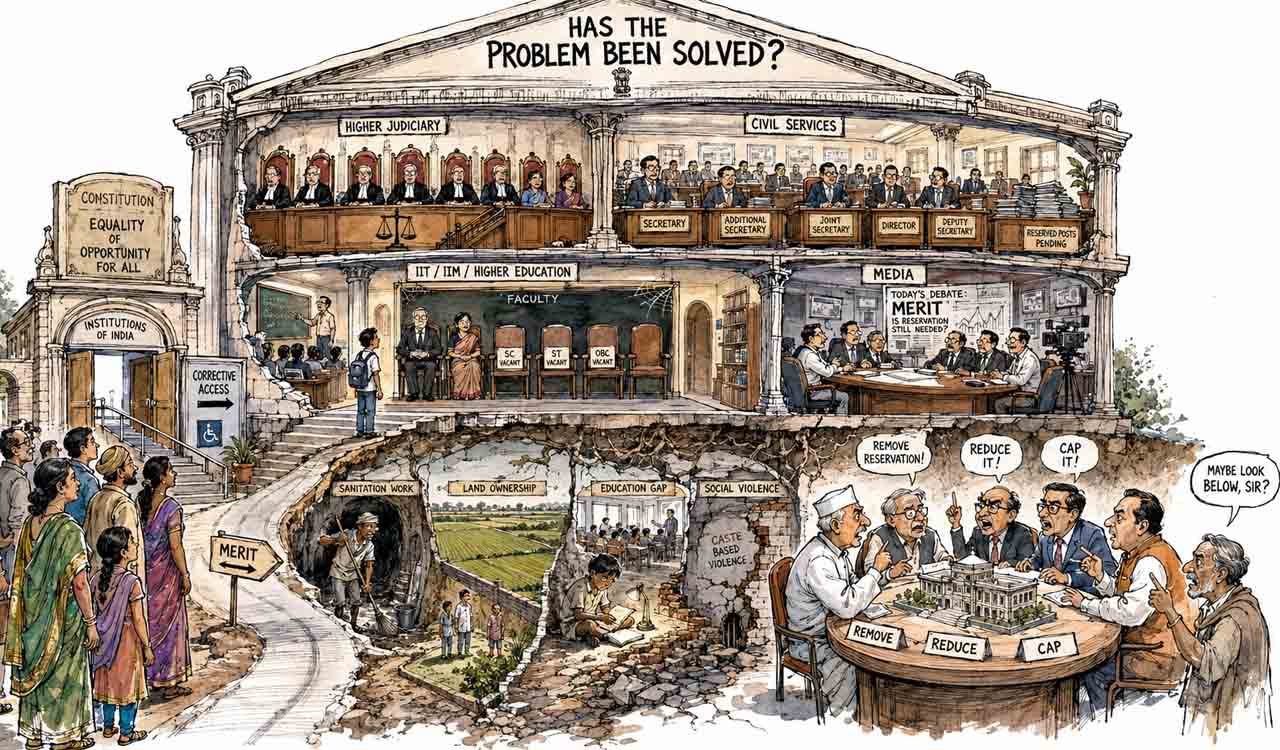
These are legitimate questions in a democracy. But before asking whether reservation should be withdrawn, we need to ask a more fundamental question: Has the underlying problem that reservation was intended to address actually been resolved? The evidence from India’s institutions suggests otherwise.
Higher Judiciary
Consider the judiciary, an institution often perceived as operating above social divisions such as caste. Government data placed before the Rajya Sabha in December 2023 show that, of 650 High Court judges appointed between 2018 and 2023, only 23 belonged to Scheduled Castes, representing 3.54 per cent, while 10 belonged to Scheduled Tribes, representing 1.54 per cent. OBC representation was 11.7 per cent, and religious minorities 5.54 per cent.
SCs and STs alone constitute roughly one-quarter of India’s population, while estimates of the OBC population range from about 41 per cent in National Sample Survey Organisation data to 52 per cent in the Mandal Commission’s 1980 estimate. The point is not that every institution must mechanically reproduce the demographic composition of the population. Rather, persistent under-representation raises a legitimate question about whether equal opportunity has translated into equal access to positions of authority.
Civil Services
The situation in the higher civil services also deserves attention. According to a written reply in Parliament, between 2020 and 2024 only 135 SC and 67 ST candidates were directly recruited to the IAS. In the IPS, the corresponding figures were 141 SC and 71 ST candidates. These numbers should not be interpreted in isolation, since recruitment in any period depends on the number of vacancies and the structure of the recruitment process.
Nevertheless, the continued absence of comprehensive caste-wise information on the composition of serving IAS, IPS and IFS officers makes it difficult to assess how far representation has progressed over the longer term.
India’s constitutional framework recognised that historically excluded communities need access not only to employment but also to institutions in which public decisions are made
The private sector provides even less reason for optimism. Evidence from sectors such as the media suggests continuing disparities. An Oxfam India–Newslaundry study found no Dalit or Adivasi editor-in-chief or managing editor among major Indian media organisations in both 2019 and 2022, while around 90 per cent of leadership positions were occupied by upper-caste individuals.
Of Representation
One of the weaknesses in the public debate is the tendency to reduce reservation to government employment. That was never its entire purpose. The constitutional framework recognised that historically excluded communities need access not only to employment but also to institutions in which public decisions are made. This is why affirmative-action provisions extend into political representation and educational institutions as well.
Representation matters because institutions do not operate in a social vacuum. Legislatures make laws, courts interpret them, universities shape knowledge and professional norms, and public administrations design and implement policy. When communities that have experienced historical exclusion remain substantially under-represented in these institutions, their perspectives and experiences are less likely to influence decision-making. It means something more basic: a democratic institution should not repeatedly reproduce the exclusion found in society around it.
Major Concern
The situation in higher education makes the issue even more visible. RTI concerning IIT Delhi’s faculty composition in mid-2024 showed that only 2.69 per cent of filled faculty positions were occupied by SC candidates and 1.11 per cent by ST candidates, while 89.1 per cent were from the general category. At the same time, a substantial number of sanctioned faculty positions remained vacant.
The situation at the IIMs has also raised concerns. A government response in 2021 indicated that a large proportion of reserved faculty positions remained vacant, including nearly 60 per cent of reserved SC and OBC positions and close to 80 per cent of ST positions. Nationally, government data have also indicated that reserved teaching positions in central institutions have remained substantially unfilled.
These figures highlight the gap between formal reservation and effective representation, as reserved posts have little impact when they remain vacant for years. Likewise, representation cannot improve if institutions repeatedly fail to recruit eligible candidates or if recruitment procedures systematically create barriers to entry. The question, therefore, should not simply be whether reservation exists. We should also ask whether it is being implemented effectively.
The argument for retaining reservation becomes stronger when institutional representation is considered alongside broader social conditions. Data from the NAMASTE programme, covering approximately 38,000 sanitation workers, showed that 77 per cent belonged to SC or ST communities, with a further 14.7 per cent belonging to OBC communities. This concentration is particularly significant given that manual scavenging has been prohibited by law for decades.
Similarly, patterns of land ownership continue to reflect historical inequalities. National-level evidence consistently indicates that Dalit and Adivasi households possess agricultural land at levels that are low relative to their population shares. Violence against historically disadvantaged communities also remains a serious concern.
NCRB data indicate that 48,669 cases were registered under the Scheduled Castes and Scheduled Tribes (Prevention of Atrocities) Act in 2024, while more than 2,87,000 cases remained pending trial at the end of the year. These indicators matter because reservation cannot be evaluated independently of the broader social structures in which people compete for education, employment and political influence.
Reservation Needs Reform
Defending reservation does not require defending every aspect of its present implementation. There are serious problems that deserve attention: large backlogs of reserved vacancies, uneven enforcement of laws protecting SCs and STs, inadequate representation in some institutions, and the limited reach of affirmative action in the private sector.
Private higher education is a particularly important example. Parliamentary findings have indicated very low enrolment of SC students and negligible enrolment of ST students across private higher education institutions. These failures should not be used as evidence that reservation has failed. In many cases, they demonstrate that the policy has not been implemented adequately.
The appropriate response is, therefore, to improve implementation, strengthen transparency, address institutional vacancies, improve educational opportunities at earlier stages, and examine carefully whether sectors currently outside the reservation framework require additional mechanisms to promote equal opportunity.
The Real Question
The strongest case for retaining reservation is empirical. If reservation was introduced to address social exclusion and unequal opportunity, its continuation should be judged by whether those inequalities have declined. The evidence shows that significant gaps in representation, education, employment, land ownership, and social security remain.
This does not mean reservations should remain unchanged forever. Policies must evolve with changing circumstances, and their design and implementation should be regularly reviewed. But reform is not the same as withdrawal.
India has made substantial progress, but the persistence of deep inequalities suggests that the underlying problem has not been fully resolved. The priority should, therefore, be to make reservation more effective and better targeted, rather than to conclude prematurely that its purpose has been achieved.
(The author is Assistant Professor of Economics, Centre for Economic and Social Studies [CESS], Hyderabad)

Related News
-

Opinion: Fuelling cars, emptying plates—the hidden costs of India’s ethanol policy
-
Opinion: From literacy to livelihood— the missing link in women’s empowerment
-
KTR extends financial aid to tribal student pursuing agriculture degree
-
Opinion: Don’t ‘fix’ young people — understanding India’s youth mental health crisis