Over 15,000 snakes rescued in Telangana in 2025
More than 15,000 snakes were rescued across Telangana last year, with over half being venomous. Data from Friends of Snakes Society show rising snake–human encounters in Hyderabad’s expanding urban areas, especially along the Outer Ring Road.
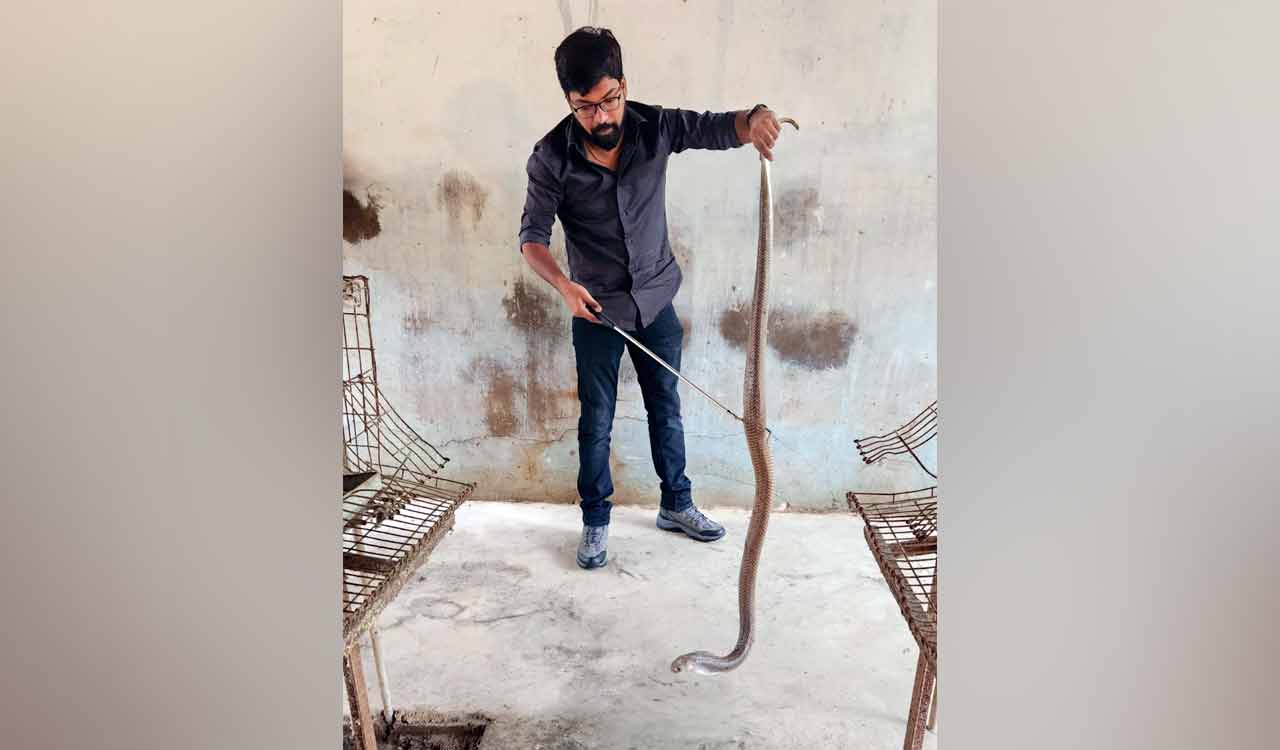


Hyderabad: The Hyderabad-based Friends of Snakes Society (FOSS), in collaboration with Telangana Forest department has rescued 15,265 snakes across Telangana in the last year. Interestingly, the FOSS rescue data has indicated that 55.61 per cent of the rescued snakes were venomous and predominantly in urban and peri-urban settings of Hyderabad.
There is a strong clustering of snakes along Hyderabad’s expanding urban fringe, particularly near the Outer Ring Road corridor. Prominent hotspots in areas such as Miyapur, Dammaiguda, Nagaram, Rampally, Vanasthalipuram, Balapur, Bandlaguda Jagir, and Manikonda correspond closely with zones of rapid residential and infrastructure development.
The dominance of medically significant venomous species of snakes such as Spectacled Cobras, Russell’s Vipers, and Kraits has important implications for public safety and underscores the necessity of trained expert intervention, FOSS General Secretary Avinash Vishwanathan said.
The high frequency of venomous species in urban and peri-urban settings reflects their ecological adaptability and association with human-modified environments that provide prey, shelter, and water.
Non-venomous rescues, while fewer, encompassed a wide range of ecological guilds, indicating the continued presence of diverse microhabitats within the urban landscape. At the same time, their displacement into human spaces signals increasing habitat compression and loss of ecological buffers, Avinash added.
The patterns indicate that snake–human conflict is most intense in transitional landscapes where ongoing construction overlaps with remnant natural habitats. Habitat fragmentation, loss of shelter, and disruption of movement corridors in these areas are likely driving higher encounter rates.
As cities expand into peri-urban and semi-natural landscapes, contact between snakes and people has intensified. At the same time, greater trust in professional rescue services has led to higher reporting rates.
Rescue numbers remain relatively moderate from January to March during cooler temperatures and increase steadily during April and May as rising pre-monsoon temperatures stimulate greater movement and foraging. The monsoon months from June to September represent the primary peak period, driven by flooding of natural shelters, habitat displacement, and the emergence of hatchlings, which increases overall encounter rates.
Our findings highlight the need to transition from a predominantly reactive rescue model to a more anticipatory and preventive framework. Systematic integration of rescue data into urban planning, infrastructure development, waste and rodent management, and green-space design can help reduce conflict at its source.
Snakes rescued in Telangana:
- 2016- 3097
- 2017- 4504
- 2018- 5644
- 2019-6689
- 2020- 8895
- 2021- 10525
- 2022- 9101
- 2023- 10282
- 2024- 13028
- 2025- 15265
Some important observations:
Venomous snakes rescued are 55.6 per cent
Strong clustering of snakes along expanding ORR region of Hyderabad
Snake–human conflicts are intense where construction areas overlap natural habitats
Spectacled Cobras, Russell’s Vipers, and Kraits are most commonly rescued snakes
Snake rescue hotspots in Hyderabad: Miyapur, Dammaiguda, Nagaram, Rampally, Vanasthalipuram, Balapur, Bandlaguda Jagir, and Manikonda

Related News