
Punjab activist Gurjeet Khalsa brought down from BSNL tower after long protest
Activist Gurjeet Singh Khalsa was safely brought down from a BSNL tower in Punjab after over 18 months of protest demanding stricter anti-sacrilege laws. He ended the agitation following the notification of a new law addressing his demands
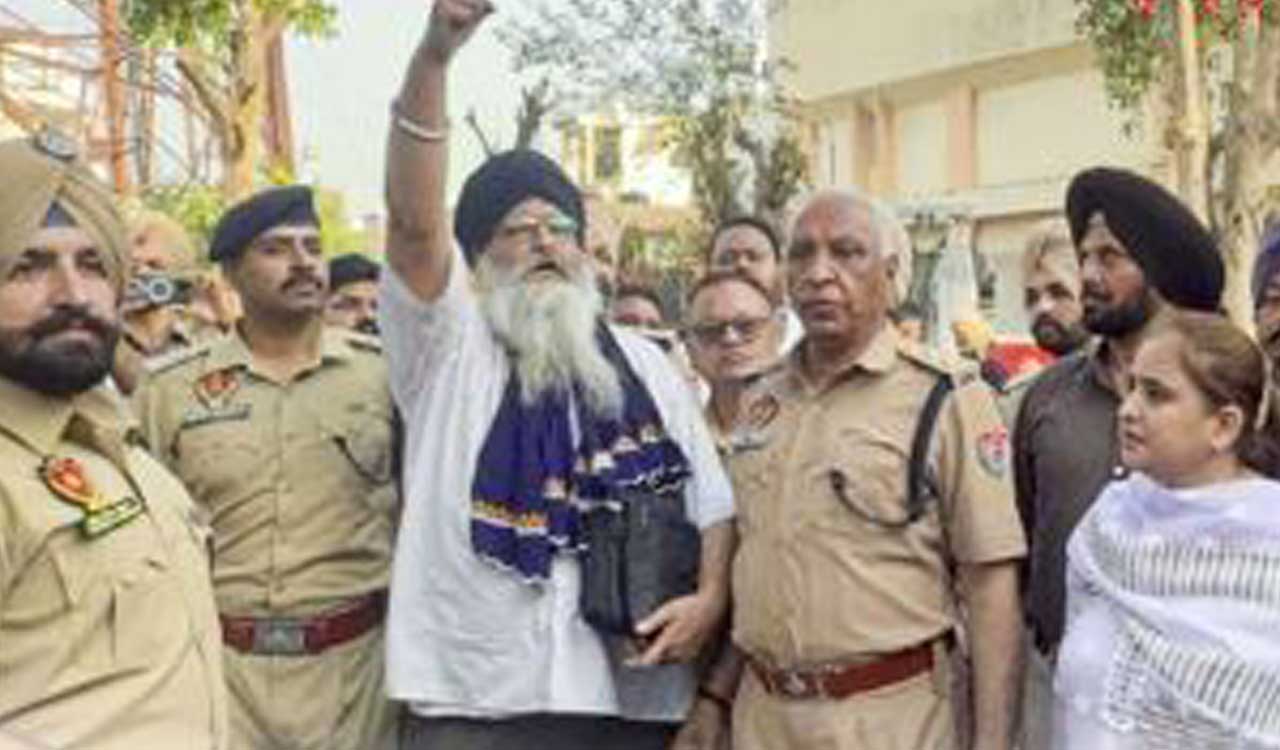


Samana (Punjab): Activist Gurjeet Singh Khalsa, who had been sitting atop a 400-foot BSNL tower for about 560 days demanding stricter laws against sacrilege incidents in Punjab, was finally brought down safely on Friday morning, officials said.
The development brought to an end a dramatic protest that began when Khalsa (43) climbed atop the tower in Samana near Patiala on October 12, 2024, demanding stringent punishment for the sacrilege of the Guru Granth Sahib.
He was brought down by a team comprising firemen, police and civil officials with the help of a specialised crane-lift (turntable ladder), a fire official in Patiala said.
As he was being brought down, the activist waved to his supporters standing below, with one of them shouting that Khalsa was in “Chardi Kala” (high spirits).
After he descended amid ‘Sikh Jaikara’ and ‘Jo Bole So Nihal, Sat Sri Akal’ chants, Khalsa was taken for a medical check-up in an ambulance, with his supporters showering flower petals on him.
Many locals were seen watching the entire operation from the rooftops of their houses.
“We have won,” said Khalsa, a dairy farmer from Kheri Nagaian village in Patiala district, as he stepped onto the ground.
“By the Guru’s grace, I have come down safely after 18 months and 12 days. I thank the Punjab government,” Khalsa said, expressing his gratitude to Chief Minister Bhagwant Mann and Assembly Speaker Kultar Singh Sandhwan for enacting an anti-sacrilege law.
Khalsa also thanked the local administration for bringing him down safely.
The activist decided to end his protest after the Punjab government recently notified an anti-sacrilege law – the Jaagat Jot Sri Guru Granth Sahib Satkar (Amendment) Act, 2026 – which proposes stricter punishment, including life imprisonment and a fine of up to Rs 25 lakh, for any act of sacrilege against the Guru Granth Sahib.
The protest drew attention across Punjab due to its unique nature and the extreme conditions endured by Khalsa, who remained atop the tower through harsh winter and scorching summer months.
He was sent essential supplies using a rope by one of his supporters every day. He stayed in an 8-10 feet makeshift tarpaulin tent atop the tower, using a polythene bag to relieve himself.
The fire department carried out a meticulous operation to bring Khalsa down, which took around 30-40 minutes. However, the entire preparation, including a mock drill, took about two hours, officials said.
Six members of the fire department climbed the tower to bring Khalsa down.
Harinderpal Singh, an assistant fire officer in Patiala, said that Khalsa, who weighed around 110 kg, was first lowered 125 feet to a specially made platform with the help of a ladder using a full-body harness, ropes and pulleys.
Two men were positioned above and below Khalsa during his descent to ensure his safety.
Later, he was shifted to the cabin of a hydraulic turntable ladder that brought him down, keeping in mind the air velocity, the fire officer said.
The fire officials also brought down bedsheets, batteries, clothes and other belongings of Khalsa from atop the tower, he added.
After he was brought down, Khalsa said he had only one thought in mind – either he would be a ‘shaheed’ (martyr) or the ‘morcha’ (protest) would be victorious.
Asked about his lengthy stay atop the tower, Khalsa said it had been a good journey.
The activist, however, said that he is now suffering from elevated blood sugar levels because of a lack of physical activity. He also said his blood pressure would sometimes fluctuate.
“There is no history of diabetes in my family,” he told reporters.
Khalsa also said that he was immensely happy with the new law that proposes stricter punishment for sacrilege.
“There must be a fear of law to check ‘beadbi’ (sacrilege) of religious scriptures. Section 295A of the IPC (now 299 in BNS) was not strict enough to check sacrilege incidents,” he said.
Khalsa had earlier said that his brother would look after his dairy business after he decided to start his protest seeking an anti-sacrilege law.
Paramjit Kaur, Khalsa’s mother, said she is proud of her son.
“My son is a ‘Yodha’ (warrior). He told me that either his body would be brought down from the tower or the anti-sacrilege law would be passed,” she said.
“I could not sleep properly as I wanted to see my son. Today I am very happy,” she added.
With Khalsa on the ground now, the protest at Baba Banda Singh Bahadur Chowk would be lifted following a ‘bhog’ ceremony and ‘Akhand Path’ (continuous recitation of Guru Granth Sahib).
In February, Khalsa’s supporters had staged a ‘dharna’ under the banner of Dharam Yudhh Morcha to press the state government to enact the anti-sacrilege law.
The Jaagat Jot Sri Guru Granth Sahib Satkar (Amendment) Act proposes stricter punishments to deter incidents of sacrilege and uphold the sanctity of the Guru Granth Sahib.
According to the law, any person who commits sacrilege shall get a minimum of seven years’ imprisonment, extendable to up to 20 years, along with a fine of Rs 2 lakh to Rs 10 lakh.
Any person who, in a criminal conspiracy, commits sacrilege with the intention of disrupting peace or communal harmony shall get a minimum 10-year sentence, extendable to life imprisonment, along with a fine of Rs 5 lakh, which may go up to Rs 25 lakh, the law says.

