Quality vs Quantity: Does Indian education expenditure meet outcome?
An analysis of recent data compiled from reports of the Ministry of Education and the Government of India from 2015-16 to 2023-2024 shows a mixed picture of financial allocation and participation in school education over the last few years


By Aishwarya HS, Shreya H, Dr Vijayalakshmi S
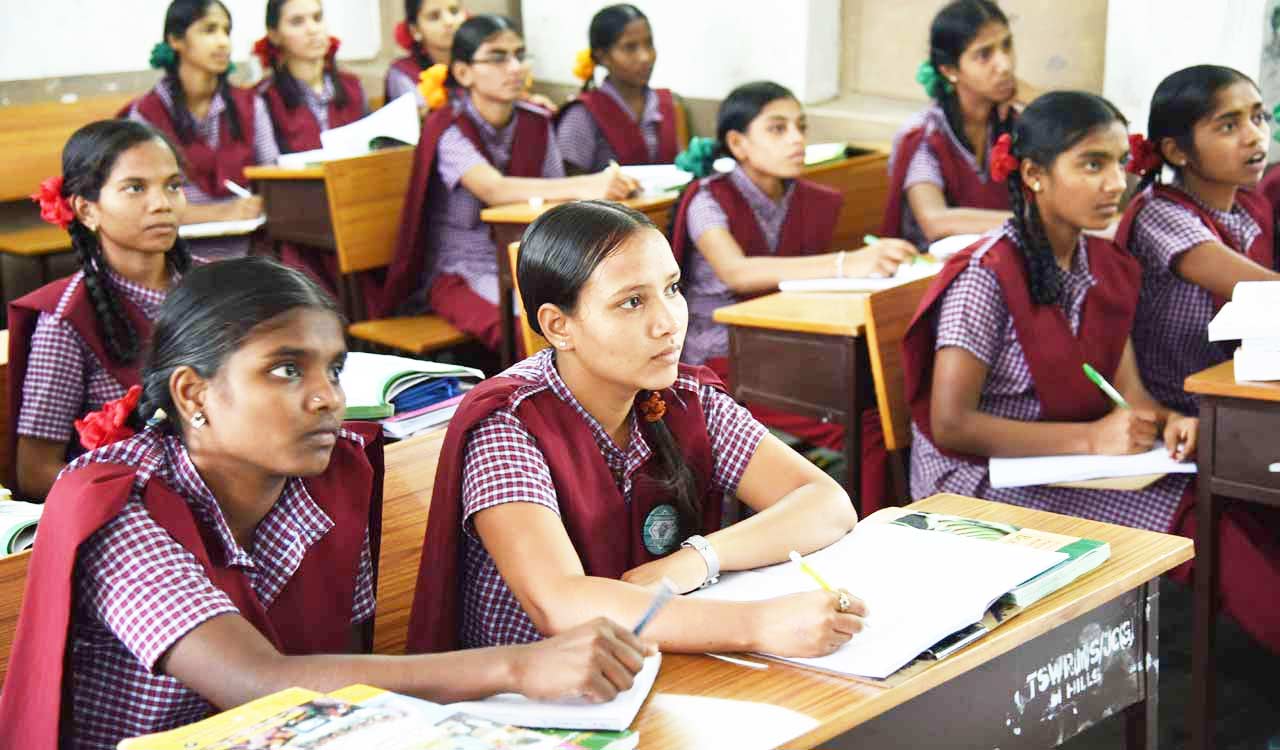
Education is not only a key social factor, but it is also a major determinant of the economic status of the country. Especially in a country like India, which homes the largest school-going population in the world, education holds even greater significance due to the country’s vast population and demographic diversity. Over the years, though the access to schooling has expanded considerably, challenges related to learning outcomes, retention, and public investment continue to shape the national education discourse.
Education is often described as the foundation for human capital growth and equitable social opportunities. Both globally and in India, quality education is established as Sustainable Development Goal 4, which aims to ensure inclusive, equitable, and quality learning for all. National policy frameworks such as the National Education Policy 2020 recommend that education expenditure should be atleast 6% of the country’s GDP to align with global standards. Yet, actual budget patterns show a persistent shortfall. According to a report from the UNESCO Institute for Statistics, India’s government expenditure on education ranged between about 4.1% and 4.6% of its GDP in recent years.
Despite this investment, education in India faces issues like insufficient utilisation of funds, a shortage of trained teachers, inadequate infrastructure in many institutions, and implementation challenges in education policies. These factors reduce the overall effectiveness of educational spending compared to the developed nations.
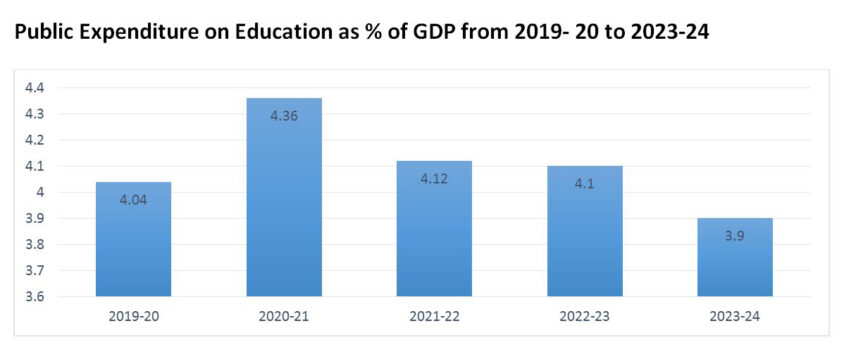
India’s commitment to education can best be understood through two key indicators, public expenditure on education and school enrolment trends. An analysis of recent data compiled from reports of the Ministry of Education and the Government of India from 2015-16 to 2023-2024 shows a mixed picture of financial allocation and participation in school education over the last few years. The country’s spending on education reached about 4.04% of GDP in 2019–20, but later declined to around 3.9% in 2023–24.
If we look at the different stages of education enrolment, the picture of India’s education status becomes much clearer. As per the UDISE+ 2024–25 report on “Enrolment of Students by School Management and Level of School Education,” India’s school education enrolment pattern for 2024–25 reflects a clear concentration at the early stages of schooling. The Preparatory stage accounts for 34.61% of total enrolment, making it the largest share among all levels. This is closely followed by the foundational stage at 30.78%, indicating that total enrolment is concentrated in the early years of education. As students progress to higher grades, the share of enrolment gradually declines. The decline becomes more pronounced at the Secondary stage, which accounts for only 10.89% of total enrolment.
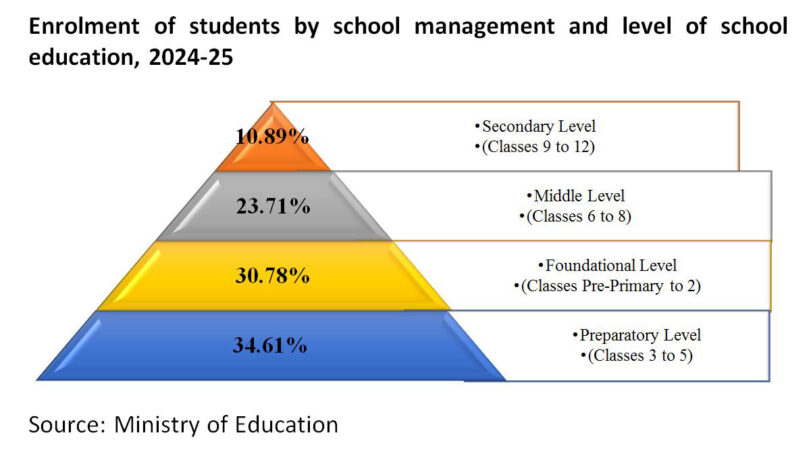
This pyramidal enrolment structure highlights the need for policies towards retention and transition rates as students move to higher levels of schooling. The decline in enrolment at the secondary level is generally linked to multiple structural, legal, and socio-economic challenges. While primary school access has expanded significantly over the years, students often encounter barriers when transitioning to higher grades.
The persistent low retention and transition rates at the secondary level reveal a deeper contradiction within India’s education framework. Under Article 21A of the Constitution of India, the State is obligated to provide free and compulsory education to all children between the ages of six and fourteen. Further, Article 24 explicitly prohibits the employment of children below fourteen years in factories, mines, or hazardous occupations. Together, these constitutional provisions establish education as a fundamental right and seek to shield children from economic exploitation.
However, once students cross the age of fourteen, the constitutional guarantee of free and compulsory education ceases, and dropout rates begin to rise. The main reasons revealed by many studies indicate that, for many economically vulnerable families, adolescents are expected to contribute to household income or assume domestic responsibilities.
According to an article published by Education for All in India, the limited availability of secondary schools in rural regions increases travel distance and reduces regular attendance. Financial constraints also intensify as children grow older, with many expected to support family income or take on household duties. In addition, learning deficiencies accumulated in earlier grades make it harder for students to adapt to the more rigorous secondary curriculum. Gender-specific concerns, including safety issues and early marriage, further contribute to lower continuation rates among girls. These combined factors result in a gradual narrowing of participation as students move up the education ladder.
State-wise status
A closer look at state-wise enrolment and education expenditure in India reveals a striking imbalance between population pressure and financial commitment. The data shows that while some states carry a significantly larger share of students, their proportional spending on education does not always reflect that responsibility.
Based on the data derived from School Education Statistics by UDISE+ (2024–25), Uttar Pradesh accounts for nearly27% of the total enrolment, making it the largest contributor to India’s school population. It is followed by Bihar (around 19%), Jharkhand (about 19%), and West Bengal (around 18%). These states dominate the enrolment landscape primarily due to their large population base and significant school-age demographic. In absolute terms, they shoulder a substantial share of the country’s educational responsibility.
However, the picture shifts when education expenditure is examined as a percentage of Gross State Domestic Product (GSDP). The northeastern states, such as Mizoram (5.11%), Manipur (around 5.7% in recent years), and Nagaland (4.82%), allocate a significantly higher proportion of their state income to education. These figures are well above the national average of 2.75%, indicating a stronger fiscal prioritisation of education relative to their economic size.
In contrast, some larger and high-enrolment states like Karnataka (1.43%) and Gujarat (1.36%) allocate a comparatively lower share of their GSDP to education. This highlights a structural challenge in India’s education system. States with the highest number of students are not dedicating a larger share to education. Meanwhile, smaller states with fewer students often demonstrate a stronger commitment.
This suggests that demographic weight and fiscal priority do not always move together. For India to improve educational quality, infrastructure, and long-term learning outcomes, high-enrolment states may need to strengthen their proportional investment. Bridging the gap between enrolment burden and financial commitment could be key to building a more balanced and effective education system nationwide.
Since education is largely a state subject in India, state governments play a key role in improving both funding and student outcomes. Differences in enrolment and spending across states show that stronger policy priorities can make a significant difference. States can improve the system by allocating a higher, more stable share of their GSDP to education, strengthening school infrastructure, ensuring adequate numbers of teachers, and improving learning resources.
Expanding secondary schools in rural areas, providing transport or financial support for students, and improving foundational learning can help reduce dropouts as students move to higher grades. Addressing social barriers, especially those affecting girls, is also essential to ensure that students not only enrol in school but also continue their education through the secondary level.
(Aishwarya HS, Shreya H are graduate students, and Dr Vijayalakshmi S is Assistant Professor of Economics at School of Business, RV University Bengaluru)

Related News
-

KTR extends financial aid to tribal student pursuing agriculture degree
-
Opinion: India’s inclusive education gap—why putting children in classrooms is not enough
-
Gang rape at elite university draws attention to rampant sexual assaults on US campuses
-
BRAOU to confer degrees on 36,145 candidates during Oct 7 convocation