Rewind: FIFA World Cup 2026 — The Beautiful Game begins, with changes
Expanded format, new rules, soaring costs and geopolitical tensions surround football’s biggest spectacle starting June 11


By Amit Banerjee
The 2026 FIFA World Cup, the world’s most popular quadrennial sporting event, is set to rule the roost from June 11 to July 19. However, it is bedevilled by several challenges, including myriad geopolitical tensions, massive security and safety concerns arising from cartel violence in Mexico, ballooning costs, sharply marked-up hotel and travel tariff, strict enforcement of US immigration and visa requirements, an expanded 48-team format (earlier 32) that increases the workload for participating teams, players and administrators alike and the hosting of 104 matches across three countries — United States, Canada and Mexico — entailing unprecedented levels of coordination.
Also Read
The traditional concept of soccer as ‘a game of two halves’ now gives way to ‘four-quarter ties’, with a mandatory three-minute cooling break in each quarter. Devised ostensibly to reduce the ‘heat stress’ and to ensure the general well-being of the players, the proposed change has invited the ire of soccer purists and the coaching fraternity. There is, however, a strong commercial rationale behind this questionable decision, as these intermissions will help FIFA rake in the moolah through enhanced commercial and advertising airtime.
US coach Mauricio Pochettino has lambasted the move, stating it will “cut the rhythm of the game.” Celebrated French coach Didier Deschamps has also voiced his anguish over the stoppages, as these interruptions will “kill any team’s momentum.”
The iconic 87,000-seat Estadio Azteca Stadium in Mexico City, which has witnessed several World Cup cliff-hangers, including Pelé’s heroics in the 1970 final and Diego Maradona’s incredible run past a host of English players in 1986 to score one of the greatest goals in World Cup history, will host the inaugural match between South Africa and Mexico on June 11.
The fabled venue has attracted attention for all the wrong reasons, largely due to the vehement opposition from local communities over the impact of the stadium’s renovation project on water supplies. This nails the presumption that major sporting mega-events are always an unmitigated boon for the local economy. The problem has been further exacerbated by the fact that renovation progress has not kept pace with early projections, putting a question mark over the stadium’s readiness for the big event.
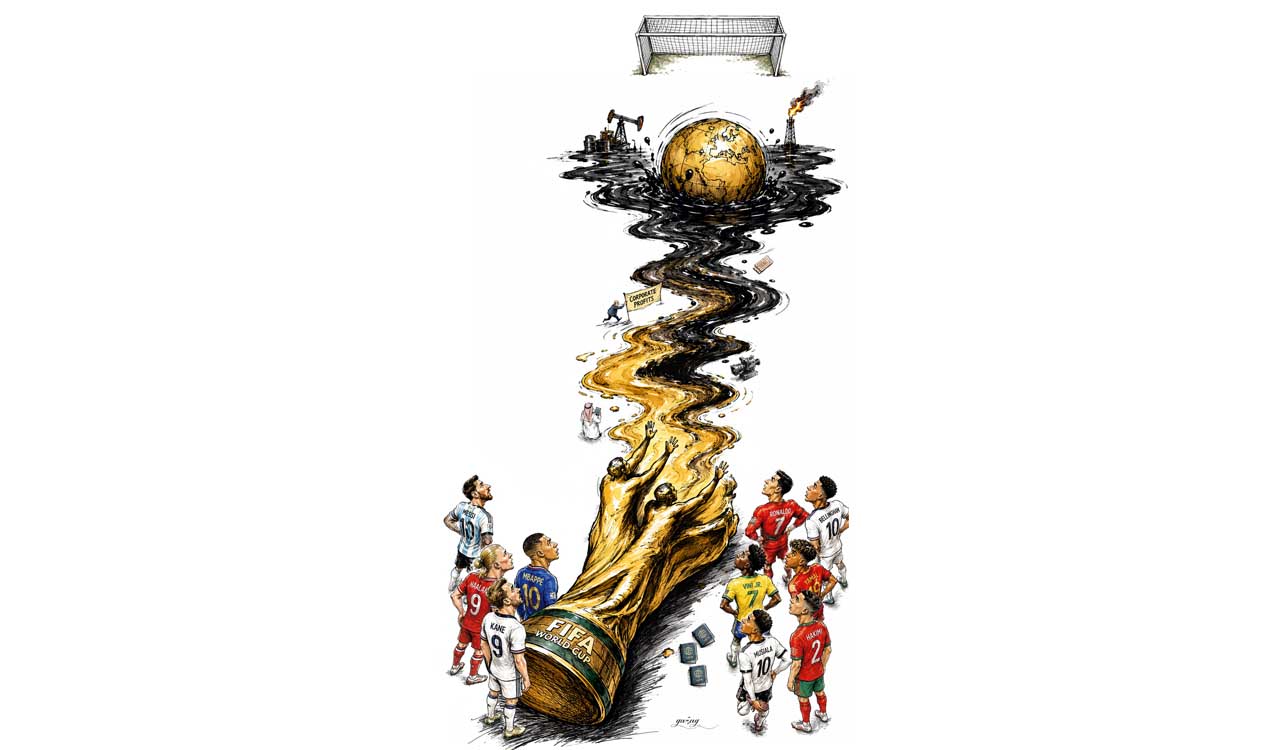
Pricey tickets, highly inflated resale ticket costs, outrageous commuter fares to different venues, and massive price surges in standard hotel rooms costing upward of $1,000 per night have added to the woes of the fans. The cheapest tickets for the matches are priced nearly three times the rates charged at Qatar 2022, while premium tickets for the final have been jacked up almost 30 times compared to those for the previous final.
The iconic 87,000-seat Estadio Azteca in Mexico City, best known for hosting legendary World Cup moments like Pelé’s 1970 final heroics and Diego Maradona’s 1986 ‘Goal of the Century’, will host the opening match between South Africa and Mexico on June 11
Considering that the World Cup is expected to bring seven million fans to North America, FIFA’s aggressive pricing strategy could prove to be a dampener in drawing hordes of supporters to the venues. These developments have already irked soccer lovers, who have accused FIFA of a ‘monumental betrayal’.
The problems have been further aggravated by the Trump administration’s travel ban on the fans and support staff of Senegal, Ivory Coast, Iran and Haiti, permitting exceptions only for the players, team officials and immediate relatives. Fans from Ghana, Egypt, Jordan and Morocco have to furnish prohibitive financial bonds of $15,000 to secure visas. This contradicts the claim of FIFA president Gianni Infantino that this World Cup will be “an unforgettable experience and most inclusive…ever.” The arbitrary travel ban has been justifiably slammed as “discriminatory, racist, and downright cruel” by Amnesty International.
Amid escalating geopolitical instability and global uncertainty with two competing teams at war, the highly competitive sport is confronted with one of its toughest challenges in recent times. As D-day approaches, the question lingering in the minds of soccer fans is whether the beautiful game can transcend these man-made challenges and emerge triumphant against all odds.
What’s New
The International Football Association Board (IFAB), a FIFA-affiliated body, has approved a slew of measures designed to enhance match tempo and minimise time-wasting tactics. These include:
• Time-limited substitution, which mandates that the player being subbed off during the match should leave the field within 10 seconds of being handed the signal.
• To dissuade players from making discriminatory slurs, any player covering his mouth with hand, arm or shirt in a confrontational situation will be awarded a red card.
• Video Assistant Referee to review any obvious errors made by officials in issuing a second yellow card that leads to a red card.
• Players leaving the field to protest against referee’s decision will be shown a red card.
• Any playing side that causes a match to be abandoned prematurely would, in principle, forfeit the game.
• Referees will implement a five-second visual countdown through an on-field signal to limit delays from throw-ins and goal kicks after the ball has gone out of play, failing which the ball possession shifts to the opposing team, which gets the throw-in and a corner kick in terms of delayed goal kicks.
• In the event of a player receiving an on-field assessment for an injury, he will be required to leave the ground for one minute after the resumption of the game.
• If a goalkeeper holds the ball inside the penalty area for more than eight seconds, the other side is awarded a corner kick.
• For offside to be awarded, there must be a clear gap — the so-called ‘daylight’ between the attacker and the defender. The offside rule will not apply as long as the attacker’s body is level with the defender’s.
Lampard’s Ghost Goal, The Golden Goal, Murder In Medellin: A fascinating peek into World Cup Memorabilia
- Footballer Luis Monti has the unique distinction of appearing in two consecutive World Cup finals for two different countries: Argentina 1930 and Italy 1934.
- The Indian team had qualified for the Brazil 1950 tournament but had to withdraw due to financial and logistical problems.
- At the 1954 World Cup in Switzerland, Hungary scored 27 goals—an enviable feat that remains unsurpassed in tournament history.
- After the Spain Vs Turkey qualification playoff in 1954 proved to be inconclusive, a blindfolded schoolboy, Luigi Franco Gemma, drew lots that enabled Turkey to make its World Cup debut.
- At the 1958 edition in Sweden, France’s Just Fontaine scored 13 goals in 6 matches, a single tournament record that stands even today.
- The tournament also marked the advent of Pelé, who became the youngest player and first teenager to score in a World Cup final. French forward Kylian Mbappe emulated the feat in Russia in 2018, becoming only the second teenager to score in a World Cup final.
- England’s Geoff Hurst notched up the first hat-trick in the 1966 World Cup Final organised in England, a feat repeated 56 years later at Qatar in 2022 by Mbappe.
- Mexico 1970 marked the introduction of yellow and red cards for the first time in World Cup history. Italy’s 4-3 triumph over West Germany in a keenly contested thriller in the tournament semi-final is often hailed as the ‘game of the century’.
- The 1986 event in Mexico took Maradona’s popularity to dizzy heights for his exemplary individual performance — more so for his ‘Goal of the Century’ and the contentious ‘Hand of God’ goal against England in the quarter final.
- Italy 1990 was made memorable by footballer Paul Gascoigne’s profuse breaking into tears during England’s semi-final loss against West Germany.
- The 42-year-old Roger Milla of Cameroon became the oldest scorer in World Cup history in the 1994 edition hosted in the USA, which also witnessed the suspension of Maradona for drug abuse and the murder of Colombian footballer Andres Escobar in Medellin days after scoring an inadvertent self-goal against the USA.
- In the 1998 edition hosted by France, Croatia made a dream debut by advancing to the semi-final stage. Also, France’s Laurent Blanc made history by scoring the first ‘Golden Goal’ (extra-time goal that ends a match) against Paraguay.
- In his final international outing in Germany in 2006, France’s Zinedine Zidane was given the marching orders after head-butting Italian player Marco Materazzi in the final.
- The 2010 edition is remembered for ‘Lampard’s ghost goal’. In England’s Round of 16 match against Germany, Frank Lampard’s shot crossed the goal line after hitting the crossbar, but with no goal-line technology in place, the goal was not awarded.
- The Video Assistant Referee system was introduced for the first time in Russia in 2018.
- At the 2022 Qatar showpiece event, Argentina’s 1-2 loss to Saudi Arabia ranks among the biggest upsets in World Cup history.

(The author is a freelance journalist)

Related News