Rewind: Modi’s India and cost of a Lost Decade—the ledger of broken promises
Did Narendra Modi make India perform better than it would otherwise have? A new study reconstructs the India that might have been and draws a stark conclusion: his era represents a “tale of broken promises”


By Pendyala Mangala Devi
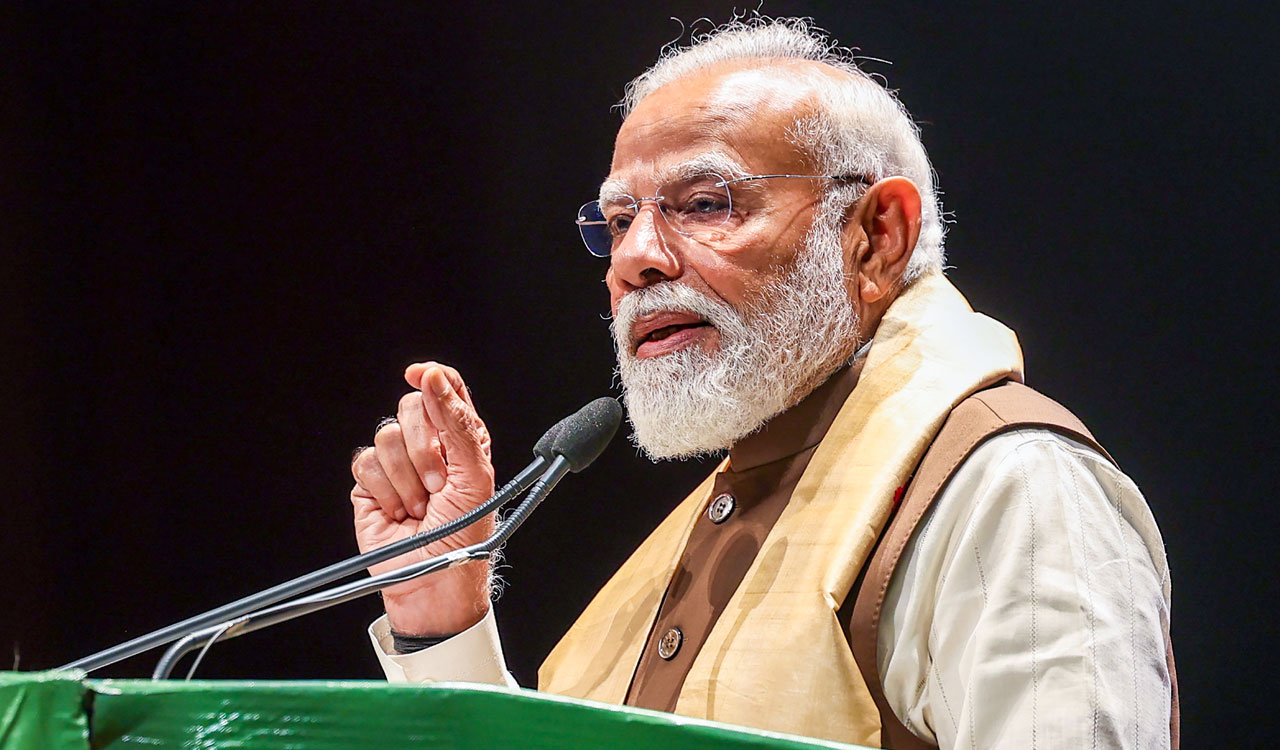
For more than a decade, Narendra Modi’s India has been presented as a story of extraordinary transformation. To his supporters, Modi was the decisive leader India had long awaited; a leader who broke through bureaucratic inertia, accelerated infrastructure development, digitised public services, strengthened India’s global profile and replaced the perceived indecision of the old political order with a more assertive and centralised style of governance. His political appeal rested on two powerful promises: the economic competence associated with the celebrated “Gujarat Model” and the governance doctrine encapsulated in the slogan, “Minimum Government, Maximum Governance.”
Also Read
To his critics, however, the same decade represented a very different transformation: the concentration of executive power, the weakening of institutional checks and balances, shrinking democratic space, pressure on civil society and a gradual erosion of constitutional safeguards.
For years, these competing narratives have been fought through speeches, slogans and selectively chosen statistics. Yet both sides often overlook the most important question: the test of governance is not whether India in 2024 had more infrastructure, technology or economic activity than it did in 2013. A country of India’s size would inevitably continue to change through technological progress, urbanisation, demographic expansion, private enterprise and global integration. The more difficult and meaningful question is this: Did Modi make India perform better than it otherwise would have?
That question lies at the heart of Promises, Promises: Governance and Growth in India under Modi and the BJP, by economists Kevin Grier and Robin Grier. The authors construct a “business-as-usual” India, an estimate of how the country might have evolved had its earlier political and economic trajectory continued, and compare it with actual performance after Modi came to power in 2014.
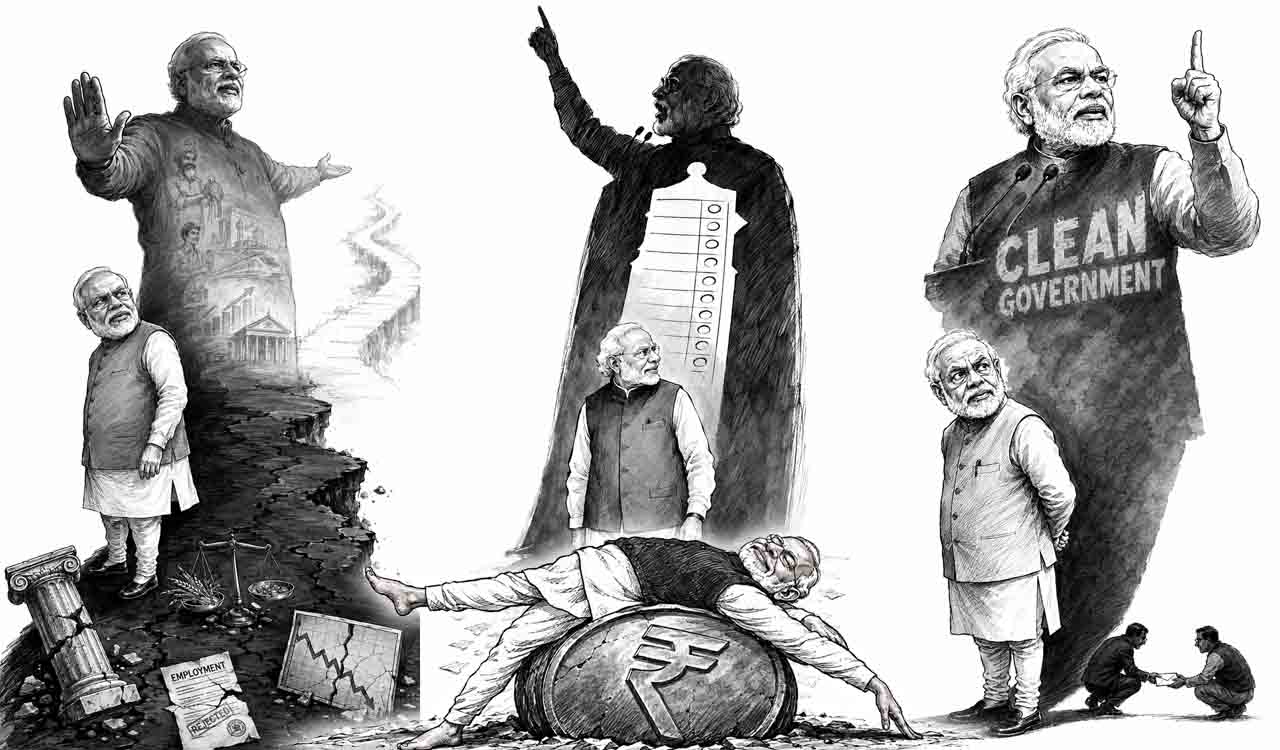
Their conclusion is stark. Modi’s tenure represents a “tale of broken promises.” India underperformed its counterfactual not only in governance and democratic health but also in economic growth, landing the country in what their analytical framework describes as the “Worst Case” scenario: simultaneous institutional deterioration and economic underperformance.
The Real Test
Modi did not come to power promising merely to continue India’s existing developmental trajectory. He promised to transform it. The “Gujarat Model” was presented as evidence that decisive leadership, administrative efficiency and a pro-business environment could generate superior economic outcomes. The political message of 2014 was unmistakable: the BJP would accomplish in 60 months what previous governments had failed to achieve in 60 years.
The governance promise was equally ambitious. ‘Minimum Government, Maximum Governance’ suggested that India would become more efficient, transparent and accountable.
The Griers take that promise seriously and test it empirically. Their question is not whether India grew after 2014. India did grow. The more important question is whether it grew faster and performed better than it would have under its previous trajectory.
To answer this, they use the Synthetic Control Method. Instead of comparing India with a single country, they construct a statistical “Synthetic India” using a weighted combination of countries whose economic and institutional trajectories closely resembled India’s before 2014.
In the economic model, Ethiopia carried the largest weight at 38%, China at 28% and Bangladesh at 25%, with smaller contributions from countries including Pakistan and the Philippines. The objective is not to suggest that these countries are politically identical to India, but to create a statistical counterfactual that closely reproduces India’s pre-2014 economic trajectory.
The pre-2014 fit is remarkably close. After 2014, however, actual India begins falling below its synthetic counterpart. That divergence forms the central empirical basis of the study.
Four Possible Outcomes
The authors develop a simple but powerful framework to assess the Modi era. There were four possible outcomes:
- Modi Promise: Better governance accompanied by stronger economic performance. This would validate the claim that improved institutions and more competent leadership produce superior development.
- Strongman Bargain: Democratic institutions might weaken, but the country would experience exceptional economic performance in return. Citizens might, therefore, tolerate greater executive concentration because the economic payoff was substantial.
- Democratic Paradox: Governance institutions improved, but the economy underperformed.
- Worst Case: Institutions weakened and the economy also underperformed.
The Griers’ findings place Modi’s India in the fourth category. India did not achieve the institutional improvement promised under “Maximum Governance.” Nor did it receive the extraordinary economic performance required to support the argument that concentrated executive power delivers superior development. Instead, it experienced deterioration on both fronts.
This is the most consequential finding of the research. The supposed trade-off between democratic safeguards and rapid economic development did not materialise. The Strongman Bargain failed. India paid an institutional price without receiving the promised economic dividend.
A Broad Decline in Governance
The governance findings are among the most striking elements of the study. The authors examine 10 institutional indicators drawn from the V-Dem database: electoral democracy, liberal democracy, legislative and judicial constraints on executive power, political corruption, equality before the law, freedom of association, freedom of expression, freedom of religion and equal protection under the law.
Across 10 indicators measured over 10 post-2014 years, the authors evaluate one hundred treatment effects. Ninety-six out of one hundred show India underperforming its synthetic counterfactual. Ninety-two of those effects are reported as highly statistically significant, with p-values of 0.00.
The deterioration extends across the architecture of democratic governance. (See Disturbing Decline) The findings challenge the argument that concerns about democratic decline are merely ideological criticism or the product of external bias. The synthetic counterfactual is assessed using the same methodology. The comparison is essentially between India’s actual trajectory and the trajectory India itself would have been expected to follow based on its historical pattern.
Disturbing Decline
- 96 of 100 governance measures showed India underperforming its synthetic counterfactual.
- Liberal democracy declined 69.1%, while freedom of expression fell 56.2%.
- Political corruption worsened 46.8% compared with the synthetic India benchmark.
- By the final treatment year, polyarchy, or electoral democracy, declined 60.2% relative to the 2013 baseline. Freedom of religion showed the most dramatic deterioration at 168.7%.
- Equality before the law declined 30.4%, freedom of association 29.6%, legislative constraints 28.8%, equal protection under the law by 26.1%, and judicial constraints by 12.7%.
Perhaps the most politically uncomfortable finding concerns corruption. Modi’s rise in 2014 was closely associated with the public demand for cleaner government. Yet the study finds that political corruption deteriorated by 46.8% relative to India’s synthetic counterfactual.
The question, of course, is not whether corruption existed before Modi. It clearly did. The relevant question is whether India became less corrupt than it would otherwise have become. According to the authors, it did not. This reveals a fundamental problem with the idea that centralisation automatically produces cleaner governance. Centralisation may eliminate competing centres of authority, but it does not necessarily eliminate corruption. It can simply alter its structure and make it more opaque.
The $1,000 Shortfall
The second pillar of Modi’s political project was economic competence. The “Gujarat Model” was presented as proof that his leadership could deliver superior growth. The Griers test that claim through real per capita GDP.
Their finding is clear: India began underperforming its synthetic counterfactual soon after 2014, and the gap widened over time. By the end of the study period, India’s real per capita income was approximately 10% below the counterfactual trajectory. In concrete terms, the authors estimate that the average Indian was earning roughly $1,000 less per year than the model suggests they would have earned under the business-as-usual counterfactual.
This does not mean that India became poorer. India grew. But the study’s argument is more demanding: India grew less than it could reasonably have been expected to grow. This is the difference between absolute growth and lost potential.
Lost potential is the most invisible form of economic failure. A recession is visible. A factory closure is visible. A financial crisis is visible. But income that was never earned cannot be photographed. Jobs that were never created do not appear in official statistics. Investments that never materialised leave no physical evidence.
That is the value of the counterfactual. It asks not merely whether things improved, but whether political leadership improved them more than the momentum already present in the system would have done.
Limits of Pandemic Excuse
The pandemic is the obvious explanation for India’s economic difficulties, but the authors address this argument directly. The divergence between actual India and Synthetic India had already begun before Covid-19. The pandemic may have intensified the problem, but it did not create the underlying gap.
Moreover, the countries used to construct the synthetic counterfactual also experienced Covid-19. The pandemic was a global shock, not an India-specific event. The authors further find that even when the pandemic years are excluded, the broad conclusion of economic underperformance remains.
Demonetisation, meanwhile, was a deliberate decision. The withdrawal of 86% of India’s circulating currency, therefore, belongs on the government’s economic record. Demonetisation was part of the Modi economic experiment. Its consequences must be part of the Modi economic ledger.
The authors also discuss the controversy surrounding India’s GDP methodology and the possibility that official growth estimates after 2015 may have overstated actual performance. If so, the study’s estimated 10% shortfall may actually be conservative. India’s true economic underperformance could be greater.
The Political Paradox
If economic performance fell below potential and institutional indicators deteriorated, why did Modi and the BJP continue to win elections?
The authors point to electoral arithmetic and political fragmentation. In 2014, the BJP secured a parliamentary majority with only 31.3% of the national vote. The party had substantial support, but India’s first-past-the-post electoral system allowed a consolidated vote to translate into a disproportionately large number of seats when opposition parties divided the remaining vote. In that election, 61% of Lok Sabha winners won with less than 50% of the vote. The BJP’s success was therefore amplified by the fragmentation of its opponents.
The 2024 election demonstrated the significance of this electoral arithmetic. Nationally, the BJP increased its vote share to about 36.6%, yet it failed to secure a majority on its own for the first time since 2014. The principal difference was greater opposition coordination under the I.N.D.I.A bloc.
Uttar Pradesh provided the clearest example. The BJP maintained a vote share of around 41%, broadly comparable to its earlier performance, yet its seat tally fell dramatically from 71 seats in 2014 to 33 seats in 2024. The difference was opposition coordination. The Samajwadi Party and Congress largely stopped competing against each other, reducing the division of the anti-BJP vote.
The lesson was unmistakable: votes do not automatically translate into seats. A fragmented opposition can turn a plurality into a landslide. A coordinated opposition can turn a similar plurality into a minority government.
The authors, therefore, explain the BJP’s political endurance not simply through economic performance but through the combination of a durable ideological base and a historically divided opposition. Identity, ideology and polarisation can weaken conventional economic accountability. Voters may tolerate institutional decline or economic underperformance if they believe that defeating the ideological opponent is more important than judging the government solely on its performance.
The authors do not claim that the Congress era was free from corruption, institutional weakness or governance failures. Nor do they argue that returning to the previous political order would automatically solve India’s problems.
Their argument is more precise. Modi promised to outperform the trajectory he inherited. The authors construct that trajectory statistically. They then ask whether he did. Their answer is no. This is not nostalgia. It is measurement.
India That Never Came into Being
The most important lesson of the Modi decade may lie not in the visible India of highways, airports, digital platforms and global summits, but in the invisible India that was never realised—the India that might have earned more, grown faster and preserved stronger democratic institutions.
The Griers’ analysis suggests that concentrated power did not produce the promised economic miracle. India did grow, but according to the study, it grew less than its own historical potential. Its institutions weakened without a compensating economic dividend. The real ledger of the decade must, therefore, record not only what was built, but what was lost: income never earned, opportunities never realised and institutional safeguards weakened. And the greatest loss of the decade may be the India that could have been.

Related News
-

PM Modi wishes speedy recovery to Pope Leo XIV as he undergoes surgery
-
Canada aims to seal trade pact during PM Modi’s visit: Indian envoy
-
SC stays trial in defamation case against Rahul Gandhi over derogatory remarks against PM Modi
-
PM Modi to launch Chennai metro stretch, inaugurate projects during visit today