RGUKT Basar celebrates National Science Day with expert lectures
RGUKT Basar marked National Science Day 2026 with five guest lectures on high-energy materials, topological materials, biotechnology and quantum computing. Speakers highlighted scientific research, interdisciplinary collaboration and the enduring relevance of C. V. Raman’s discovery.
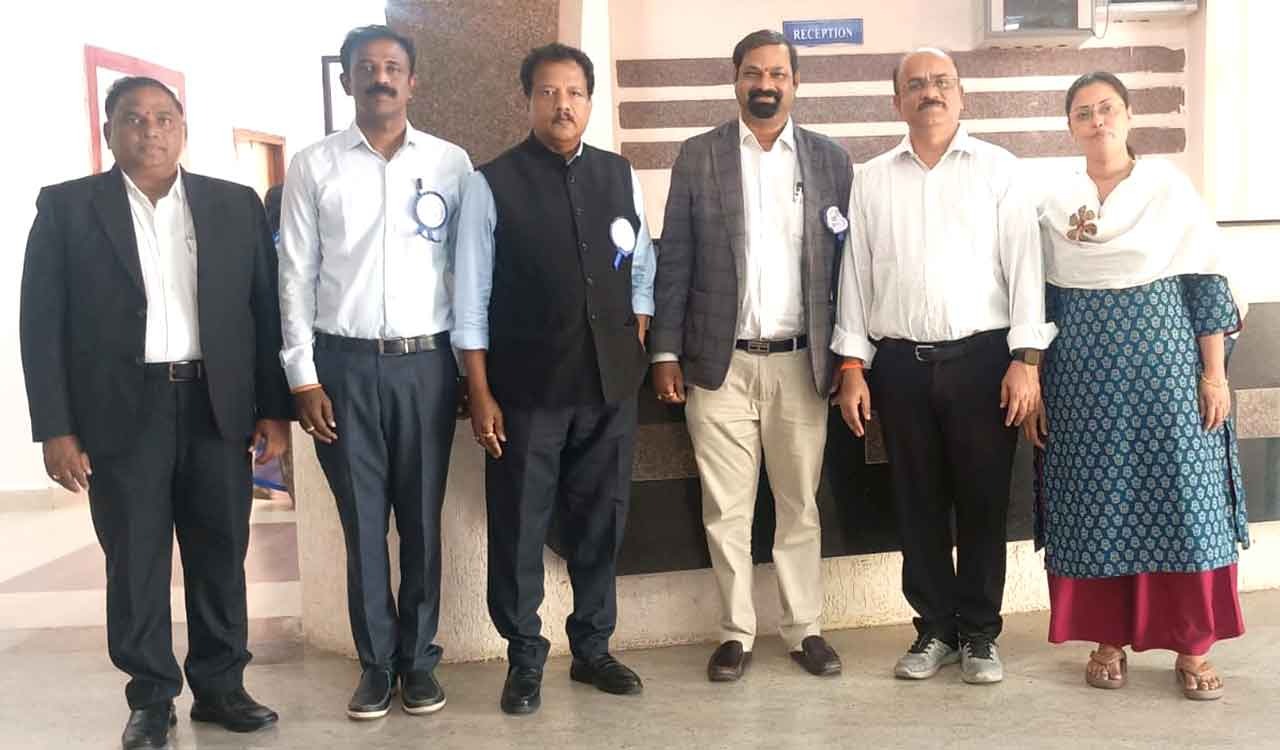


BASAR: The Department of Physics, Rajiv Gandhi University of Knowledge Technologies (RGUKT) has celebrated the National Science Day 2026 by organising five guest lectures delivered by eminent scientists from different parts of India.
Prof. G. S. Vaitheeswaran, Professor, School of Physics, University of Hyderabad delivered a lecture on high-energy materials under extreme conditions of high pressure and temperature. He elaborated on how scientists optimise computational parameters to closely match experimental observations.
Prof. V. Kanchana, Fellow of the Royal Society of Chemistry and Professor, Department of Physics, IIT Hyderabad spoke on topological materials and their simulations across various scientific fields.
Prof. A. Uma, Centre for Biotechnology (CBT), JNTUH, Hyderabad, spoke about the importance of science in everyday life and the interdisciplinary nature of scientific progress.
Prof. Odelu Vanga, Department of Computer Science and Engineering (CSE), University of Hyderabad, delivered a lecture on quantum computing — exploring its principles, emerging applications, and transformative potential for the future of technology.
The programme was inaugurated afer an address by the University vice chancellor Prof. A. Govardhan and a talk by Prof. E. Murali Darshan, Administrative Officer. Dr. G. Devaraju, Head of the Department of Physics and Convenor, NSD 2026, welcomed the gathering. In his welcome address, he He explained that when matter is irradiated, an unknown radiation is emitted as the molecule enters an excited state, producing scattered light that serves as a unique fingerprint of the molecule and its chemical composition — the very essence of Sir C. V. Raman’s Nobel Prize-winning discovery. He noted that this principle continues to drive cutting-edge research in spectroscopy, materials science, and beyond.

Related News