
Rich legacy of Japanese ceramic craft
Hyderabad: Asian ceramics have always been sought-after by the collectors of decorative antiques across the globe. With their exquisite beauty and rich history of craftsmanship, Asian antiques add a touch of traditional sophistication to an interior and can accentuate an antique collection tremendously. Traditionally known as ‘Yakimono’ meaning “fired thing” or “burned thing,” ceramics from […]
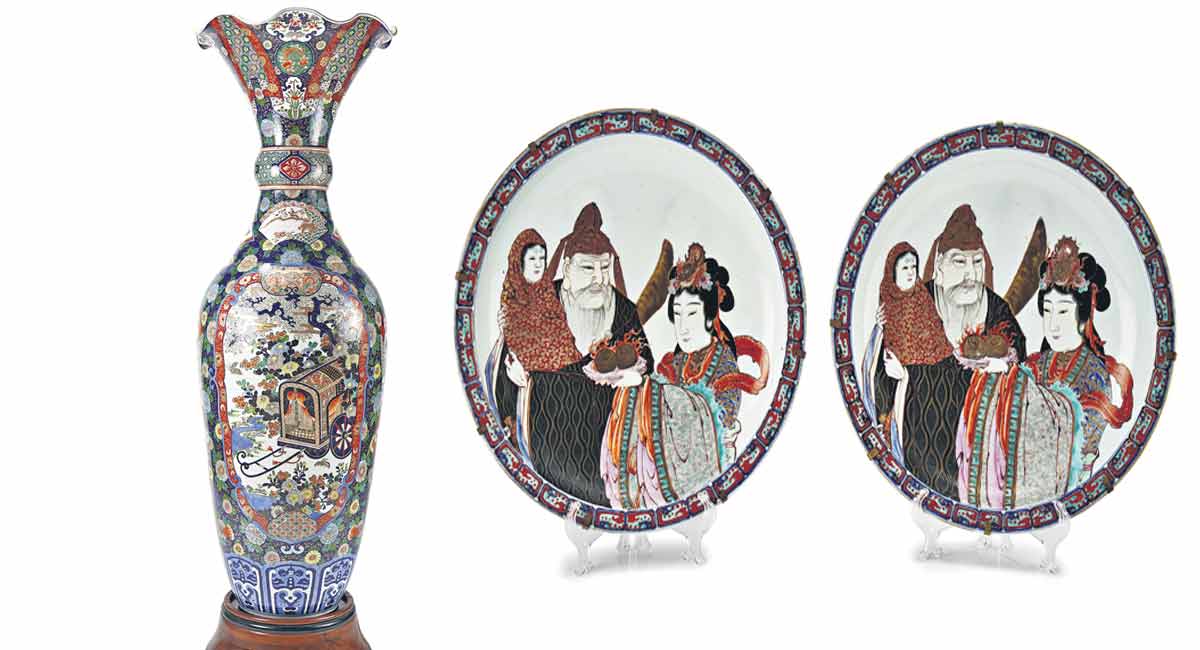


Hyderabad: Asian ceramics have always been sought-after by the collectors of decorative antiques across the globe. With their exquisite beauty and rich history of craftsmanship, Asian antiques add a touch of traditional sophistication to an interior and can accentuate an antique collection tremendously.
Traditionally known as ‘Yakimono’ meaning “fired thing” or “burned thing,” ceramics from Japan include a wide range of objects spanning from aesthetic sculptures to utility ware to decorative pieces of profound beauty. Of the various types and styles of ceramics originating in Japan, Satsuma and Imari have carved a special identity owing to their timeless beauty and uniqueness.
The creation of Japanese Satsuma ware goes back to the 16th century. Satsuma ware was firstly produced at Naeshirogawa in Satsuma by skilled Korean potters who were brought by the Prince of Satsuma, Shimazu Yoshihiro to Kyushu following the invasions of Korea by Japan in 1597. Forty-seven Korean craftsmen including the leader of potters, Park Ping Yi (Seiemon Okimochi), settled and established the first kiln in Naeshirogawa. In 1617, they discovered white pot clay and started to make white pottery (Shiro-Satsuma), in contrast to the traditional local black pottery (Kuro-Satsuma).
Initially, typically floral and stylized geometric patterns were applied to create Satsuma wares. With hand, Korean potters began producing vessels for tea ceremonies and other utilitarian purposes. A distinctive aspect of Satsuma earthenware is a cream coloured body over which a clear or slightly yellowish glaze is applied, creating a delicate finely crackled network. Early Satsuma pottery was simple and undecorated. In the 17th and 18th centuries, the production was small and was intended for only the Shimazu clan.
By the 18th century, the Satsuma vases were revolutionised with a new range of designs, colours, and techniques. Created with white clay and covered with a cream-coloured glaze, Satsuma vases were skilfully decorated in thick applied gold and multi-coloured, bright overglaze enamels. The decorative themes on these pieces were inspired by ancient Japanese culture and typically included literary and mythological scenes depicting flowers, birds, oriental landscapes, Shishi, dragons, and phoenix.
Imari ware is another highly desired category of ceramic that was first created in Japan in the 17th century. Originating in the town of Arita, Imari ware inherited its name from the port of Imari used to ship these objects to the westWith the passage of time, the designs on Imari ware became more intricate as craftsmen started to include the depictions of lush landscapes and fantastic scenery in their creations.
They also adopted various motifs popularly used in the Japanese textile at the time such as gnarled tree branches, fish, cranes, as well as Japanese figures including courtiers and beautiful women. A wider variety of bright colours including rust red, green, and gold were also introduced in the production leading to the bright iconic palette that Imari ware is most famous for.
From 18th century onwards, Japanese porcelain became increasingly popular not just in Asia but also in western countries. Seeking an alternative to China’s ceramics, the Dutch East India Company started to ship significant amounts of Japanese ceramic ware to western countries.
While used for decoration and as high-end crockery, Japanese porcelain also became symbolic of an augmented status in royal palaces and affluent societies. In the modern world, it enjoys a special status among the collectors of antiques.
Several Satsuma and Imari wares dating from different eras will be a part of our upcoming auction scheduled on January 27 to 28, 2022.
Sneha Gautam, Vice President Client Relations, AstaGuru auction house
Now you can get handpicked stories from Telangana Today on Telegram everyday. Click the link to subscribe.
Click to follow Telangana Today Facebook page and Twitter .
