Supreme Court seeks CBSE response on revised three-language policy
The Supreme Court has issued notices to the Centre, CBSE and NCERT on fresh petitions challenging the revised three-language policy. The court sought responses within two weeks, declined interim relief and scheduled a detailed hearing on July 29
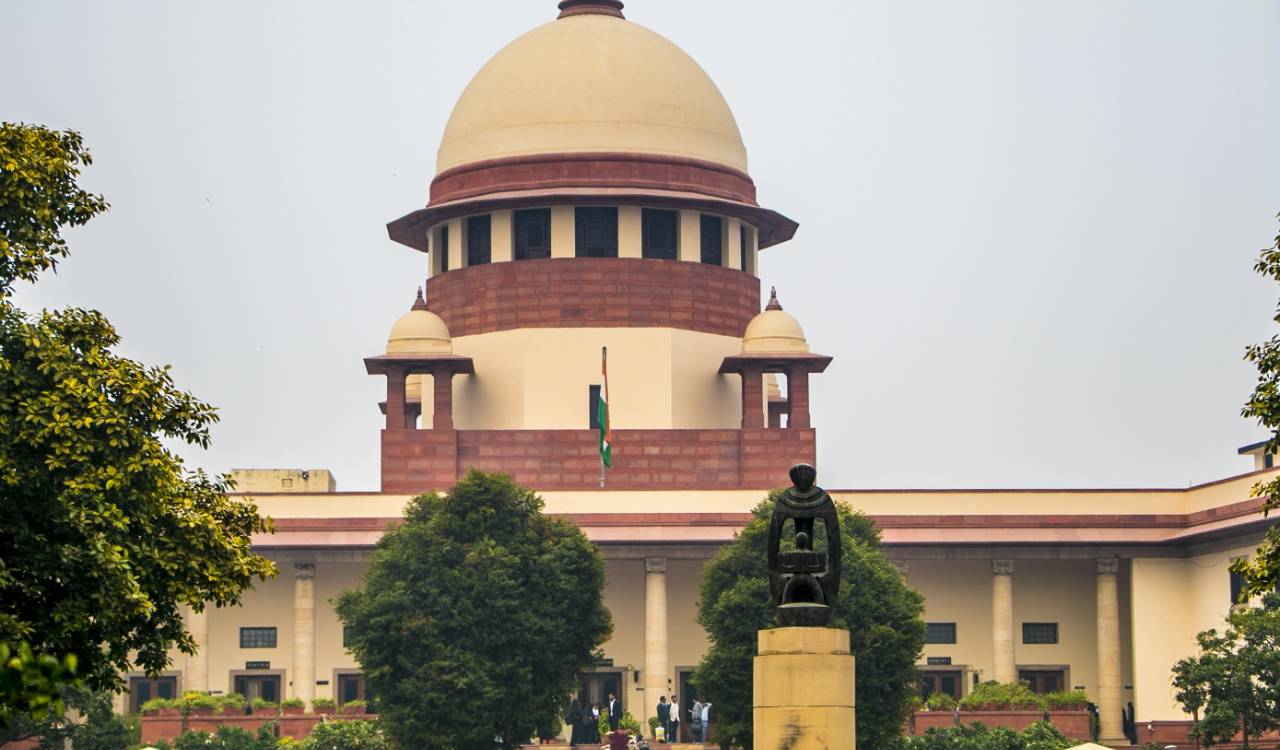


New Delhi: The Supreme Court on Tuesday issued a notice to the Central Board of Secondary Education (CBSE) on a fresh batch of petitions challenging the implementation of its revised three-language policy, which mandates the study of two Indian languages from Class 6 onwards, and sought its response within two weeks.
A Bench of Chief Justice of India (CJI) Surya Kant and Justices Joymalya Bagchi and V. Mohana issued notice to the Centre, the CBSE, and the NCERT on the fresh petitions and fixed the matter for detailed hearing on July 29.
No interim stay on the operation of the impugned CBSE circulars was granted at this stage. Appearing for the CBSE, Additional Solicitor General Aishwarya Bhati assured the apex court that it would file its response within two weeks.
The fresh petitions challenge the CBSE’s Secondary School Curriculum (Classes IX-X) 2026-27 and circulars dated April 9 and May 4, contending that they make the study of two languages “native to India” compulsory from Class 6 onwards in CBSE-affiliated schools, contrary to students’ academic choices and fundamental rights.
The petitioners, represented by senior advocate Anand Grover, along with advocates Tripti Tandon and Advocate-on-Record Rohit Kumar-I, argued that the policy has been implemented without authority of law and is unconstitutional.
According to the plea, the petitioners are parents of children studying in Class 6 in CBSE-affiliated private schools in Delhi-NCR whose children had been studying English, Hindi and a foreign language.
It alleged that after the commencement of the academic session, schools abruptly discontinued foreign languages and directed students to study Sanskrit instead, causing “enormous mental stress, anxiety and uncertainty”.
The petition contended that under Section 29 of the Right to Free and Compulsory Education Act, 2009, only the National Council of Educational Research and Training (NCERT), as the notified academic authority, is empowered to prescribe the curriculum for elementary education, including Class 6.
“The 2026-27 CBSE Curriculum has neither been developed nor issued by the Respondent No.3, as required by the RTE Act, 2009. It is therefore, without legal sanction and cannot be enforced in respect of children studying in class VI,” the plea said.
It further claimed that the abrupt implementation of the revised curriculum after the academic session had already commenced was arbitrary and unreasonable.
“The sudden imposition of changes in the linguistic curriculum for class VI, after the commencement of the academic year… is arbitrary and unconstitutional,” the petition said, adding that schools were directed to comply with the revised curriculum within seven days, effectively ending the teaching of foreign languages “overnight”.
The plea also questioned the feasibility of implementing the revised language framework in the absence of textbooks and teaching material, highlighting that NCERT itself had reconstituted the committee responsible for developing school syllabi and textbooks.
“It is inconceivable how the new linguistic curriculum will be implemented without proper syllabi and teaching and learning materials,” the petition submitted.
The petitioners further argued that the CBSE circulars infringe the fundamental right to freedom of speech and expression under Article 19(1)(a), relying on the Constitution Bench judgment in State of Karnataka vs. Associated Management of English Medium Primary and Secondary Schools (2014).
The petition also challenged the classification of English as a non-native language for the purposes of the policy, contending that English, being one of the official languages of the Union under the Official Languages Act, 1963, cannot be equated with foreign languages such as French, German or Spanish.
It described the requirement compelling students to choose between English and a foreign language as “irrational and arbitrary”.
Further, the plea alleged that the revised framework discriminates against middle-class students studying in CBSE schools by effectively depriving them of the opportunity to learn foreign languages, while such options remain available in more expensive international boards.
The petitioners also argued that the policy runs contrary to the National Education Policy (NEP) 2020, which emphasises flexibility, learner choice and academic autonomy, and instead compels students to study two Indian languages irrespective of their interests or aspirations.
The Supreme Court is already seized of an earlier batch of petitions challenging the revised three-language policy.
In May, a Bench headed by CJI Kant had issued notice to the Union government, CBSE and NCERT after agreeing to examine the validity of the revised framework mandating Class 9 students to study three languages, including at least two Indian languages.
At that stage as well, the apex court had declined to stay the implementation of the policy, observing that it would examine implementation-related concerns, including the availability of teachers and study material, while leaving constitutional questions to be considered during the final hearing.
Meanwhile, the CBSE has since issued further implementation guidelines clarifying that the third language (R3) will not be a Board examination subject in the Class 10 examination for the present batch of Class 9 students.
However, students will have to successfully clear the school-based assessment in the third language to become eligible for the CBSE Secondary School Examination Pass Certificate.
The Board also clarified that while students promoted to Class 10 without clearing the third-language assessment in Class 9 would be given an opportunity to qualify during the following academic year, those entering Class 6 from the 2026-27 academic session would eventually face a Board examination in the third language once the curriculum and textbooks are fully rolled out.
Related News
-

ED letters to Punjab DGP: Mann govt moves SC against HC-ordered CBI probe
-
SC directs Assam authorities to examine concerns raised over recurring floods and erosion
-
Supreme Court seeks Delhi Police response on recent rape, sexual assault cases
-
Plea challenging CEC’s individual exercise of ECI powers before SC on Monday