Telangana posts Rs 15,096 crore revenue deficit in six months
Telangana recorded a revenue deficit of Rs 15,096 crore in the first six months of 2026-27 as expenditure outpaced receipts. Higher borrowing limits, substantial interest payments, pension commitments and weak non-tax revenue collections are adding to the State’s fiscal pressures.
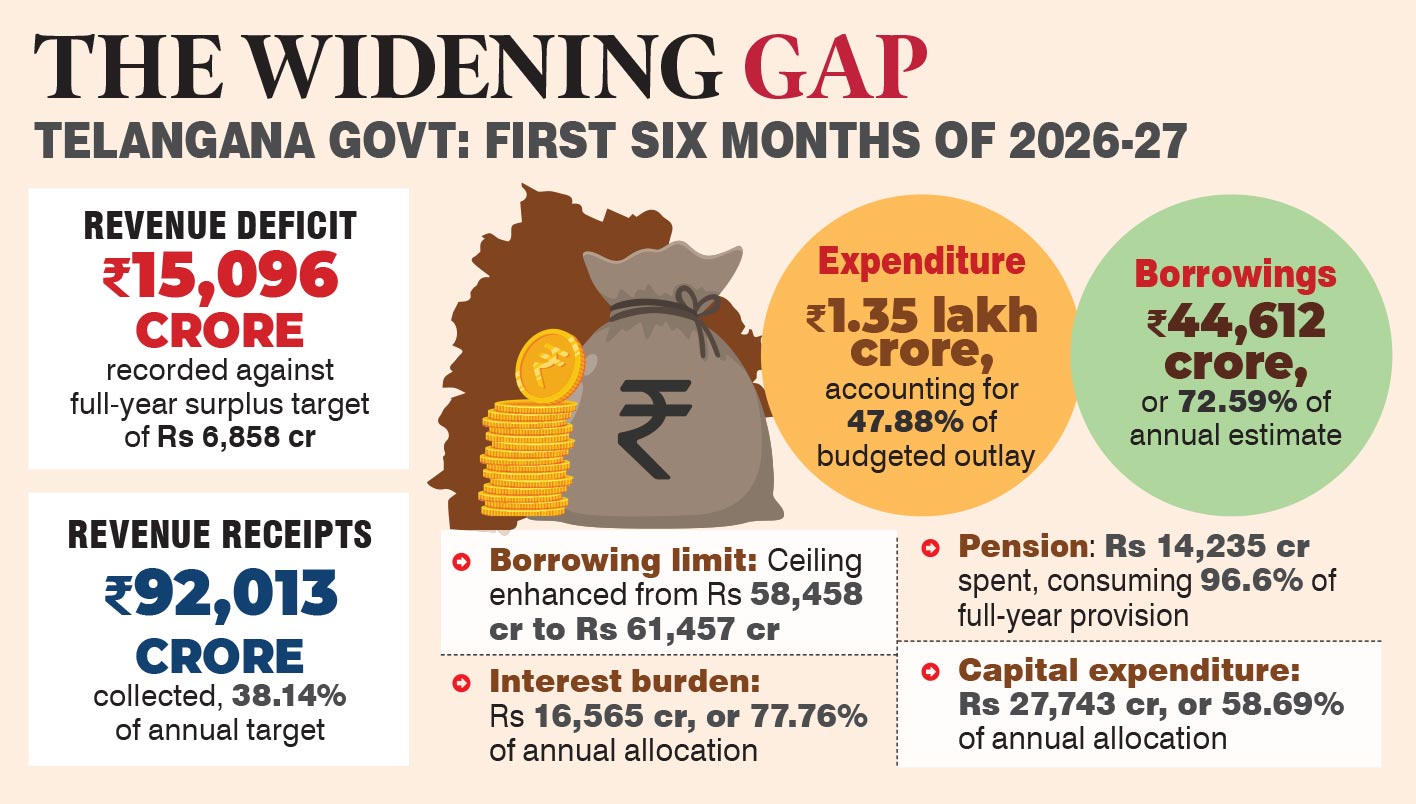


Hyderabad: Telangana is facing not just a natural El Nino, but also a financial drought, with the State recording a revenue deficit of Rs 15,096 crore in the first six months of 2026-27. During the same period, its annual borrowing limit was enhanced from the budget estimate of Rs 58,458 crore to Rs 61,457 crore. The September accounts indicated that expenditure was outpacing revenue, while interest payments and pensions were consuming a substantial share of the State’s resources.
According to the State Accounts for September, revenue receipts stood at Rs 92,013 crore, or 38.14 per cent of the annual budget estimate of Rs 2.41 lakh crore. Total expenditure, including capital expenditure, reached Rs 1.35 lakh crore, accounting for 47.88 per cent of the budgeted outlay. The gap between revenue receipts and revenue expenditure widened to Rs 15,096 crore.
The State budgeted a revenue surplus of Rs 6,858 crore for the full financial year. The mid-year deficit raises questions about the government’s ability to meet that target without containing expenditure or improving revenue mobilisation in the remaining months.
The revised borrowing ceiling of Rs 61,457 crore is also significant. Net borrowings and other liabilities had reached Rs 44,612 crore by September, equivalent to 72.59 per cent of the annual estimate. While the higher limit provides additional borrowing headroom, it also underlines the State’s dependence on debt to finance its spending commitments.
Official sources said the revised borrowing limit was granted with the Centre’s consent after the Congress government in the State agreed to implement certain structural reforms. However, they declined to elaborate on the specific reforms the government had agreed to undertake. The State revised only the borrowing limits, while all other accounts remained unchanged from the annual financial estimates.
Interest payments alone reached Rs 16,565 crore, or 77.76 per cent of the annual allocation of Rs 21,304 crore. Pension expenditure stood at Rs 14,235 crore, consuming 96.6 per cent of the Rs 14,737 crore budgeted for the entire year. Subsidy spending reached Rs 10,298 crore, or 56.88 per cent of the annual provision.
Capital expenditure, which can support infrastructure creation and long-term economic growth, stood at Rs 27,743 crore, or 58.69 per cent of the Rs 47,267 crore budgeted. Although this was substantial in absolute terms, it remained below the 60.84 per cent utilisation recorded during the corresponding period of the previous year.
Revenue performance also remains uneven. Tax revenue reached 45.52 per cent of the annual target, but non-tax revenue was only 16.1 per cent of its estimate and grants-in-aid 15.34 per cent. The weak collection of non-tax revenue and grants adds to the pressure on the State’s finances.

Related News