Telangana’s Mudumal Menhirs set for major archaeological dig
The Telangana Heritage Department will begin excavations at the 3,000-year-old Mudumal Menhirs site in Narayanpet district to strengthen its case for UNESCO World Heritage status. Studies suggest the site may have functioned as a prehistoric observatory with stone alignments and star maps
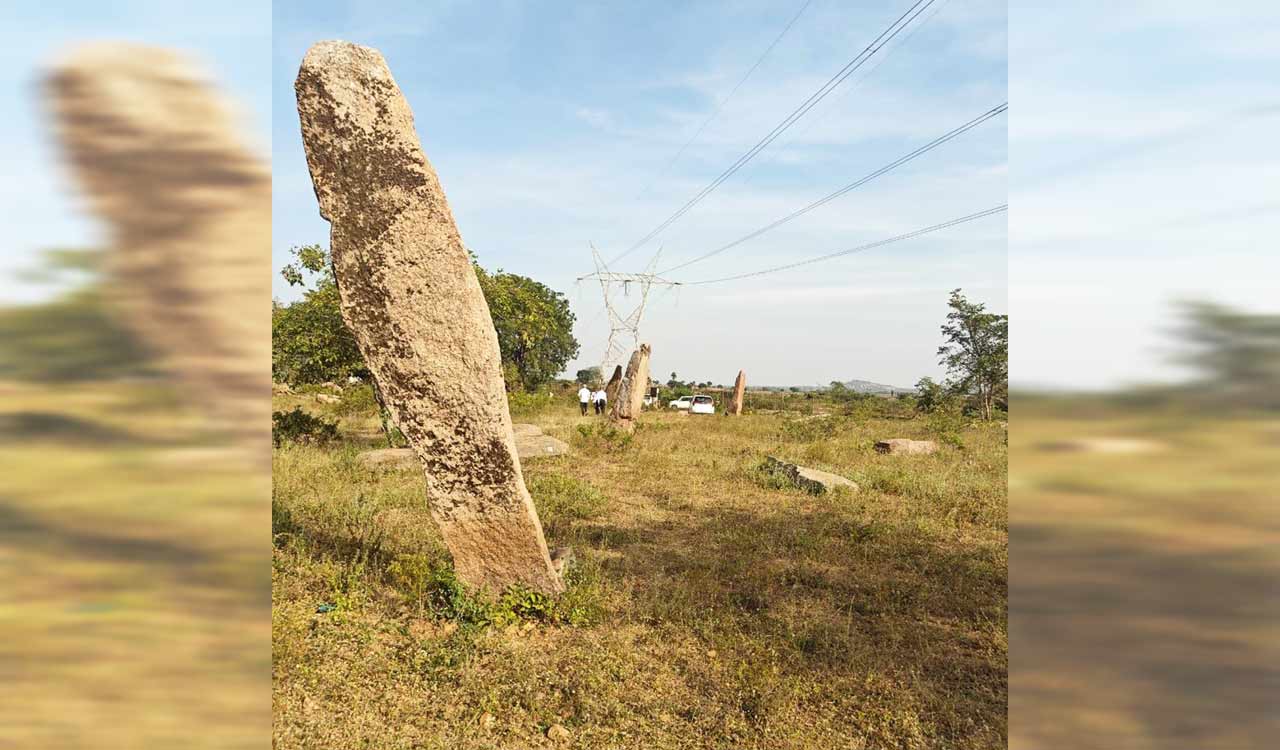


Hyderabad: For centuries, they withstood the vagaries of time and elements of nature. Now, excavations will unravel the mystery of menhirs, upright stones of a kind erected during the prehistoric era, in Narayanpet district.
With an aim to secure UNESCO World Heritage site tag, the Telangana Heritage Department is set to undertake excavations at Mudumal Menhirs, a megalithic burial site, in Mudumal village of Narayanpet district. These menhirs have made it to the tentative list of UNESCO World Heritage sites.
“We have received necessary permissions from the Archaeological Survey of India for excavation, which will commence in the second week of April,” said Prof K Arjun Rao, Director, Heritage Department.
The archaeological site, which is home to 80 big menhirs, is one of the important areas in the State that reflects people’s culture, tradition and astronomical knowledge who lived here some 3,000 years ago.
Originally spread across about 80 acres, each menhir is about 3 metres and 5 metres tall. In addition, there are several thousands of aligned boulders of about 1 metre to 1.5 metres in width and breadth, with a height of 0.5 to 1 metre. The site also has several megalithic stone circles, which are under the department’s protection.
Following the excavation, DNR samples from the site will be sent to CSIR-CCMB to ascertain who the people were and their ancestry.
“Thermoluminescence, a technique to find out how old objects are, will be carried out in collaboration with NGRI. The samples will be sent to Beta Labs, US, for Carbon-14 testing that estimates the age of burial. This scientific study will be submitted as a dossier to the UNESCO seeking World Heritage site tag for Mudumal Menhirs,” said Dr P Nagaraju, Excavation Director and Deputy Director, Heritage Department.
As per the department’s preliminary study, menhirs of Mudumal are in patterns known as Alignments (single rows) and Avenues (two parallel rows), suggesting they were placed to track sun’s movement and mark summer and winter season, besides creating calendars.
Further, on a small hill near the site, thousands of smaller stones arranged in patterns, including stone circles, had been found. Among these, a near-square stone about 80 cm tall has a sloped top with cup-shaped markings.
The study showed that these marks depict the Ursa Major constellation, which is also known as ‘Saptarshi Mandala’ in India.
This, as per the department, could be one of the earliest known star maps in South Asia made around 3,000 years ago. The arrangement of the stones, along with the sun’s alignments and star map, suggested that Mudumal functioned as a megalithic observatory.

Related News