What makes a star a star? A strange ‘in-between’ celestial object is testing astronomers’ boundaries
Astronomers have identified TOI-2155b, a rare celestial object about 80.6 times Jupiter’s mass, lying on the boundary between a brown dwarf and a star. Its study could improve understanding of how stars ignite and where the stellar mass threshold begins
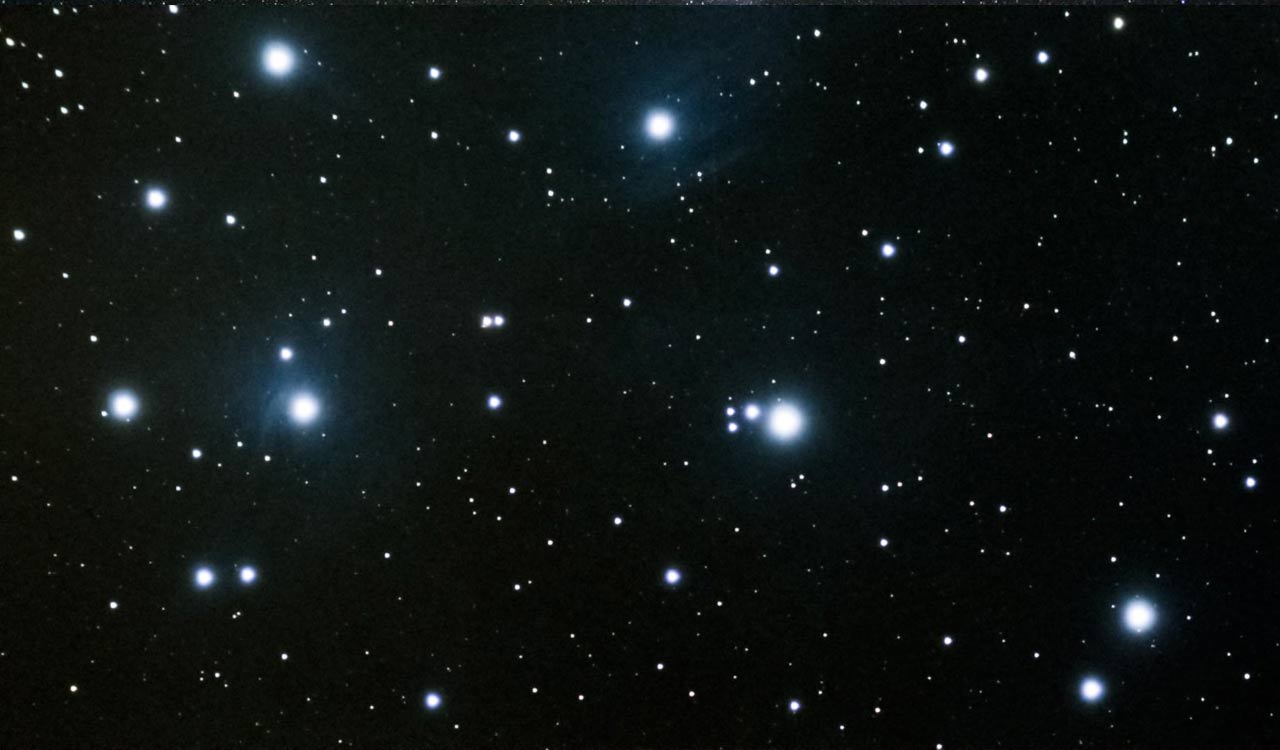


Sydney: Around 1,350 light years away from Earth is a star called TOI-2155. It’s a little bigger, heavier and hotter than the Sun, and it’s not particularly interesting or unusual in itself.
But orbiting around TOI-2155 is something very interesting indeed: a much smaller object called TOI-2155b, which we only know about by observing the tiny changes in light from the host star when the smaller object passes in front of it.
What is TOI-2155b? A mini-star? A giant planet? Or something in between? I’m glad you asked.
As my collaborators and I write in a recent paper in The Astronomical Journal, we’re not yet sure whether TOI-2155b is quite a star. But it seems to live on the fascinating boundary between a celestial beacon blazing through the heavens and a failed star that never quite ignites sustained hydrogen fusion.
Why stars fail
Stars start out as huge blobs of gas in space – but how big and heavy does a blob of gas have to be before it becomes a star? It sounds like a simple question, but astronomers have debated the answer for decades.
The gravitational pressure inside a star has to be great enough to fuse hydrogen atoms together into helium atoms, and to do it consistently for a long period. This is what creates the intense stream of heat and light that is a star’s signature.
If an object isn’t quite big enough to generate that much pressure – or if fusion doesn’t really kick off properly for some other reason – the gas becomes a kind of “failed star” known as a brown dwarf. These objects are hot early in life, but without sustained hydrogen fusion they gradually cool, giving off a dim infrared glow.
To learn more about why some blobs become stars and others become brown dwarfs, astrophysicists look for objects in the intermediate zone – the heaviest brown dwarfs and the lightest of stars.
That’s where TOI-2155b comes in. Weighing in at around 80.6 times the mass of Jupiter, it sits right on the theoretical boundary.
Where do stars end and brown dwarfs begin?
Using observations from NASA’s Transiting Exoplanet Survey Satellite (TESS) together with ground-based telescopes around the world, we determined the size and mass of TOI-2155b precisely. Although it is almost the same size as Jupiter, it is around 80 times more massive.
You might expect there to be a precise mass at which an object suddenly becomes a star. But as so often happens, in real life there is no clean line.
Astronomers have traditionally placed the boundary near 75–80 times the mass of Jupiter. But modern theoretical models show the transition depends on other factors as well as mass.
An object’s age, its chemical composition, and even its atmospheric properties influence whether it can have sustained hydrogen fusion. That is why astronomers still disagree about exactly where the mass boundary between brown dwarfs and stars should be drawn.
A remarkably rare object
TOI-2155b may be one of the most massive brown dwarfs ever discovered – or one of the lightest stars. There are very few known objects in this transition zone of mass, and TOI-2155b will help us better understand the boundary.
Astronomy often learns the most from its rarest objects.
However, one object alone cannot determine the exact location of that boundary. Only once we have discovered and precisely studied more objects in this transition region can we refine our models to understand the conditions that allow a star to ignite and burn for billions of years – the process that has made the universe as we know it.

Related News
-

Incredible to watch capability ISRO is developing in science missions: Indian-American NASA senior official
-
Editorial: Question mark over ISRO’s future
-
Astronauts remove faulty ISS antenna during spacewalk; out of time to install spare
-
NASA invites ISRO to join Moon Base programme for lunar South Pole outpost