Explainer: 30 years since Dolly’s birth, where does cloning stand today?
Thirty years after Dolly the sheep became the first cloned mammal, cloning has evolved from a sci-fi idea into a biotechnology tool. Scientists now use cloning for disease research, conservation and agriculture, while challenges remain in efficiency, ethics, extinct species revival and human cloning
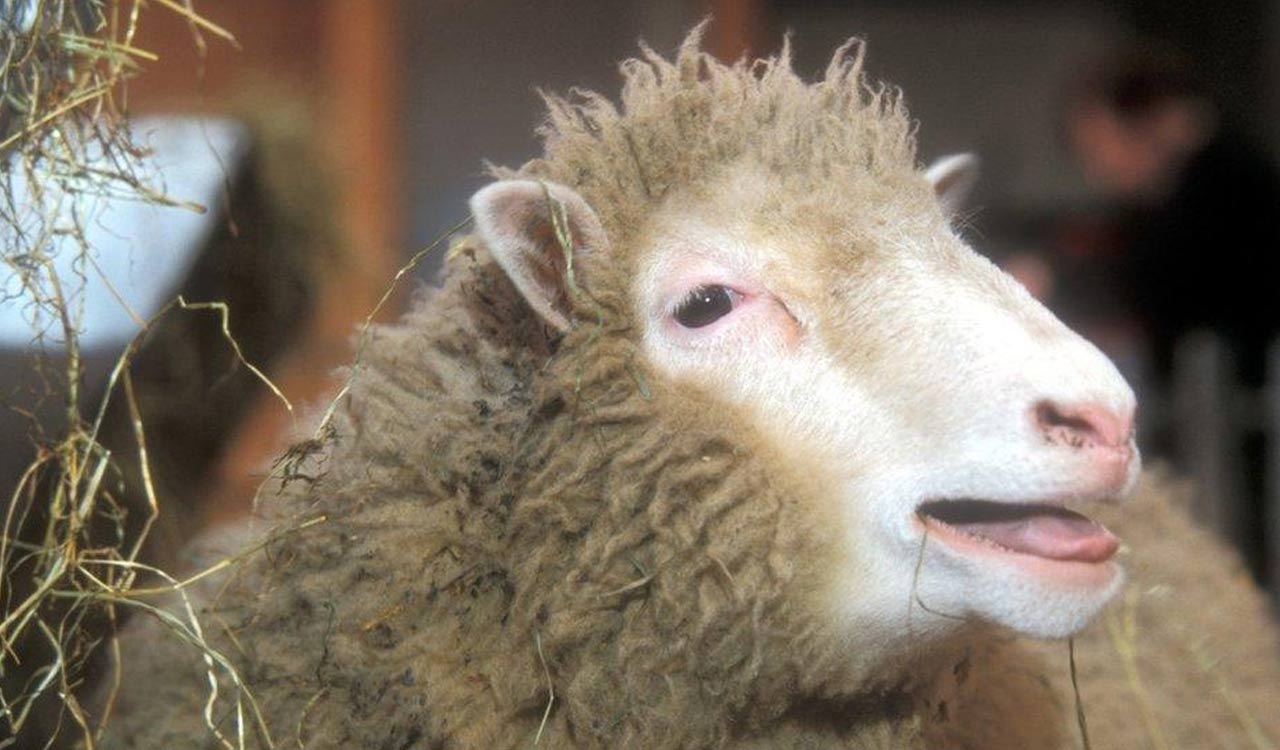


Melbourne: When Dolly the sheep — the first cloned mammal — was born 30 years ago, she became one of the most famous animals in science history.
Her arrival sparked predictions of a sci-fi future filled with cloned pets, cloned humans and even resurrected extinct animals like the woolly mammoth. But the reality of cloning has turned out to be much more complicated.
Today, cloning is not a technology that can simply “copy and paste” living things. Instead, it has become one biotechnology tool among many.
It’s helping scientists understand diseases, support conservation efforts and develop new approaches to manipulating life.
How cloning actually works
Most animal cloning is done using a technique called somatic cell nuclear transfer. Here, a non-reproductive cell (that is, not a sperm or egg) is taken from an animal’s body and its nucleus (which contains DNA) is removed. In the case of Dolly, the donor cell came from a mammary gland.
Then an egg is taken from another animal’s ovaries, and its nucleus is also removed. The nucleus from the first cell is inserted into the egg with the help of an electric pulse. Once the fused egg begins developing into an embryo, it is implanted into a surrogate animal’s uterus.
The resulting animal is nearly identical in DNA to the original donor.
Why cloning remains difficult decades later
Despite advances in technology, cloning mammals is still inefficient. For every successful clone, many reconstructed embryos may fail to develop. For example, it took 277 attempts for Dolly. Cloning still requires specialised equipment, donor cells, egg cells and surrogate pregnancies, making it expensive and difficult to scale.
The major challenge is not copying DNA. Genes are only part of what makes an organism unique. Environment, development and experiences also influence how an animal grows and behaves. So the hard part is persuading a highly specialised adult cell, such as a mammary cell, to “forget” its job and behave like a newly fertilised embryo.
This is known as epigenetic reprogramming. The egg cell must reset the chemical instructions that control which genes are switched on or off. This reset is often incomplete, which is why many cloned embryos fail to develop normally.
But research into cloning led to another major breakthrough. Scientists discovered they could reprogram adult cells into induced pluripotent stem cells. These are adult cells that behave much like embryonic stem cells but are not used to create a whole organism. Instead, they can be grown into many different cell types.
These cells have allowed researchers to study diseases, test new drugs and explore regenerative medicine.
Cloning research showed that specialised cells are not permanently fixed — they can be biologically “rewritten”.
Where else is cloning used today?
Some livestock industries use cloning to reproduce animals with valuable traits, such as strong genetics, high productivity or disease resistance.
However, cloning is not replacing traditional breeding. Instead, it allows breeders to replicate already desirable animals. In Australia it’s currently possible to clone a horse, and several famous clones have participated in equestrian sports worldwide.
Countries such as China and the United States offer commercial pet cloning for cats and dogs. Famously, Broadway star Barbra Streisand had her beloved dog Samantha cloned into two new puppies. However, the personalities of the new clones were different to the original dog, because they only shared the DNA — not memories or experiences.
In 2024, researchers in China cloned a rhesus monkey in a world first, because of its physiological similarity to humans. The hope was it would speed up drug testing. However, animal welfare advocates raised ethical concerns over these experiments, questioning whether the animal suffering was worth it for the low success rate and lack of immediate real-life applications.
Helping restore the populations of endangered species is one of the most promising uses of cloning. In 2020, scientists cloned a black-footed ferret using genetic material preserved from an animal that had died decades earlier. The project aimed to increase genetic diversity in a species experiencing a severe population decline in the US.
Could cloning bring back extinct animals?
The idea of bringing back extinct species has captured public imagination, but the scientific reality is much harder.
A true clone requires an intact genome, a suitable egg cell and a closely related surrogate species. For animals that disappeared thousands of years ago, such as the woolly mammoth, this is not possible because ancient DNA is usually damaged.
Instead, researchers are exploring approaches to reverse the extinction of lost species (known as de-extinction) that combine ancient DNA research with gene-editing technologies such as CRISPR.
Rather than recreating an extinct animal exactly, scientists are attempting to modify living relatives to introduce selected extinct traits. For example, a future “mammoth-like” animal would likely be an edited elephant, not a true mammoth.
Scientists also caution that bringing back extinct traits doesn’t automatically recreate the ecological role of an extinct species. Animals exist within complex ecosystems, and those ecosystems may no longer exist in the same form.
While cloning can help restore lost genes in endangered populations, producing too many genetically similar animals could increase their vulnerability to disease.
Why human cloning remains off the table
Despite decades of speculation, human cloning has not become a reality. The main barrier is safety. Animal cloning still has high failure rates, and applying the technology to humans would create unacceptable risks for embryos, surrogate mothers and children born through the process.
There are also major ethical concerns, including questions about identity, consent and the potential exploitation of human tissues and reproductive technologies. For these reasons, reproductive human cloning is prohibited or heavily restricted in many countries, including Australia.
Since Dolly was born 30 years ago, what we learned from her cloning has improved disease research, agriculture and conservation.
But cloning is still tricky, and it continues to raise questions about safety, regulation and whether some applications should be pursued at all.

Related News
-

What makes a star a star? A strange ‘in-between’ celestial object is testing astronomers’ boundaries
-
Explainer: Aliens might exist. But there are three reasons why they’re not visiting us
-
‘Telomeres’, genes, chromosomes impact ageing and cancer: Nobel Laureate Jack Szostak
-
Rewind: Never Let Me Go — The clones we create