Why picking right location for Artemis base camp on Moon is a challenge
Among the many things NASA must take into account in choosing a specific location are two key features the site must bask in near continuous sunlight
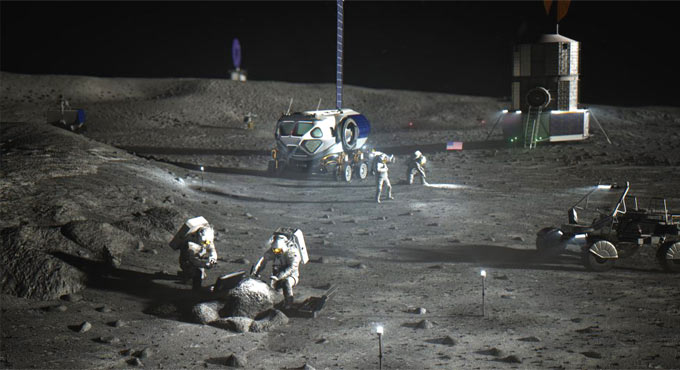


Washington: As NASA plans to land the first woman and next man on the Moon by 2024 with the Artemis programme, scientists and engineers are helping NASA determine the precise location of the Artemis Base Camp concept as several factors are needed to be considered to pick the right site.
Among the many things NASA must take into account in choosing a specific location are two key features the site must bask in near continuous sunlight to power the base and moderate extreme temperature swings, and it must offer easy access to areas of complete darkness that hold water ice, NASA said on Wednesday.
American astronauts in 2024 will take their first steps near the Moon’s South Pole: the land of extreme light, extreme darkness, and frozen water that could fuel NASA’s Artemis lunar base and the agency’s leap into deep space.
While the South Pole region has many well-illuminated areas, some parts see more or less light than others.
Scientists have found that at some higher elevations, such as on crater rims, astronauts would see longer periods of light.
But the bottoms of some deep craters are shrouded in near constant darkness, since sunlight at the South Pole strikes at such a low angle it only brushes their rims.
These unique lighting conditions have to do with the Moon’s tilt and with the topography of the South Pole region.
Unlike Earth’s 23.5-degree tilt, the Moon is tilted only 1.5 degrees on its axis.
As a result, neither of the Moon’s hemispheres tips noticeably toward or away from the Sun throughout the year as it does on Earth — a phenomenon that gives us sunnier and darker seasons here.
This also means that the height of the Sun in the sky at the lunar poles doesn’t change much during the day.
If a person were standing on a hilltop near the lunar South Pole during daylight hours, at any time of year, they would see the Sun moving across the horizon, skimming the surface like a flashlight lying on a table.
“It’s such a dramatic terrain down there,” W. Brent Garry, a geologist at NASA’s Goddard Space Flight Center in Greenbelt, Maryland, said in a statement.
Garry is working with engineers on a virtual reality tour of the Moon’s South Pole to help immerse astronauts, scientists, and mission planners in the exotic environment of that region as they prepare for a human return to the Moon.
While a base camp site will require lots of light, it is also important for astronauts to be able to take short trips into permanently dark craters.
Scientists expect that these shadowed craters are home to reservoirs of frozen water that explorers could use for life support.
“One idea is to set up camp in an illuminated zone and traverse into these craters, which are exceptionally cold,” said NASA Goddard planetary scientist Daniel P. Moriarty, who’s involved with NASA’s South Pole site analysis and planning team.
Temperatures in some of the coldest craters can dip to about minus 235 degrees Celsius.
Initial plans include landing a spacecraft on a relatively flat part of a well-lit crater rim or a ridge.
“You want to land in the flattest area possible, since you don’t want the landing vehicle to tip over,” Moriarty said.
The landing area, ideally, should be separated from other base camp features — such as the habitat or solar panels — by at least half a mile, or one kilometre.
It also ought to be situated at a different elevation to prevent descending spacecraft from spraying high-speed debris at equipment or areas of scientific interest.

Related News