Beyond rules: Enforcing accountability in classrooms
Just as firm enforcement transformed examinations, traffic discipline, and anti-corruption efforts, a similar approach can reinvigorate classroom teaching and restore public trust in government schools


By S Pradeep Kumar
Laws and rules are the backbone of governance. But experience repeatedly shows that rules alone do not ensure compliance; they must be supported by strong monitoring and enforcement mechanisms.
Consider a few familiar examples from daily life. Copying in public examinations has always been prohibited. Yet, malpractice persisted until the government introduced flying squads. Their surprise inspections created both vigilance and a credible fear of consequences, significantly curbing the practice.
Daily life examples
Traffic rules clearly prohibit signal jumping, crossing the zebra line, and parking in no-parking zones. However, violations continued unabated until the introduction of CCTV cameras and e-challan systems. Today, automated surveillance detects violations, generates evidence, and enforces penalties — often without the need for human intervention.
Corruption, too, has long been outlawed. Yet, it continued until agencies such as the Anti-Corruption Bureau (ACB) began conducting raids and trapping offenders, making enforcement visible and real. Similarly, drunk driving is a punishable offence, but it was only after random breath analyser checks and sustained enforcement drives that compliance improved.
The lesson from all these examples is clear and consistent: where enforcement is weak, violations become normal; where monitoring is strong, behaviour changes. Equally important, when violations are identified and acted upon, it strengthens public confidence in governance. People begin to trust the system when they see that rules are not merely written, but enforced with fairness and consistency.
Improvement matters
It may be argued that enforcement alone cannot bring lasting change, and that individuals must reform from within. While this is true in principle, governance cannot rely solely on voluntary compliance. Experience shows that even if violations do not disappear entirely, consistent monitoring and enforcement significantly reduce their frequency and create a culture of discipline. In public systems, it is not perfection but improvement at scale that matters. Systems cannot wait for ideal behaviour; they must be designed to ensure responsible behaviour.
School education, however, remains a striking exception. In many schools today, classrooms are increasingly becoming spaces of passive neglect rather than active learning. Teachers are often seen distracted, frequently engaged with mobile phones, while students remain disengaged. Observations also suggest that a section of teachers attend to personal engagements during school hours, including small business activities such as real estate dealings, chit funds, saree sales, or insurance-related work.
While such instances may not represent the entire teaching community, even their limited prevalence is enough to erode classroom discipline and weaken learning outcomes.
More concerning is that this is not an isolated issue. It reflects a systemic problem in which classroom supervision remains weak, institutional accountability is diluted, and existing administrative mechanisms are ineffective. Even headmasters, who are expected to ensure discipline, often find themselves unable to enforce it consistently.
This concern becomes sharper when viewed alongside the scale of public investment. Telangana’s Budget is about Rs 3.04 lakh crore, with a substantial portion committed to salaries and pensions, which together consume nearly 45% of State’s revenue. The education sector alone receives over Rs 23,000 crore annually, supporting a vast network of schools, more than three lakh teachers, and lakhs of students.
Yet, despite this significant investment, a majority of parents continue to prefer private schools, often at considerable financial strain. Thousands of government schools are witnessing declining or even zero admissions. This is not merely a statistical trend; it is a public verdict on the quality of teaching and learning in government schools.
Unlike examinations, traffic management, or anti-corruption enforcement, classroom teaching remains largely unmonitored. There is little real-time verification of whether teaching is actually taking place, no independent mechanism to assess classroom engagement, and limited consequences for habitual negligence. In such an environment, even a small degree of indifference can have a disproportionate impact on learning outcomes and public trust.
Fair teaching
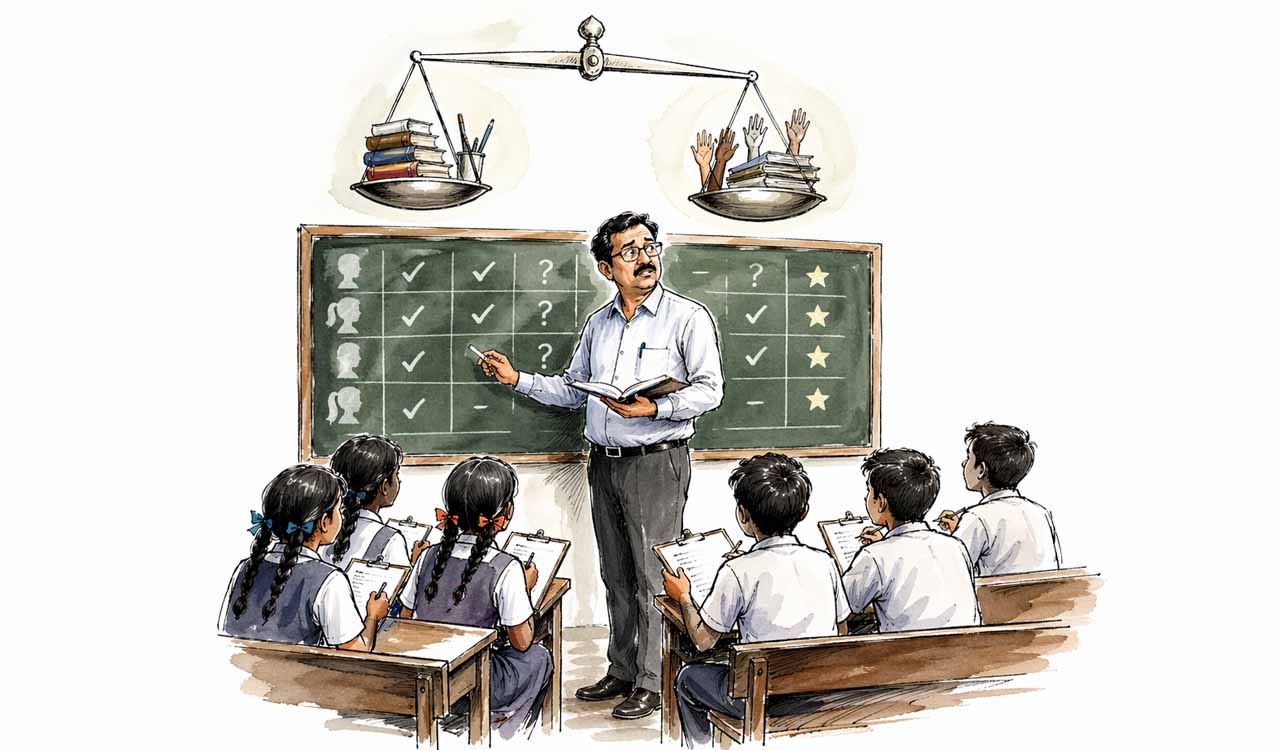
If flying squads can ensure fair examinations, there is a compelling case to ensure fair teaching as well. The introduction of Academic Vigilance Squads — independent teams authorised to conduct surprise visits to schools — could provide the necessary corrective. Their role would be to verify that teaching is taking place, observe student engagement, and record evidence-based observations.
Such a mechanism should be transparent, fair, and focused on improving professional standards, while ensuring that negligence invites prompt and appropriate disciplinary action. The visibility of such action would act as a deterrent and reinforce a culture of accountability. This proposal is not about targeting teachers. On the contrary, it is about protecting the integrity of the profession and supporting the many educators who remain committed to their responsibilities. A credible monitoring system would discourage complacency, reinforce accountability, and restore confidence in government schools.
Telangana has made significant strides in expanding educational access and infrastructure. The next step must be to ensure that classrooms function as intended. Public spending must translate into public outcomes. When governments invest heavily in salaries, ensuring performance is not optional; it is essential.
Just as enforcement mechanisms transformed examinations, traffic discipline, and anti-corruption efforts, a similar approach can revitalise classroom teaching. Ensuring that teaching is both present and purposeful may well be the reform that determines the future of public education.
(The author is a Deputy Executive Engineer, O/o the Director of School Education)

Related News