Friday, Apr 24, 2026
English News
  • Hyderabad
  • Telangana
  • AP News
  • India
  • World
  • Entertainment
  • Sport
  • Science and Tech
  • Business
  • Rewind
  • ...
    • NRI
    • View Point
    • cartoon
    • My Space
    • Education Today
    • Reviews
    • Property
    • Lifestyle
E-Paper
  • NRI
  • View Point
  • cartoon
  • My Space
  • Reviews
  • Education Today
  • Property
  • Lifestyle
Home | Hyderabad | Ccmb Researchers Estimate Critically Endangered Hangul Deer Population Using Genetic Data

CCMB researchers estimate critically endangered ‘Hangul deer’ population using genetic data

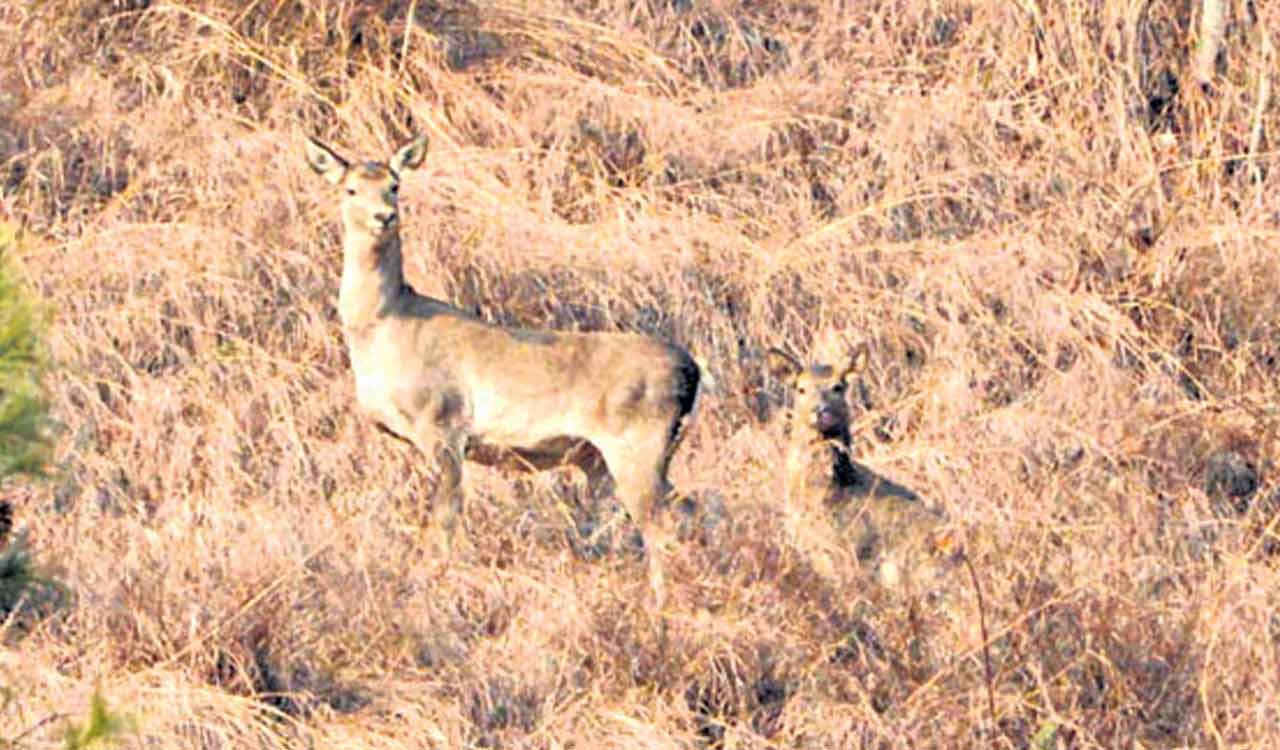
The Hangul deer (hangul Cervus hanglu hanglu) is categorised as ‘Critically Endangered’ on the IUCN Red List and as a Schedule 1 species in the Indian Wildlife (Protection) Act, 1972.
By M. Sai Gopal
Published Date - 15 December 2023, 11:01 PM
CCMB researchers estimate critically endangered ‘Hangul deer’ population using genetic data
Hangul deer, the critically endangered iconic species of Kashmir Himalayas.
whatsapp facebook twitter telegram

Hyderabad: For the first time in India, geneticists from the Hyderabad-based Centre for Cellular and Molecular Biology (CCMB) have utilised genetic data to estimate the population of the Hangul deer, the critically endangered iconic species of Kashmir Himalayas, which faces imminent threat of population loss and extinction.

Once widely distributed across Kashmir, the Chenab Valley of Jammu and Himachal Pradesh, the Hangul deer (hangul Cervus hanglu hanglu) is categorised as ‘Critically Endangered’ on the IUCN Red List and as a Schedule 1 species in the Indian Wildlife (Protection) Act, 1972.

Also Read

  • Wind pattern adds to construction pollution: IIIT Hyderabad study

The CCMB study, published in Cambridge Core — the journal of Cambridge University Press — on December 13, 2023, was led by senior principal scientist Dr P Anuradha Reddy. The researchers utilised non-invasive genetics to understand the population status of Hanglu at the Dachigam National Park, Jammu and Kashmir, which contains its last sizeable population.

In the early 1900s, there were 3,000-5,000 Hangul and over the years, due to a variety of reasons (including hunting), their numbers in the wild are now estimated to be close to 200 individuals with skewed sex ratio of just 12-15 males for every 100 females.

Using 14 microsatellite markers, the CCMB team identified 293 individuals (208 females and 85 males) through faecal analysis and generated data on the genetic status and population size of Hangul in its winter habitat. The detection of males was the highest in November, coinciding with the breeding season, whereas the detection of females was the highest in December.

“Our estimate of the Hangul population using genetic mark-recapture with bootstrapping was 394 individuals,” the CCMB said.

Hangul is a seasonal migrant, moving between lower and higher elevations in winter and summer, respectively. Throwing some light on the breeding patterns, the CCMB researchers said it is a seasonal breeder, with a few observational and anecdotal records suggesting that males rut during September-November, when they guard large female harems and break away from groups immediately after the mating season.

The study will guide future studies of the subspecies and also serve as an impetus to identify founder animals for captive breeding to ensure the long-term survival of the Hangul deer.

  • Follow Us :
  • Tags
  • Centre for Cellular and Molecular Biology (CCMB)
  • Hangul deer
  • Kashmir Himalayas

Related News

  • Hyderabad researchers find high antimicrobial resistance in eye pathogens

    Hyderabad researchers find high antimicrobial resistance in eye pathogens

  • CCMB maps antimicrobial resistance in Indian urban wastewater

    CCMB maps antimicrobial resistance in Indian urban wastewater

  • Hyderabad scientist Dr Dorairajan Balasubramanian honoured by CCMB

    Hyderabad scientist Dr Dorairajan Balasubramanian honoured by CCMB

  • Hyderabad scientists discover ‘metabolic short circuit’ to stop deadly fungal infections

    Hyderabad scientists discover ‘metabolic short circuit’ to stop deadly fungal infections

Latest News

  • Indian seafarer safe as vessel in Iranian custody moved to safer zone

    10 mins ago
  • Trump is extending Jones Act waiver for 90 days

    13 mins ago
  • Sunetra Pawar takes charge in NCP leadership shake-up

    22 mins ago
  • Centre doubles down on enhancing safety in flying training institutes

    27 mins ago
  • 8 Ways to Improve Your Credit Score in 2026

    24 mins ago
  • Singareni CMD wants to strengthen coal transportation from Sathupalli CHP at full capacity

    34 mins ago
  • YSRCP MLC Anantha Babu arrested in Dalit youth murder case amid bail row

    36 mins ago
  • AI engineering jobs in India surge 59.5 pc, outpacing US and Europe: LinkedIn report

    36 mins ago

company

  • Home
  • About Us
  • Contact Us
  • Privacy Policy

business

  • Subscribe

telangana today

  • Telangana
  • Hyderabad
  • Latest News
  • Entertainment
  • World
  • Andhra Pradesh
  • Science & Tech
  • Sport

follow us

  • Telangana Today Telangana Today
Telangana Today Telangana Today

© Copyrights 2024 TELANGANA PUBLICATIONS PVT. LTD. All rights reserved. Powered by Veegam

.