Editorial: India’s Economic Survey 2025-26 signals cautious optimism
Amid global slowdown and erosion of the rules-based international order, the Economic Survey 2025-26 offers a note of tempered hope
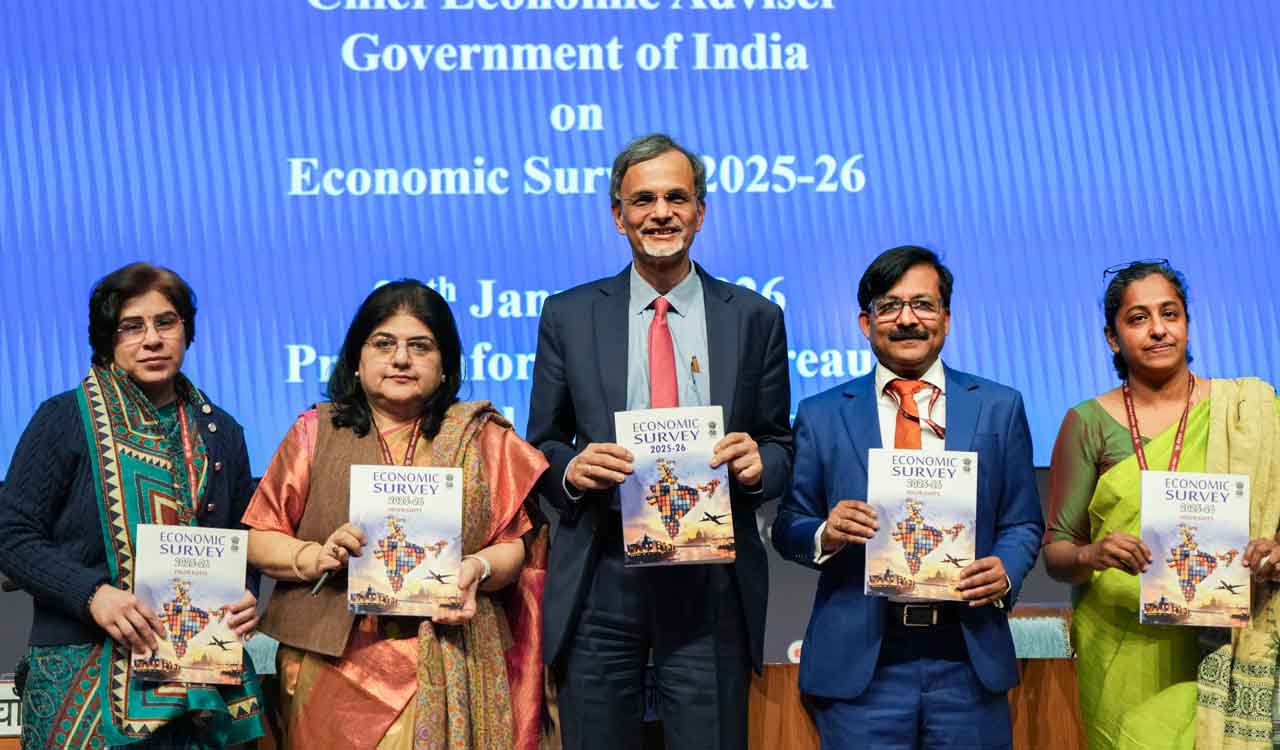


At a time when the Indian economy is facing global headwinds and erosion of rules-based international order, the Economic Survey 2025-26, tabled in Parliament ahead of the Union Budget presentation, paints a picture of cautious optimism. It highlighted the paradoxes facing the economy. While acknowledging the country’s robust and resilient macroeconomic fundamentals despite the global slowdown, the Survey has raised red flags on a range of issues that require well-calibrated policy choices and interventions. On the positive side, India’s GDP is expected to grow in the range of 6.8% to 7.2% in the next financial year, reinforcing its status as the world’s fastest-growing major economy. Retail inflation has remained muted, while both corporate and bank balance sheets are healthy. The rationalisation of the GST rates has created a sense of buoyancy. However, the Survey report flagged about the falling currency, lack of investment appetite among the corporates, sluggish merchandise exports, and drying up of foreign capital inflows. Sustaining growth at 7% over the medium term, amid an uncertain global environment, will be challenging. The global economic system, reeling under geopolitical tensions, trade disruptions and financial volatility, no longer rewards macroeconomic success with currency stability, capital inflows or strategic insulation, while gains from new technologies like artificial intelligence (AI) are uneven and require supportive human capital and regulatory frameworks. Uncertainty over the much-delayed India-US trade deal is set to persist, with the Survey saying that ongoing negotiations are “expected to conclude during the year”.
For the time being, India is hoping that the euphoria over its historic pact with the European Union will last long, yielding big benefits. An overall outlook is one of cautious optimism. This reflects the strength of domestic demand and consumption even as external risks — from tariffs to supply-chain stress — temper expectations. Interestingly, the Survey advocates ‘Swadeshi’ model, saying it is “inevitable and necessary” as the global trading environment is marked by export controls, technology denial regimes and carbon border mechanisms that signal the end of “naïve globalisation”. The report lamented the relative lack of willingness among Indian corporates to invest in long-term risk mitigation and enhance their global competitiveness. India needs to scale up private participation in building infrastructure. After prioritising infrastructure spending through direct budgetary support, central government capital expenditure is now normalising, making a rise in private capex essential for a sustainable investment boost. It suggested that the Budget should continue to support capex, aligning it with fiscal consolidation goals. It should simultaneously create an environment that encourages private investment and public-private partnership in infrastructure. The Survey has raked up a controversy by calling for re-examining the two-decade-old Right To Information (RTI) Act to exempt confidential reports and draft comments from disclosures, saying that such provisions constrain governance. This suggestion is politically divisive, considering that the citizen-centric law was enacted by the UPA government.
Also Read

Related News