Editorial: Passive euthanasia — hope for the hopeless
The Supreme Court’s order allowing withdrawal of life support for a 32-year-old in a 13-year vegetative state is a landmark verdict, recognising that the right to die with dignity is as important as the right to live
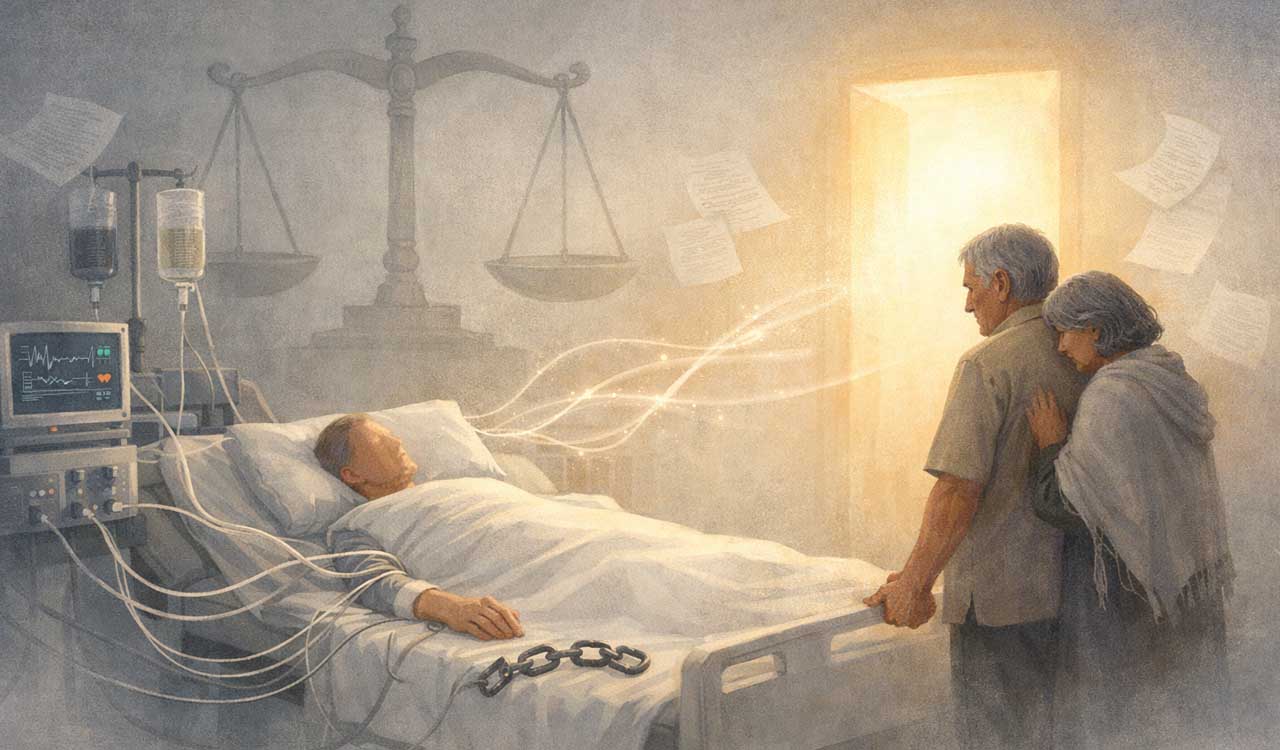


The Supreme Court’s order allowing withdrawal of artificial life-support to a 32-year-old patient, who had been in a persistent vegetative state for over 13 years, is a landmark verdict that recognises, for the first time, that the right to death with dignity is as important as the right to live. This is India’s first case of a judicially sanctioned passive euthanasia that brought closure to the grief-stricken family of Harish Rana, a resident of Uttar Pradesh’s Ghaziabad, who has been in a vegetative state since August 2013, when he suffered head injuries after falling from a fourth-floor flat in Chandigarh. His parents had been knocking on the doors of courts seeking an end to their son’s ordeal since there was no hope for his recovery. Significantly, the two-judge bench of the apex court urged the Central government to bring a comprehensive law to address issues related to passive euthanasia. The court noted that in Rana’s case, the medical reports showed no change in his condition over the years, and both primary and secondary medical boards that it had constituted in 2025, along with Rana’s parents, agreed that the treatment should be stopped. The bench ordered the removal of clinically administered nutrition (CAN) in a humane manner. Rana’s heart-wrenching case has brought into focus the legal complexities and ethical dilemmas surrounding euthanasia. There is a growing consensus now among the judiciary that forcing patients to remain in an irreversible vegetative state may undermine human dignity.
Though the SC had allowed passive euthanasia in 2018, the withdrawal of life-sustaining treatment, even in cases when doctors acknowledge the futility of their interventions, is fraught with complex ethical and medical questions. Making laws on euthanasia is fraught with several dilemmas in a culturally sensitive and complex society like India. For any government, the issue presents a minefield of ethical dilemmas. However, the harsh reality is that thousands of patients are stuck in vegetative states with absolutely no hope of recovery, burdening their families emotionally and financially. The absence of a law on euthanasia complicates the situation for terminally ill patients and their families. Rana’s parents had approached the court twice in the last two years, seeking passive euthanasia for him. The case brings back memories of a haunting tragedy involving Aruna Shanbaug, a nurse who spent 42 years in a vegetative state after a horrific sexual assault at Mumbai’s KEM Hospital in 1973. The case triggered widespread outrage and compelled the nation to confront the question of passive euthanasia. Her case became a moral trigger that led to a landmark judgement in 2018 when a Constitution Bench of the Supreme Court legalised passive euthanasia, recognising the right to die with dignity as a fundamental right in the spirit of Article 21. The recognition of an individual’s right to exercise bodily autonomy is a sign of maturity in any evolved society.

Related News