European spacecraft rockets toward Jupiter and its icy moons
The journey began with a morning liftoff by Europe's Ariane rocket from French Guiana in South America
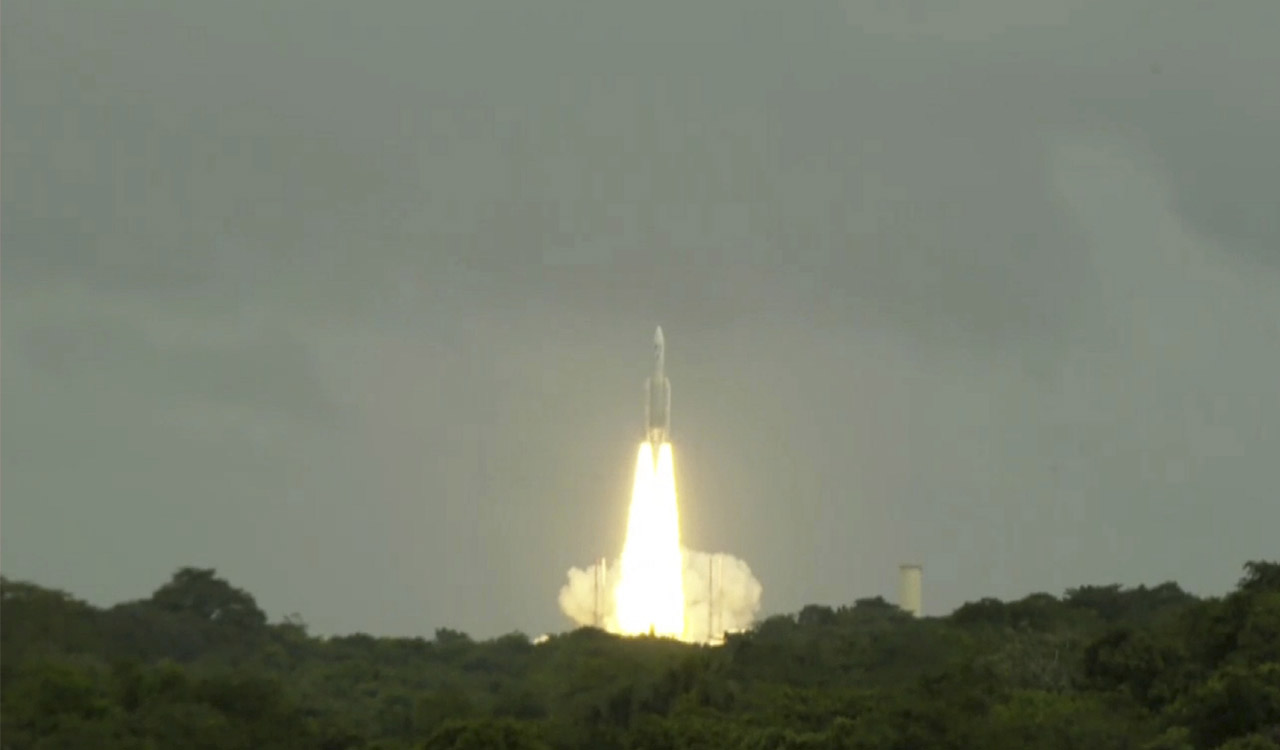


French Guiana: A European spacecraft rocketed away Friday on a decade long quest to explore Jupiter and three of its icy moons that could have buried oceans.
The journey began with a morning liftoff by Europe’s Ariane rocket from French Guiana in South America.
Also Read
It will take the robotic explorer, dubbed Juice, eight years to reach Jupiter, where it will scope out not only the solar system’s biggest planet but also Europa, Callisto and Ganymede.
The three ice-encrusted moons are believed to harbour underground oceans, where sea life could exist.
Then in perhaps the most impressive feat of all, Juice will attempt to go into orbit around Ganymede: No spacecraft has ever orbited a moon other than our own.
With so many moons,— at last count 95 — astronomers consider Jupiter a mini solar system of its own, with missions like Juice long overdue.
“We are not going to detect life with Juice,” stressed the European Space Agency’s project scientist, Olivier Witasse.
But learning more about the moons and their potential seas will bring scientists closer to answering the is-there-life-elsewhere question. “That will be really the most interesting aspect of the mission,” he said.
Juice is taking a long, roundabout route to Jupiter, covering 4 billion miles (6.6 billion kilometres) It will swoop within 125 miles (200 kilometres) of Callisto and 250 miles (400 kilometres) of Europa and Ganymede, completing 35 flybys while circling Jupiter. Then it will hit the brakes to orbit Ganymede, the primary target of the 1.6 billion-euro mission (nearly USD 1.8 billion).
Ganymede is not only the solar system’s largest moon — it surpasses Mercury — but has its own magnetic field with dazzling auroras at the poles.
Even more enticing, it’s thought to have an underground ocean holding more water than Earth.
Ditto for Europa and its reported geysers, and heavily cratered Callisto, a potential destination for humans given its distance from Jupiter’s debilitating radiation belts, according to Carnegie Institution’s Scott Sheppard, who’s not involved with the Juice mission.
“The ocean worlds in our solar system are the most likely to have possible life, so these large moons of Jupiter are prime candidates to search,” said Sheppard, a moon hunter who’s helped discover well over 100 in the outer solar system.
The spacecraft, about the size of a small bus, won’t reach Jupiter until 2031, relying on gravity-assist flybys of Earth and our moon, as well as Venus.
“These things take time — and they change our world,” said the Planetary Society’s chief executive, Bill Nye. The California-based space advocacy group organised a virtual watch party for the launch.
Belgium’s King Philippe and Prince Gabriel, and a pair of astronauts — France’s Thomas Pesquet and Germany’s Matthias Maurer — were among the spectators in French Guiana. Thursday’s launch attempt was nixed by the threat of lightning.
Juice — short for Jupiter Icy Moons Explorer — will spend three years buzzing Callisto, Europa and Ganymede.
The spacecraft will attempt to enter orbit around Ganymede in late 2034, circling the moon for nearly a year before flight controllers send it crashing down in 2035, later if enough fuel remains.
Europa is especially attractive to scientists hunting for signs of life beyond Earth. Juice will keep its Europa encounters to a minimum, however, because of the intense radiation there so close to Jupiter.
Juice’s sensitive electronics are encased in lead to protect against radiation. The 14,000-pound (6,350-kilogram) spacecraft also is wrapped with thermal blankets — temperatures near Jupiter hover around minus 380 degrees Fahrenheit (minus 230 degrees Celsius). And its solar panels stretch 88 feet (27 metres) tip to tip to soak in as much sunlight that far from the sun.
Late next year, NASA will send an even more heavily shielded spacecraft to Jupiter, the long-awaited Europa Clipper, which will beat Juice to Jupiter by more than a year because it will launch on SpaceX’s mightier rocket.
The two spacecraft will team up to study Europa like never before.
NASA has long dominated exploration at Jupiter, beginning with flybys in the 1970s by the twin Pioneers and then Voyagers. Only one spacecraft remains humming at Jupiter: NASA’s Juno, which just logged its 50th orbit since 2016.
Europe provided nine of Juice’s science instruments, with NASA supplying just one.
If Juice confirms underground oceans conducive to past or present life, Witasse said the next step will be to send drills to penetrate the icy crusts and maybe even a submarine.
“We have to be creative,” he said. “We can still think it’s science fiction, but sometimes the science fiction can join the reality.”

Related News
-

Incredible to watch capability ISRO is developing in science missions: Indian-American NASA senior official
-
Astronauts remove faulty ISS antenna during spacewalk; out of time to install spare
-
NASA invites ISRO to join Moon Base programme for lunar South Pole outpost
-
NASA astronauts Anil Menon, Jessica Meir undertake spacewalk to upgrade space station