Hubble finds new planet forming in intense, violent way
Washington: NASA and European Space Agency’s Hubble Space Telescope has captured images of a Jupiter-like protoplanet forming through what researchers describe as an “intense and violent process”. This discovery supports a long-debated theory for how planets like Jupiter form, called “disk instability”, the researchers said. The new planet under construction is embedded in a protoplanetary […]
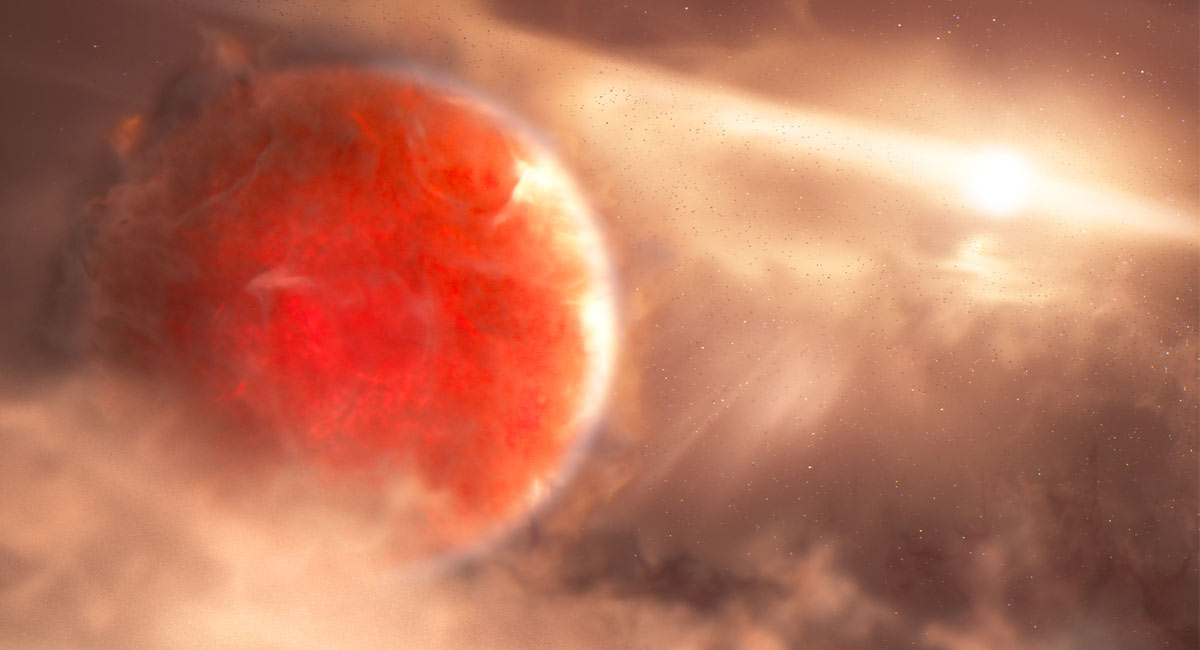


Washington: NASA and European Space Agency’s Hubble Space Telescope has captured images of a Jupiter-like protoplanet forming through what researchers describe as an “intense and violent process”.
This discovery supports a long-debated theory for how planets like Jupiter form, called “disk instability”, the researchers said.
The new planet under construction is embedded in a protoplanetary disk of dust and gas with distinct spiral structure swirling around surrounding a young star that’s estimated to be around 2 million years old — the age at when planet formation was underway in our solar system. Our solar system’s age is currently 4.6 billion years.
“Nature is clever; it can produce planets in a range of different ways,” said lead researcher Thayne Currie from the Subaru Telescope and Eureka Scientific.
The newly forming planet, called AB Aurigae b, is probably about nine times more massive than Jupiter and orbits its host star at a whopping distance of 8.6 billion miles – over two times farther than Pluto is from our Sun.
At that distance it would take a very long time, if ever, for a Jupiter-sized planet to form. This leads researchers to conclude that the disk instability has enabled this planet to form at such a great distance.
And, it is in a striking contrast to expectations of planet formation by the widely accepted core accretion model.
All planets are made from material that originated in a circumstellar disk. The dominant theory for jovian planet formation is called “core accretion”, a bottom-up approach where planets embedded in the disk grow from small objects – with sizes ranging from dust grains to boulders – colliding and sticking together as they orbit a star.
The new analysis, published in the journal Nature Astronomy, combines data from two Hubble instruments: the Space Telescope Imaging Spectrograph and the Near Infrared Camera and Multi-Object Spectrograph.
These data were compared to those from a state-of-the-art planet imaging instrument called SCExAO on Japan’s 8.2-metre Subaru Telescope located at the summit of Mauna Kea, Hawaii.
Understanding the early days of the formation of Jupiter-like planets provides astronomers with more context into the history of our own solar system.
This discovery paves the way for future studies of the chemical make-up of protoplanetary disks like AB Aurigae, including with NASA’s James Webb Space Telescope.

Related News
-

Venus and Jupiter to dazzle sky-watchers in rare conjunction on June 9
-
A noon without a shadow: Hyderabad set to witness Zero Shadow Day on May 9
-
How we sharpened James Webb telescope’s vision from million kilometres away
-
Rare interstellar comet 3I/ATLAS captivates astronomers as it speeds through solar system