Hyderabad on dengue alert as changing mosquito behaviour challenges traditional control measures
Health authorities have warned that dengue is becoming a year-round public health challenge in Telangana, driven by intermittent monsoon conditions, changing mosquito breeding patterns and a high number of asymptomatic infections that continue to fuel transmission across urban areas.
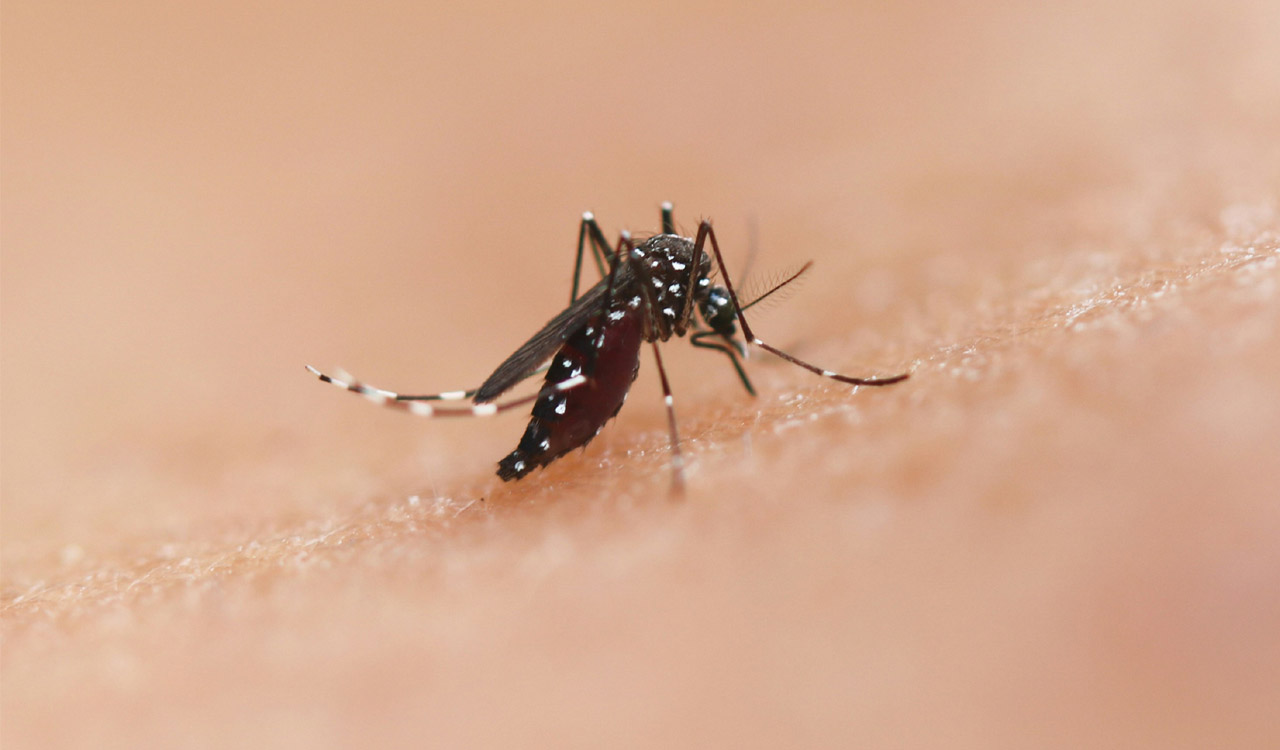


Hyderabad: The prevention, management, and control of dengue in Hyderabad and other key urban centers of Telangana has escalated into a major public health challenge as the disease has evolved aggressively. Triggered by a Union Health Ministry alert, warning of a possible early surge, Telangana’s disease surveillance wings have openly acknowledged the evolving nature of the vector (mosquito) threat and the severe difficulties it is posing to traditional containment strategies.
Authorities warned that standard seasonal protocols are proving increasingly ineffective against a virus that is actively shifting shapes and has now, more or less, become a year-long threat.
The local health authorities have urged people to be cautious because a few days ago the National Center for Vector Borne Diseases Control (NCVBDC) indicated that the country had already recorded 16,313 dengue cases by May. All states witnessed a sharp 28 percent spike in new cases in May alone, much before the actual onset of monsoons.
A primary reason for the urgency among state-level surveillance authorities and multiple reviews on dengue preparedness between Union Health Ministry and all Indian States is the intermittent nature of the ongoing monsoons.
“This year, monsoons are going to be intermittent in Telangana that suit mosquitos. Continuous downpour flushes out mosquito eggs/larvae from breeding habitats. But, rains interspersed with dry spells are ideal for mosquitoes, as they get time to breed and larvae to grow,” a senior official from Integrated District Surveillance Programme (IDSP), explained.
Present weather conditions allow stagnant clean water to remain undisturbed at construction sites, terrace layouts, and government buildings in Hyderabad, thus providing ideal conditions for mosquito breeding.
Another major challenge health authorities are pointing out is the hidden epidemic of asymptomatic cases. Public health data establishes that up to 80 percent of all dengue infections are entirely asymptomatic.
“An individual may experience mild lethargy or a transient low-grade fever, attribute it to common exhaustion, and never seek formal testing. However, because they carry the live virus in their bloodstream, they act as an invisible community reservoir. Local Aedes mosquitoes feed on these asymptomatic carriers and subsequently transmit the virus to vulnerable individuals who develop severe clinical manifestations. This is a major difficulty for us,” a senior health official said.
IDSP field staff indicate that the primary dengue vector, Aedes aegypti, has structurally adapted to modern Indian urban environments. So, there is no point in focussing on clearing mud puddles, open municipal drains, and swampy peripheral grounds.
Aedes is a clean-water container breeder and its larvae are increasingly discovered inside modern, temperature-controlled domestic settings like trays of frostfree refrigerators, indoor ornamental money plants, air cooler bases, and poorly sloped air-conditioning condensate pipes etc. Since it is daytime feeder, transmission of dengue has changed from residential bedrooms to school classrooms, open-plan corporate spaces, and public transit hubs.
- Intermittent nature of present monsoons ideal for dengue mosquito breeding
- 80 percent of dengue cases are asymptomatic cases
- Asymptomatic patients carry live dengue virus in their bloodstream
- Aedes feeds on asymptomatic carriers and transmit the virus to vulnerable populations
- Dengue now has four different strains DENV 1 to 4) and recovering from one does not give protection from another
- One can fall sick with different dengue strains every year
- If tested positive multiple times for different strains, it can lead to Dengue Hemorrhagic Fever (DHF) or Dengue Shock Syndrome (DSS)
- DHF/DSS cause platelet drops, internal plasma leaking, and multi-organ failure

Related News