Hyderabad: Stone age tools discovered in Haridra Riverbed near Medak
Researchers exploring the Haridra River near Medak district discovered stone tools dating from the Paleolithic to Neolithic eras. Archaeologists say the finds confirm prehistoric human presence in the region and contribute significantly to understanding Telangana’s ancient history.


Hyderabad: The Haridra River, a tributary of the Manjira River flowing near the Medak district headquarters, has yielded significant archaeological finds. The Manjira and Haridra rivers join the Godavari at Kandakurthi to form the ‘Pedda Godavari’.
During an exploration of the Haridra riverbed, Macha Pranay Kumar and Burra Santosh, research members of the Kotha Telangana Charitra Brundam, discovered and collected a variety of stone tools ranging from the Paleolithic to the Neolithic eras.
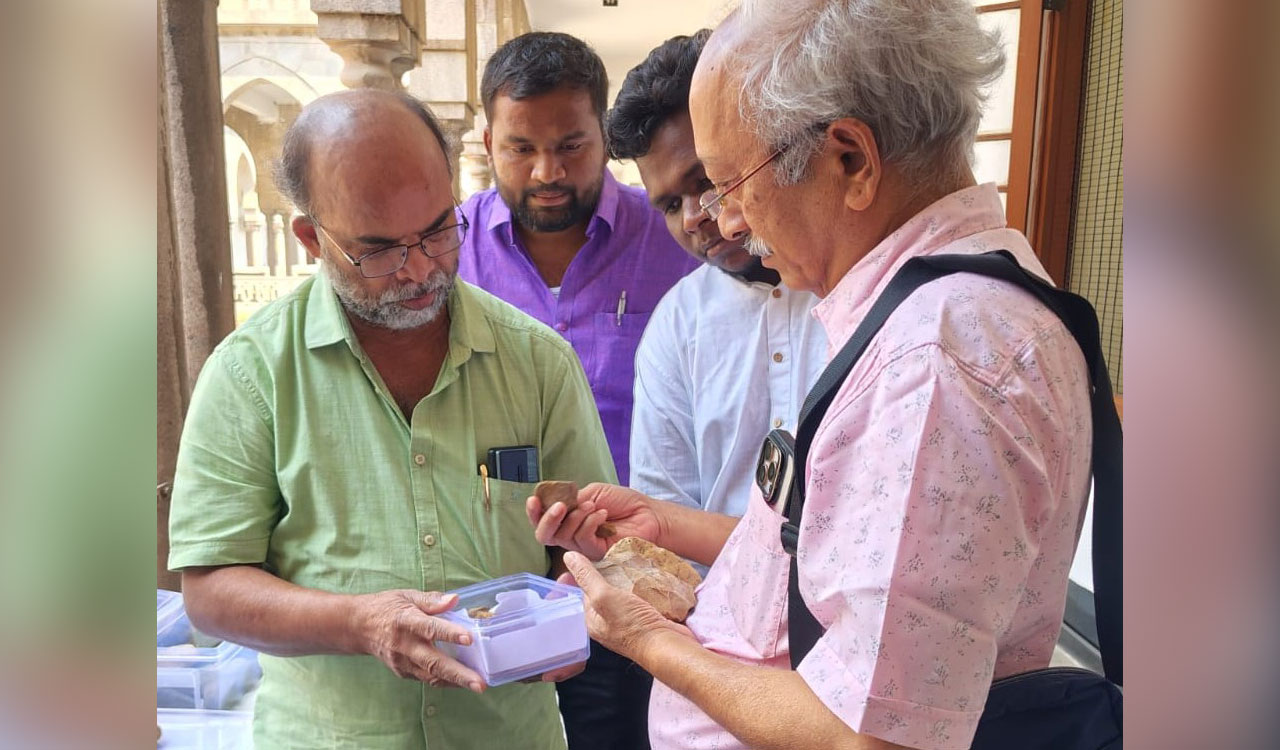
A press release said that at a recent workshop organised by the Department of Archaeology at Osmania University, Dr Ravi Korisettar examined the chert stone tools collected by the group and commended the team for discovering Middle Paleolithic implements. Dr Korisettar noted that these stone tools, similar to those being found across various regions in India, confirm that human evolution and presence in this area date back hundreds of thousands of years.
Sriramoju Haragopal, Convener of the Kotha Telangana Charitra Brundam, stated that the efforts of Pranay Kumar and Santosh—who have identified prehistoric rock art sites, temple sculptures, and now these stone tools—are adding new pages to the history of Telangana.
The Middle Paleolithic Age is the second phase of the Old Stone Age, spanning approximately 3,00,000 to 30,000 years ago. During this period, humans transitioned to using flake tools crafted from stones such as quartzite, chert, and flint.

Related News